What a Government Shutdown Really Means for the Housing Market

Jay Friedman • November 14, 2025

There’s been a lot of talk lately about how a government shutdown impacts the housing market. You might be wondering: Is it causing everything to grind to a halt?


The short answer? No.


The housing market doesn’t stop. It keeps moving. Homes are still being bought and sold, contracts are still being signed, and closings are still happening. The difference is that a few parts of the process may slow down a little, but overall, the market continues to function.


Here’s What Typically Happens


Whenever the government shuts down, some federal agencies temporarily close or scale back their operations. That can cause a few hiccups in real estate, especially when it comes to processing certain types of government loans and insurance requirements:

  • Applicants for FHA, VA, or USDA loans—which account for about one-quarter of all mortgage applications—may encounter significant processing delays due to agency furloughs.” - Selma Hepp, Chief Economist at Cotality
  • “By recent estimates, more than 2,500 mortgage originations per working day are at risk of delays during a shutdown . . .”  - Zillow
  • Flood insurance approvals may also be paused. The National Flood Insurance Program can be temporarily affected, which delays closings in flood zones.


Even with those challenges and delays, most transactions still go through. Buyers keep buying, sellers keep selling, and agents keep helping people move forward.


The Housing Market Usually Bounces Back Fast


And you can see that play out in this data. If you look back at the most recent government shutdown that began at the end of 2018 and lasted for 35 days, sales activity dipped very slightly during the closure but picked right back up once the government reopened.


Data from the National Association of Realtors (NAR) shows existing home sales slowed for about two months, and then rebounded quickly as delayed closings worked their way through the system when the government reopened (see graph below):
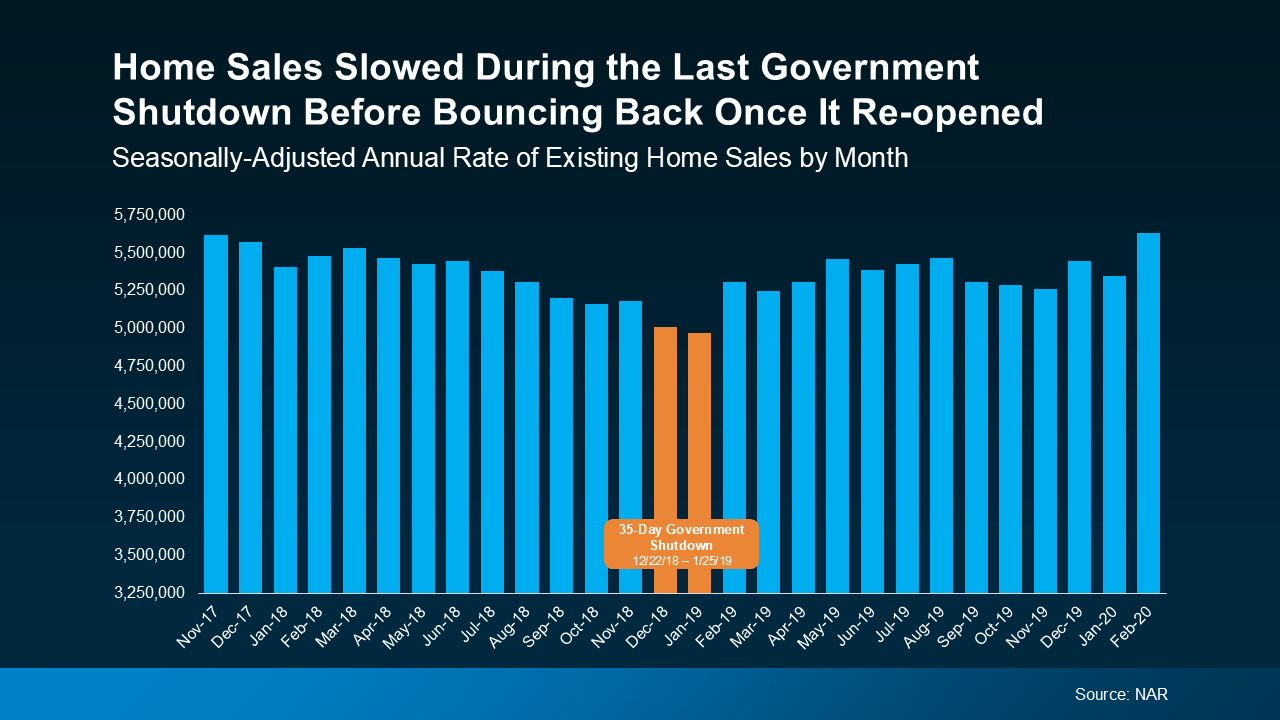
What’s important to note is that the slowdown you see in the orange bars on this graph wasn’t simply due to seasonality in a typical housing market cycle. The sharper, shorter drop in this case lines up exactly with the 35-day government shutdown, and then sales bounced back as soon as it ended.


What This Means for You


If you’re in the middle of buying or selling a home, don’t panic. Most deals will still move forward, even if it takes a few extra days. Jeff Ostrowski, Housing Market Analyst at Bankrate, explains:

“If you’re expecting to close in a week or a month, there could be some slight delay, but I think for most people, it’s probably going to be a blip more than a real deal killer.

And if you’re just starting to think about buying or selling, this could actually work in your favor. Some buyers and sellers may become cautious and pause their plans during times of uncertainty, like this, and that can open a short window of opportunity.

When fewer people are active in the market, well-prepared buyers may find less competition for homes, and motivated sellers may be more willing to negotiate. These brief slowdowns often create a moment where you can make a move that would be harder once activity ramps back up.


Bottom Line


A government shutdown can cause short-term delays for some buyers, but it doesn’t derail the housing market. The last time this happened, sales picked back up as soon as the government re-opened.


If you’re unsure how this might affect your plans, or just want to make sense of what’s happening, let’s connect.


December 30, 2025
If a move is on your radar for 2026, there’s a lot more working in your favor than there has been in a while. After a stretch where many people felt stuck, 2026 is shaping up to be a year with more balance, more options, and more clarity for people who want to make a move. Not because the market is suddenly “easy,” but because several key conditions are shifting. Here’s what the experts are saying you have to look forward to. Danielle Hale, Chief Economist at Realtor.com : “After a challenging period for buyers, sellers and renters, 2026 should offer a welcome, if modest, step toward a healthier housing market. ” The National Association of Realtors (NAR): “ Top economists have one word to sum up the housing market for 2026: opportunity. Lower mortgage rates and a rising supply of homes are expected to open up the housing market . . . something the real estate industry and potential home buyers and sellers have been waiting for, following three years of stagnation.” Mark Fleming , Chief Economist at First American: “. . . for the first time in several years, the underlying forces are finally aligned toward gradual improvement. Mortgage rates may drift down only slowly, but income growth exceeding house price appreciation will provide a boost to house-buying power — even in a higher-rate world. Affordability won’t snap back overnight, but like a ship finally catching a steady tailwind, it’s now sailing in the right direction. ” Mischa Fisher , Chief Economist at Zillow : “Buyers are benefiting from more inventory and improved affordability, while sellers are seeing price stability and more consistent demand. Each group should have a bit more breathing room in 2026. ” Why Local Insight Matters More Than Ever Just remember, while the national outlook is improving, conditions will still be different based on where you live. Some markets will move faster than others. Some will see stronger price growth. Others will remain flat. As Lisa Sturtevant, Chief Economist at Bright MLS , explains: “ Market performance will hinge on local economic conditions, making 2026 one of the most geographically divided markets we’ve seen in years.” That’s why understanding what’s happening in your specific area is key. The national trends set the stage, but local dynamics determine how they play out for you. And that's why you need an agent. Bottom Line If you want to talk through what’s expected for our local market here in Granite Bay, Roseville, Rocklin, Loomis, and other surrounding areas in Sacramento, amdwhich trends you’ll want to take advantage of, let’s connect.
December 27, 2025
You may not want to put your homebuying plans into hibernation mode this winter. While a lot of people assume spring is the ideal time to buy a house , new data shows January may actually be the best time of year for budget-conscious buyers. Kind of surprising, right? Here’s why January deserves a serious look. 1. Prices Tend To Be Lower This Time of Year Lending Tree says January is the least expensive month to buy a home. And there’s something to that. January has historically offered one of the lowest price-per-square-foot points of the entire year. But the spring? That’s when demand (and prices) usually peak. And that’s not speculation – it's a well-known trend based on years of market data.
December 23, 2025
Hearing talk about home prices falling? That may leave you worried about whether your house is losing value. But here’s what you need to know. While some local markets have seen small price dips this year, home prices are not falling nationally. So, don’t let the headlines scare you. The vast majority of the country is actually seeing prices rise. While that may feel surprising after the headlines you’ve seen, the map below uses year-over-year data from the Federal Housing Finance Agency (FHFA) to make that clear:
December 20, 2025
A lot of people are asking the same thing right now: “Is it even a good time to sell?” And the truth may come as a bit of a surprise... For many homeowners, the answer is a strong yes . Why? Because of one major factor working in your favor: your equity. Odds are, if you’ve lived in your home for a while, you know you have significant equity. But how much are we really talking about? The number might just change everything about your next move. The Hidden Wealth of Homeownership Here’s how it works. When you own a home, you build up something called equity . Each time you make a mortgage payment, you’re chipping away at your loan balance. And that helps your ownership stake in your home grow. At the same time, home values typically rise – which drives up the overall value of your home. When you put those two things together, you’re building wealth automatically, month after month, year after year. And that combo can add up to real dollars that can make a real difference in your move. That’s especially true if you’ve lived in your house for a while, which many homeowners have. According to Realtor.com : “Nearly half (45.2%) of today’s homeowners have lived in their home for more than 15 years, and 1 in 4 for over 25 years.” If that’s you, just imagine what 15-25 years of payments + steady appreciation have done to your bottom line. It's time you see how your equity stacks up over time. What That Really Means in Dollars This chart uses research coming out of Realtor.com to show an estimate of how much equity homeowners have built up depending on when they bought. For each time frame, it takes the median-priced home and uses it as the baseline example. The numbers are shocking, too. According to the study, if you bought the average-priced home in... The mid-90s? You could be sitting on over $400,000 in equity now. The early 2000s? You could have over $330,000 , even with owning during the housing crash. In 2015? Even in that shorter 10-year time frame, many homeowners have already built nearly $285,000 in equity. 
December 17, 2025
One of the biggest homebuying advantages you can give yourself today is surprisingly simple: a flexible wish list. Think of it like this. Your wish list and your budget are the guardrails of your search. And when your budget needs to hold firm, there’s another lever you can pull. That’s seeing if you truly need all of your desired features. Because the truth is, a small compromise could be the difference between feeling stuck and getting the keys to your next home. The data shows more buyers are using that strategy to offset affordability hurdles in today’s market. A recent study from Cotality found most buyers (70%) ended up compromising on one or more items from their original wish list. But before they started searching, only 33% expected to compromise at all:
December 13, 2025
If you’re like a lot of homeowners, you’ve probably thought: “ I’d like to move… but I don’t want to give up my 3% rate. ” That’s fair. That rate has been one of your best financial wins – and it can be hard to let go. But here’s what you need to remember... A great rate won’t make up for a home that no longer works for you. Life changes, and sometimes, your home needs to change with it. And you’re not the only one making that choice. The Lock-In Effect Is Starting To Ease Many homeowners have been frozen in place by something the experts call the lock-in effect. That's when you won't move because you don’t want to take on a higher rate on your next home loan. But data from Federal Housing Finance Agency (FHFA) shows the lock-in effect is slowly starting to ease for some people. The share of homeowners with a mortgage rate below 3% ( the yellow in the graph below ) is slowly declining as more people move. And while some of the people with a rate over 6% are first-time buyers, the number of homeowners with a rate above 6% (the blue) is rising as others take on higher rates for their next home: 
December 9, 2025
New home construction today is giving buyers something it feels like they haven't gotten much lately: a real shot at both the home they want and the deal they need. More brand-new options are on the market right now, and builders are rolling out incentives that make these homes more affordable than many people expect. It’s a combination that doesn’t come around often – and it’s putting buyers in a surprisingly strong position this season. Here’s why this moment matters and why it’s worth partnering with your own local agent to take advantage of it. 1. More New Homes Are Available Now – and That May Not Last There’s more new construction on the market today than normal. And for buyers, that means: More cutting-edge communities More move-in-ready homes More floor plans to pick from More upgraded designs and modern features But that variety may not last. Data from Zonda shows that even though it feels like new homes are popping up just about everywhere, builders have actually started pulling back. The number of starts (that’s when builders break ground) has been slowly but steadily declining over the past few years. And that’s good because it prevents overbuilding nationally. But here’s the real insight that can give you an edge. Forecasts show that slight downward trend should continue next year ( see graph below ):
December 6, 2025
Homebuyers are weighing their options right now, and they certainly have a lot on their minds. With everything going on in the job market, the economy, and more – there's a lot to think about these days. And maybe that’s making you wonder if it really makes sense to buy a home right now. But here’s what many recent buyers would tell you: even with all that, making a move is worth it . And this is why they’re thankful they went ahead and took the plunge already. Life doesn't wait for better market conditions. So, your decision shouldn't be about trying to time the market perfectly. It should be about moving when the time is right for you and what you need – and it’s different for everyone. The Real Reasons People Bought a Home According to the latest report from the National Association of Realtors (NAR), what’s really driving today’s moves is the desire for something better or something different . It’s a personal motivator or a change in what they need out of the home that pushed buyers to act this year ( see chart below ):
December 4, 2025
Want to know how to find the best deal possible in today’s housing market ? Here’s the secret. Focus on homes that have been sitting on the market for a while. Because when a listing lingers, sellers tend to get more realistic – and, more willing to negotiate. And that’s where the savviest buyers are finding homes other buyers overlook. The Opportunity: 1 in 5 Homes Has Had a Price Cut This Year According to Realtor.com , about 1 in every 5 listings (20.2%) have dropped their asking price at least once. And while so many things in today’s housing market vary by region, that number is consistent throughout the country. That tells you one thing... No matter where you live, there’s a chance to score a better deal. You just need to know where to look. And that’s where your agent comes in. The Tactic: Target Homes That Have Been Sitting the Longest Your agent can help you identify which homes have been on the market the longest. Those are the ones where you’re more likely to get a discount. That’s because the seller may be getting frustrated their house hasn’t sold yet, so they're more willing to play ball. And since a lot of buyers steer clear of homes that aren’t selling, you may be the only offer they get. So, you can lean in and push for a better deal. As Realtor.com explains: “Less competition means fewer bidding wars and more power to negotiate the extras that add up: closing cost credits, home warranties, even repair concessions . . . these concessions can end up knocking thousands of dollars off the price of a home .” And they’re not the only ones calling out the opportunity you have right now. Bankrate also says: “During the quieter fall and winter months, when fewer prospective buyers are shopping, home sellers may be more willing to lower their prices, or offer concessions, to attract those prospective buyers who are still looking. ” And the proof is in the data. The National Association of Realtors (NAR) shows a clear pattern: the longer a home stays on the market, the lower it tends to sell for compared to the original asking price .
November 28, 2025
Homebuyers are watching the economy closely, and for good reason. Buying a home is one of the biggest purchases most people ever make. And some recession talk in the media has made a lot of would-be buyers second guess their plans. In the latest LendingTree survey , almost 2 in 3 Americans said they think a recession is coming . And 74% of respondents say that's having an impact on their financial decisions. But here’s the good news: the experts aren’t nearly as concerned. Most Americans Expect a Recession, But Most Experts Don’t According to an October report from the Wall Street Journal (WSJ), only 1 in 3 experts surveyed say we may be headed for a recession sometime in the next 12 months ( see graph below ):
Show More
December 30, 2025
If a move is on your radar for 2026, there’s a lot more working in your favor than there has been in a while. After a stretch where many people felt stuck, 2026 is shaping up to be a year with more balance, more options, and more clarity for people who want to make a move. Not because the market is suddenly “easy,” but because several key conditions are shifting. Here’s what the experts are saying you have to look forward to. Danielle Hale, Chief Economist at Realtor.com : “After a challenging period for buyers, sellers and renters, 2026 should offer a welcome, if modest, step toward a healthier housing market. ” The National Association of Realtors (NAR): “ Top economists have one word to sum up the housing market for 2026: opportunity. Lower mortgage rates and a rising supply of homes are expected to open up the housing market . . . something the real estate industry and potential home buyers and sellers have been waiting for, following three years of stagnation.” Mark Fleming , Chief Economist at First American: “. . . for the first time in several years, the underlying forces are finally aligned toward gradual improvement. Mortgage rates may drift down only slowly, but income growth exceeding house price appreciation will provide a boost to house-buying power — even in a higher-rate world. Affordability won’t snap back overnight, but like a ship finally catching a steady tailwind, it’s now sailing in the right direction. ” Mischa Fisher , Chief Economist at Zillow : “Buyers are benefiting from more inventory and improved affordability, while sellers are seeing price stability and more consistent demand. Each group should have a bit more breathing room in 2026. ” Why Local Insight Matters More Than Ever Just remember, while the national outlook is improving, conditions will still be different based on where you live. Some markets will move faster than others. Some will see stronger price growth. Others will remain flat. As Lisa Sturtevant, Chief Economist at Bright MLS , explains: “ Market performance will hinge on local economic conditions, making 2026 one of the most geographically divided markets we’ve seen in years.” That’s why understanding what’s happening in your specific area is key. The national trends set the stage, but local dynamics determine how they play out for you. And that's why you need an agent. Bottom Line If you want to talk through what’s expected for our local market here in Granite Bay, Roseville, Rocklin, Loomis, and other surrounding areas in Sacramento, amdwhich trends you’ll want to take advantage of, let’s connect.
December 27, 2025
You may not want to put your homebuying plans into hibernation mode this winter. While a lot of people assume spring is the ideal time to buy a house , new data shows January may actually be the best time of year for budget-conscious buyers. Kind of surprising, right? Here’s why January deserves a serious look. 1. Prices Tend To Be Lower This Time of Year Lending Tree says January is the least expensive month to buy a home. And there’s something to that. January has historically offered one of the lowest price-per-square-foot points of the entire year. But the spring? That’s when demand (and prices) usually peak. And that’s not speculation – it's a well-known trend based on years of market data.
December 23, 2025
Hearing talk about home prices falling? That may leave you worried about whether your house is losing value. But here’s what you need to know. While some local markets have seen small price dips this year, home prices are not falling nationally. So, don’t let the headlines scare you. The vast majority of the country is actually seeing prices rise. While that may feel surprising after the headlines you’ve seen, the map below uses year-over-year data from the Federal Housing Finance Agency (FHFA) to make that clear:
December 20, 2025
A lot of people are asking the same thing right now: “Is it even a good time to sell?” And the truth may come as a bit of a surprise... For many homeowners, the answer is a strong yes . Why? Because of one major factor working in your favor: your equity. Odds are, if you’ve lived in your home for a while, you know you have significant equity. But how much are we really talking about? The number might just change everything about your next move. The Hidden Wealth of Homeownership Here’s how it works. When you own a home, you build up something called equity . Each time you make a mortgage payment, you’re chipping away at your loan balance. And that helps your ownership stake in your home grow. At the same time, home values typically rise – which drives up the overall value of your home. When you put those two things together, you’re building wealth automatically, month after month, year after year. And that combo can add up to real dollars that can make a real difference in your move. That’s especially true if you’ve lived in your house for a while, which many homeowners have. According to Realtor.com : “Nearly half (45.2%) of today’s homeowners have lived in their home for more than 15 years, and 1 in 4 for over 25 years.” If that’s you, just imagine what 15-25 years of payments + steady appreciation have done to your bottom line. It's time you see how your equity stacks up over time. What That Really Means in Dollars This chart uses research coming out of Realtor.com to show an estimate of how much equity homeowners have built up depending on when they bought. For each time frame, it takes the median-priced home and uses it as the baseline example. The numbers are shocking, too. According to the study, if you bought the average-priced home in... The mid-90s? You could be sitting on over $400,000 in equity now. The early 2000s? You could have over $330,000 , even with owning during the housing crash. In 2015? Even in that shorter 10-year time frame, many homeowners have already built nearly $285,000 in equity. 
December 17, 2025
One of the biggest homebuying advantages you can give yourself today is surprisingly simple: a flexible wish list. Think of it like this. Your wish list and your budget are the guardrails of your search. And when your budget needs to hold firm, there’s another lever you can pull. That’s seeing if you truly need all of your desired features. Because the truth is, a small compromise could be the difference between feeling stuck and getting the keys to your next home. The data shows more buyers are using that strategy to offset affordability hurdles in today’s market. A recent study from Cotality found most buyers (70%) ended up compromising on one or more items from their original wish list. But before they started searching, only 33% expected to compromise at all:
December 13, 2025
If you’re like a lot of homeowners, you’ve probably thought: “ I’d like to move… but I don’t want to give up my 3% rate. ” That’s fair. That rate has been one of your best financial wins – and it can be hard to let go. But here’s what you need to remember... A great rate won’t make up for a home that no longer works for you. Life changes, and sometimes, your home needs to change with it. And you’re not the only one making that choice. The Lock-In Effect Is Starting To Ease Many homeowners have been frozen in place by something the experts call the lock-in effect. That's when you won't move because you don’t want to take on a higher rate on your next home loan. But data from Federal Housing Finance Agency (FHFA) shows the lock-in effect is slowly starting to ease for some people. The share of homeowners with a mortgage rate below 3% ( the yellow in the graph below ) is slowly declining as more people move. And while some of the people with a rate over 6% are first-time buyers, the number of homeowners with a rate above 6% (the blue) is rising as others take on higher rates for their next home: 
December 9, 2025
New home construction today is giving buyers something it feels like they haven't gotten much lately: a real shot at both the home they want and the deal they need. More brand-new options are on the market right now, and builders are rolling out incentives that make these homes more affordable than many people expect. It’s a combination that doesn’t come around often – and it’s putting buyers in a surprisingly strong position this season. Here’s why this moment matters and why it’s worth partnering with your own local agent to take advantage of it. 1. More New Homes Are Available Now – and That May Not Last There’s more new construction on the market today than normal. And for buyers, that means: More cutting-edge communities More move-in-ready homes More floor plans to pick from More upgraded designs and modern features But that variety may not last. Data from Zonda shows that even though it feels like new homes are popping up just about everywhere, builders have actually started pulling back. The number of starts (that’s when builders break ground) has been slowly but steadily declining over the past few years. And that’s good because it prevents overbuilding nationally. But here’s the real insight that can give you an edge. Forecasts show that slight downward trend should continue next year ( see graph below ):
December 6, 2025
Homebuyers are weighing their options right now, and they certainly have a lot on their minds. With everything going on in the job market, the economy, and more – there's a lot to think about these days. And maybe that’s making you wonder if it really makes sense to buy a home right now. But here’s what many recent buyers would tell you: even with all that, making a move is worth it . And this is why they’re thankful they went ahead and took the plunge already. Life doesn't wait for better market conditions. So, your decision shouldn't be about trying to time the market perfectly. It should be about moving when the time is right for you and what you need – and it’s different for everyone. The Real Reasons People Bought a Home According to the latest report from the National Association of Realtors (NAR), what’s really driving today’s moves is the desire for something better or something different . It’s a personal motivator or a change in what they need out of the home that pushed buyers to act this year ( see chart below ):
December 4, 2025
Want to know how to find the best deal possible in today’s housing market ? Here’s the secret. Focus on homes that have been sitting on the market for a while. Because when a listing lingers, sellers tend to get more realistic – and, more willing to negotiate. And that’s where the savviest buyers are finding homes other buyers overlook. The Opportunity: 1 in 5 Homes Has Had a Price Cut This Year According to Realtor.com , about 1 in every 5 listings (20.2%) have dropped their asking price at least once. And while so many things in today’s housing market vary by region, that number is consistent throughout the country. That tells you one thing... No matter where you live, there’s a chance to score a better deal. You just need to know where to look. And that’s where your agent comes in. The Tactic: Target Homes That Have Been Sitting the Longest Your agent can help you identify which homes have been on the market the longest. Those are the ones where you’re more likely to get a discount. That’s because the seller may be getting frustrated their house hasn’t sold yet, so they're more willing to play ball. And since a lot of buyers steer clear of homes that aren’t selling, you may be the only offer they get. So, you can lean in and push for a better deal. As Realtor.com explains: “Less competition means fewer bidding wars and more power to negotiate the extras that add up: closing cost credits, home warranties, even repair concessions . . . these concessions can end up knocking thousands of dollars off the price of a home .” And they’re not the only ones calling out the opportunity you have right now. Bankrate also says: “During the quieter fall and winter months, when fewer prospective buyers are shopping, home sellers may be more willing to lower their prices, or offer concessions, to attract those prospective buyers who are still looking. ” And the proof is in the data. The National Association of Realtors (NAR) shows a clear pattern: the longer a home stays on the market, the lower it tends to sell for compared to the original asking price .
November 28, 2025
Homebuyers are watching the economy closely, and for good reason. Buying a home is one of the biggest purchases most people ever make. And some recession talk in the media has made a lot of would-be buyers second guess their plans. In the latest LendingTree survey , almost 2 in 3 Americans said they think a recession is coming . And 74% of respondents say that's having an impact on their financial decisions. But here’s the good news: the experts aren’t nearly as concerned. Most Americans Expect a Recession, But Most Experts Don’t According to an October report from the Wall Street Journal (WSJ), only 1 in 3 experts surveyed say we may be headed for a recession sometime in the next 12 months ( see graph below ):
Show More