Are Home Prices Going To Fall?
May 19, 2026

Have you been thinking of mutual f a new home in Roseville, Granite Bay, or another one of our amazing Sacramento valley cities? One of the biggest hold ups some buyers have right now is thinking to themselves: “What if I buy, and home prices go down?”


With everything in the news, that concern makes some sense. No one wants to make a big financial decision at the wrong time. But here’s what’s important to know. You don’t want to get hung up on the few places seeing slight declines right now.


When you zoom out and look at the full picture, home prices usually rise over time.


What the Data Really Shows


Take a look at the visual below. It uses data from Case-Shiller and Bilello to show how home prices have changed year by year going all the way back to the 1950s.


Here’s the key takeaway.


Outside of the housing crash, home prices have either held steady or increased in just about every year for decades (see visual below):
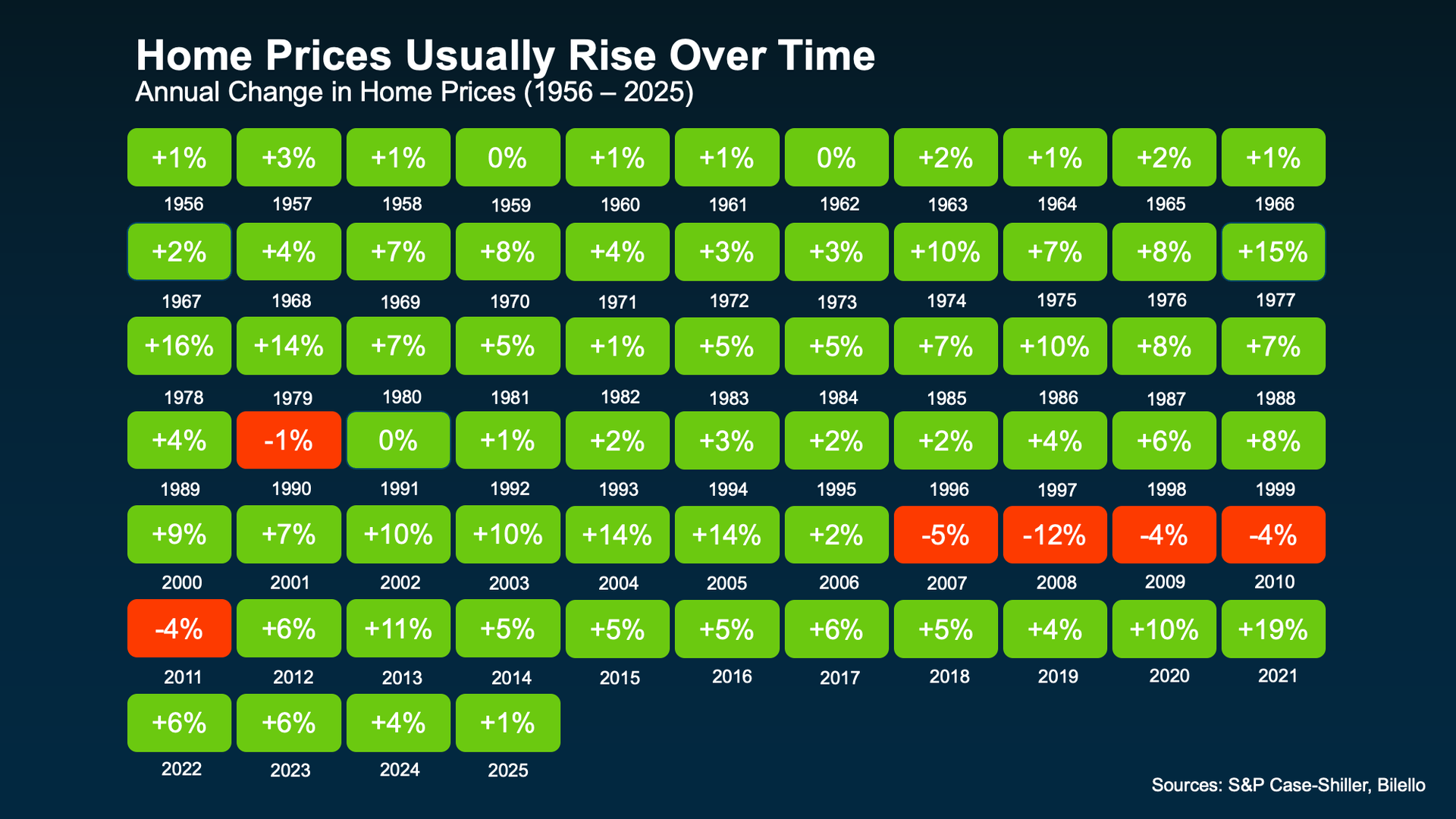
That’s a remarkably consistent track record. And it shows something a lot of headlines miss.


While short-term shifts can happen, it’s the long-term gains that really matter.


Why Prices Tend To Rise Over Time


There are a few core reasons prices usually go up each year:


  • There are always people who need to move. People need a place to live, and that demand will never fully go away. It may ebb and flow, but someone will always have to move as big changes happen in their life. So, homes stay in demand.
  • There still aren't enough homes for sale. While the number of homes for sale has grown, nationally there’s still an undersupply based on how many people want a home. That keeps upward pressure on prices.
  • Inflation has an impact. Over time, the cost of goods (including homes) naturally increases. That pushes home values higher.


What That Means for You as a Buyer


It’s easy to get caught up in what might happen with home prices next month or next year, especially if you’re a first-time buyer and you’re feeling a little anxious about making such a big financial commitment. But the big picture is clear. Prices usually rise.


That doesn’t mean prices will go up every single year in every market. Real estate is local, and there can be short-term ups and downs. We’re seeing that in some places right now. You can even see it in the few annual dips in the visual above.


But historically, the declines have been temporary.


That’s why it’s generally recommended to buy a home only if you plan to stay for a while – typically at least five years. That’s normally enough time to see your house grow in value. And, it’s enough so you can ride out any short-term changes in the market.


Because when you can do that, something powerful happens. Those rising home values grow your net worth, and by extension, help you build wealth.


The right decision isn’t about timing the market perfectly. It’s about making a move that works for your life and staying in it long enough to benefit from the bigger trend.


Bottom Line


Home prices have a long track record of going up over time. And that’s why buying a home is generally considered a safe long-term investment.


That certainly doesn’t mean you have to buy now. You should only move when it makes sense to you and your family and you plan to live there for a while as you never want to make an uneducated rush decision you regret.


If you’re interested to buy, let this reassure you now’s a great time to be a buyer if you. An afford to be a buyer! Owning is always better than paying 100% interest renting a place and building someone else’s equity.


If you want to talk through what home prices are doing in our market, your goals, or your timelines, let’s have a quick conversation.
May 16, 2026
For a lot of would-be first-time buyers , affordability is the thing that’s standing in the way. But some buyers are getting creative and finding a way to still make the numbers work – and that’s through co-buying . The Dream Is Still Alive. The Math Just Isn’t Working for Everyone. Young people haven’t given up on the dream of owning a home – not even close. According to FirstHome IQ, homeownership still ranks among the top life goals for the next generation. The problem? 73% of Gen Z and millennial buyers cite affordability as the reason for not making homeownership a priority. And it shows. First-time buyers now make up just 21% of all home purchases , the lowest share since the National Association of Realtors (NAR) started tracking the data in 1981. But still, some buyers are making it happen. And a portion of them are turning to co-buying to get their foot in the door. So, What’s Co-Buying? Co-buying means purchasing a home with someone else, like a friend, sibling, or unmarried partner. You combine incomes, split the down payment, and share monthly costs. For some people, it’s a creative way to turn “someday” into a concrete move-in date that’s just around the corner. And it's catching on fast, just look at where things stand today. According to CoBuy.io , 64 million Americans now co-own a home with someone they’re not married to. In fact, 31.5% of home purchases involve co-buyers ( see graph below ):
May 12, 2026
Selling your house this season? You’ve probably heard you should stage it before it hits the market. But what does that really mean – and is it worth the effort? The short answer is “yes,” especially right now. With more houses for sale this year, you’re likely wondering how to make the most money possible without your house sitting on the market. The answer is staging. It can help your house stand out, bring in stronger offers, and sell faster . As Nadia Evangelou, Principal Economist at the National Association of Realtors (NAR), puts it: “Staging matters. Preparing the home to be ‘buyer-ready’ attracts more buyers, especially now that inventory has increased.” Here's what staging actually involves and what it could do for your sale. What Is Home Staging? Home staging is the process of preparing your house, so it appeals to as many buyers as possible . That usually means decluttering, deep cleaning, rearranging furniture, and adding simple touches that help each room feel bright, open, and welcoming. The goal is to help buyers fall in love with the space and picture themselves living there , which makes them more likely to make an offer. Why Staging Is Worth the Effort Staged houses tend to perform better on almost every metric that matters when you sell. According to Redfin , staged homes have been shown to sell up to 73% faster than unstaged homes. And they often close in under a month, compared to anywhere from two to three months for vacant ones. There’s also a strong return on the money you spend. The Home Staging Institute says mid-level staging can deliver a 350% return on investment. On a $400k home, that turns the typical $4k cost into roughly $18k in added value when you sell ( see graph below ):
May 9, 2026
You may have heard April 12-18 was the “ best week ” to list your house. That’s based on a report from Realtor.com . But now that it’s passed, you may be wondering if you missed your moment. Here's the good news – you didn’t. Because the reality is, there isn’t just one perfect week to sell your house this Spring. There’s a window. And right now, you’re still in it. Your Window To Sell Is Still Wide Open Here’s why. Different organizations run studies like this every year. And they don’t always land on the exact same week. That’s okay. It’s because they're using different research methods and even different definitions of what “best” means. But the fact that the results vary points to a larger trend. While there may be sweet spots, the entire Spring season gives sellers an opportunity to get some of the best conditions (and best sales prices) of the year. And it’s definitely not too late to jump in. Why Listing in Late May Is the Perfect Play According to Zillow , the best time to list your house this year is the last 2 weeks of May. And that’s approaching fast. Based on their analysis, this is the ideal time to do it if you want to make top dollar. Because, in this 2-week window, homes sell for more . Sometimes, quite a bit more. Depending on where you are and the price point in your area, some homeowners may even net tens of thousands of dollars extra in this sweet spot. As Zillow explains: “Why late spring? Buyer demand typically peaks before Memorial Day. Families want to move during the summer and settle in before the new school year. More buyers shopping at once can spark competition and lift prices .” And they’re not the only ones saying listing in May could be the key to selling for more. ATTOM Data analyzed almost 52 million home sales over the past 10 years and found sellers in May are achieving some of the highest returns . That means the ideal window this year is very much still open. What This Means for You If your goal is to sell for the strongest possible price, this is where timing and strategy come together. And you want to be sure you’re ready to make the most of it. So, what should you be doing right now? When prepping for a fast-moving window like this, you don’t want to waste time or money on the wrong prep work. And your agent is your go-to to make sure you’re focusing on the right things. They’ll be able to tell you if the “ best week ” is slightly different in your market. And what quick repairs or updates can help you get a higher price, without taking a ton of time or effort. Here's a quick example of things an agent may recommend based on information from Redfin :
May 5, 2026
Looking to buy a home this season? Here's what you should know. Buyers have more leverage today than they’ve had in years. There are more homes to choose from and, in many areas, sellers are more open to negotiation. But that doesn’t mean competition is gone completely. These days, it varies a lot depending on where you’re hoping to move. If you’re buying in a popular neighborhood, or in a market where there aren’t many homes for sale, you may still find yourself competing with another buyer. And that’s especially true in the Spring. Here's how to stay one step ahead of any competition this season. Why Your Best Offer Still Matters This Spring According to experts at Zillow and Realtor.com , Spring is one of the busiest times of year to buy a home. That’s because many buyers want to move now so they can settle in before the next school year. And when more buyers enter the market, competition naturally picks up. So, depending on where you’re buying, you may still need to move quickly and make a strong offer, even though the market overall has moderated. And that’s especially true if you find a home you really love . This is what you need to know to make your offer stand out. 1. Lead with a Strong, Realistic Offer It’s tempting to start low and negotiate up. And in some markets, that strategy can work. But if a home is priced well and getting attention, lowballing could hurt your chances. Instead, focus on making an offer that reflects your local market. As Bankrate explains: “There is no magic formula for an optimal home offer. Any offer will be heavily dependent on asking price and local market conditions . . . Your real estate agent will know the local market well and can advise what a competitive — but fair — offer will look like in your area. ” The goal is to make an offer that makes sense for you and stands out to the seller. 2. Have a Plan for Competing Offers If you’ve fallen in love with a home, it’s important to have a plan in case there’s competition from another buyer. One strategy your agent may discuss with you is an escalation clause , which Investopedia explains like this: “ An escalation clause is a way to automatically escalate your bid by a certain dollar amount, up to a certain ceiling, to compete with other bids.” The key is knowing your budget and sticking to it. You don’t want to lose out over a small difference – and this can help prevent that. But you also don’t want to overpay. Keep in mind that if the appraisal comes in lower than your offer, you may have to make up the difference out of pocket. Your agent can help you weigh those risks and determine the best approach for your situation. 3. Keep Your Offer Clean Price matters. But sellers also look closely at your offer’s terms. In some cases, a simpler, cleaner offer can stand out – even if it’s not the highest. As Redfin says: “ Sellers tend to want clean, straightforward offers with minimal strings attached. Keep your requests simple and focus on the essentials.” Your agent can help you prioritize what matters most, so you’re not giving up things you need, while still making your offer as appealing as possible. 4. Be Flexible Where You Can Sometimes, what helps your offer the most is understanding what matters to the seller. NerdWallet explains: “ As you prepare an offer, you tend to focus on what the seller has (a house) and what you want (their house). But you’ll gain a competitive edge by viewing the transaction from the seller’s eyes: What does the seller want?” Does the seller need extra time to move out? Or do they want to move as soon as possible? Your agent can talk with the seller’s agent to find out what matters most. Flexibility here can make a big difference in how your offer is received. Bottom Line Today's market may be balancing out, but strong offers still matter – especially during the busy Spring season in areas like Granite Bay, Roseville, Rocklin, El Dorado Hills and Folsom. Some houses are sitting longer than others, but some are going super fast! The buyers are very picky and when a beautiful home comes on the market, they typically sell fast and for a great price. Make sure that you’re working with an agent like myself who is familiar with the market and will help guide you properly whilst strategizing your offer. 
May 2, 2026
There’s a lot of uncertainty right now and that’s leading to some dramatic headlines. And if you’re thinking about buying a home, that can make you feel a little less sure about your decision. A recent study by CNBC asked homebuyers what they’re most worried about, and three themes kept coming up again and again: Mortgage rates The number of homes for sale Home prices But a lot of what you may be hearing on those is based more on misconceptions. Not facts. So, let’s break it down and separate fact from fiction. Misconception #1: “ I’ll Just Wait, Because Mortgage Rates Are Going To Fall Dramatically ” One idea doing its rounds on social is that mortgage rates are going to drop dramatically soon. So, it’s better to wait to buy. But is that really what’s expected? While mortgage rates have come down a bit in the last few weeks, forecasts don’t show a major drop ahead. The most likely scenario is that rates stay somewhere in the low 6% range this year. And that’s not a big change from where rates are now ( see graph below ): 
April 28, 2026
According to Google Trends , online searches for down payment information recently hit an all-time high. And that’s a clear sign more buyers are trying to figure out what they really need to save before making a move ( see graph below ):
April 25, 2026
You’ve probably asked yourself lately: Is it even worth trying to buy a home right now ? It’s a question a lot of people are asking no matter where they live, or what their income is. With today’s home prices and mortgage rates, renting can feel like the easier path. In some cases, it might even seem like the only realistic option right now. And if that’s where you are, there’s nothing wrong with that. But if you’re weighing the decision, there’s one part of the conversation that doesn’t get talked about enough. It’s what each choice does for your future. What Renting Really Gets You (And What It Doesn’t) Depending on your situation, renting does have some advantages: Lower upfront costs. Less responsibility. More flexibility to move when you want. But even with those benefits, a Bank of America survey found 70% of aspiring homeowners worry about what long-term renting means for their future. And that concern comes down to one thing: you’re not building anything for your future. As Yahoo Finance explains: “Paying rent doesn't build equity. You get a place to live, but no ownership stake, no price appreciation, and no asset to leverage for future borrowing or investment .” So, while renting may feel easier, the flexibility you get comes at a cost. How Homeownership Builds Your Wealth Over Time On the other hand, owning a home is one of the most consistent ways people build wealth over time. Why? When you’re a homeowner, you gain something called equity . That’s the difference between what your home is worth and what you owe. That equity grows with every monthly payment you make. It also gets a boost as home values go up through the years – and it adds up quicker than you may think. Today, the National Association of Realtors (NAR) says the average homeowner’s net worth is 43X greater than that of a renter:
April 21, 2026
If you’re getting a tax refund this year, here’s something worth thinking about. That money could actually help you get closer to buying a home. It may not be something you’ve factored into your plan yet, but it can give your savings a nice boost right when you need it most. And whether your refund is a few thousand dollars or more, there are some smart ways to put that money to work as you get ready to buy . Your Refund May Be Even Bigger This Year Let’s start with the good news. People are getting even more money back in their refunds than they did last year. The visual below uses data from the Internal Revenue Service (IRS) to show the average individual’s refund is 11.1% higher this year:
April 18, 2026
For a lot of people, the math on buying a home just doesn’t really work right now. Maybe that’s how it feels for you too. You look at the cost of buying . Then you look at the cost of childcare. And it starts to feel like you have to choose one or the other. But some families are finding a way to make both work by doing something a little different: teaming up to purchase a multi-generational home . One Reason This Is Becoming More Common It’s no secret that affordability has been a challenge in recent years. But for families with young kids, there’s an added layer that can make it feel even harder: childcare. According to the Department of Health and Human Services , childcare should take up no more than 7% of your monthly income. But in reality, the average married couple spends closer to 10% ( see map below ): 
April 14, 2026
With economic headlines, global events, and near constant talk about affordability, you may be wondering if this is the right time to move. But here’s what you need to remember. While recent events do have some impact on the housing market, they don’t take buying off the table. You just have to use a different strategy. Mortgage Rates Have Been Up Slightly – Here's Why After trending down for most of 2025, mortgage rates have been higher again for over roughly a month now. And experts say it’s a result of what's happening overseas and in the broader economy. As Mark Fleming, Chief Economist at First American , explains : “Mortgage rates have recently moved higher, driven by geopolitical uncertainty and rising energy costs that are contributing to inflation concerns.” But what does that really mean for you? Should you wait for everything to settle back down before you buy a home? The short answer is no . You don’t have to wait. Your Window To Buy Didn’t Close It’s true that a month or so ago, when rates were just shy of 6%, buying felt a bit more affordable. And now that rates are hovering around the mid-6s, monthly payment costs are higher. But zoom out for a second. Let’s say you’re taking out a loan for $500k. Even with rates in the mid 6s, you’re still saving roughly $300 on your monthly payment compared to buyers who made their purchase early last year. That means this recent increase in rates hasn’t erased the progress we’ve seen. Buying is still more affordable than it was just one year ago ( see below ):
Show More
May 16, 2026
For a lot of would-be first-time buyers , affordability is the thing that’s standing in the way. But some buyers are getting creative and finding a way to still make the numbers work – and that’s through co-buying . The Dream Is Still Alive. The Math Just Isn’t Working for Everyone. Young people haven’t given up on the dream of owning a home – not even close. According to FirstHome IQ, homeownership still ranks among the top life goals for the next generation. The problem? 73% of Gen Z and millennial buyers cite affordability as the reason for not making homeownership a priority. And it shows. First-time buyers now make up just 21% of all home purchases , the lowest share since the National Association of Realtors (NAR) started tracking the data in 1981. But still, some buyers are making it happen. And a portion of them are turning to co-buying to get their foot in the door. So, What’s Co-Buying? Co-buying means purchasing a home with someone else, like a friend, sibling, or unmarried partner. You combine incomes, split the down payment, and share monthly costs. For some people, it’s a creative way to turn “someday” into a concrete move-in date that’s just around the corner. And it's catching on fast, just look at where things stand today. According to CoBuy.io , 64 million Americans now co-own a home with someone they’re not married to. In fact, 31.5% of home purchases involve co-buyers ( see graph below ):
May 12, 2026
Selling your house this season? You’ve probably heard you should stage it before it hits the market. But what does that really mean – and is it worth the effort? The short answer is “yes,” especially right now. With more houses for sale this year, you’re likely wondering how to make the most money possible without your house sitting on the market. The answer is staging. It can help your house stand out, bring in stronger offers, and sell faster . As Nadia Evangelou, Principal Economist at the National Association of Realtors (NAR), puts it: “Staging matters. Preparing the home to be ‘buyer-ready’ attracts more buyers, especially now that inventory has increased.” Here's what staging actually involves and what it could do for your sale. What Is Home Staging? Home staging is the process of preparing your house, so it appeals to as many buyers as possible . That usually means decluttering, deep cleaning, rearranging furniture, and adding simple touches that help each room feel bright, open, and welcoming. The goal is to help buyers fall in love with the space and picture themselves living there , which makes them more likely to make an offer. Why Staging Is Worth the Effort Staged houses tend to perform better on almost every metric that matters when you sell. According to Redfin , staged homes have been shown to sell up to 73% faster than unstaged homes. And they often close in under a month, compared to anywhere from two to three months for vacant ones. There’s also a strong return on the money you spend. The Home Staging Institute says mid-level staging can deliver a 350% return on investment. On a $400k home, that turns the typical $4k cost into roughly $18k in added value when you sell ( see graph below ):
May 9, 2026
You may have heard April 12-18 was the “ best week ” to list your house. That’s based on a report from Realtor.com . But now that it’s passed, you may be wondering if you missed your moment. Here's the good news – you didn’t. Because the reality is, there isn’t just one perfect week to sell your house this Spring. There’s a window. And right now, you’re still in it. Your Window To Sell Is Still Wide Open Here’s why. Different organizations run studies like this every year. And they don’t always land on the exact same week. That’s okay. It’s because they're using different research methods and even different definitions of what “best” means. But the fact that the results vary points to a larger trend. While there may be sweet spots, the entire Spring season gives sellers an opportunity to get some of the best conditions (and best sales prices) of the year. And it’s definitely not too late to jump in. Why Listing in Late May Is the Perfect Play According to Zillow , the best time to list your house this year is the last 2 weeks of May. And that’s approaching fast. Based on their analysis, this is the ideal time to do it if you want to make top dollar. Because, in this 2-week window, homes sell for more . Sometimes, quite a bit more. Depending on where you are and the price point in your area, some homeowners may even net tens of thousands of dollars extra in this sweet spot. As Zillow explains: “Why late spring? Buyer demand typically peaks before Memorial Day. Families want to move during the summer and settle in before the new school year. More buyers shopping at once can spark competition and lift prices .” And they’re not the only ones saying listing in May could be the key to selling for more. ATTOM Data analyzed almost 52 million home sales over the past 10 years and found sellers in May are achieving some of the highest returns . That means the ideal window this year is very much still open. What This Means for You If your goal is to sell for the strongest possible price, this is where timing and strategy come together. And you want to be sure you’re ready to make the most of it. So, what should you be doing right now? When prepping for a fast-moving window like this, you don’t want to waste time or money on the wrong prep work. And your agent is your go-to to make sure you’re focusing on the right things. They’ll be able to tell you if the “ best week ” is slightly different in your market. And what quick repairs or updates can help you get a higher price, without taking a ton of time or effort. Here's a quick example of things an agent may recommend based on information from Redfin :
May 5, 2026
Looking to buy a home this season? Here's what you should know. Buyers have more leverage today than they’ve had in years. There are more homes to choose from and, in many areas, sellers are more open to negotiation. But that doesn’t mean competition is gone completely. These days, it varies a lot depending on where you’re hoping to move. If you’re buying in a popular neighborhood, or in a market where there aren’t many homes for sale, you may still find yourself competing with another buyer. And that’s especially true in the Spring. Here's how to stay one step ahead of any competition this season. Why Your Best Offer Still Matters This Spring According to experts at Zillow and Realtor.com , Spring is one of the busiest times of year to buy a home. That’s because many buyers want to move now so they can settle in before the next school year. And when more buyers enter the market, competition naturally picks up. So, depending on where you’re buying, you may still need to move quickly and make a strong offer, even though the market overall has moderated. And that’s especially true if you find a home you really love . This is what you need to know to make your offer stand out. 1. Lead with a Strong, Realistic Offer It’s tempting to start low and negotiate up. And in some markets, that strategy can work. But if a home is priced well and getting attention, lowballing could hurt your chances. Instead, focus on making an offer that reflects your local market. As Bankrate explains: “There is no magic formula for an optimal home offer. Any offer will be heavily dependent on asking price and local market conditions . . . Your real estate agent will know the local market well and can advise what a competitive — but fair — offer will look like in your area. ” The goal is to make an offer that makes sense for you and stands out to the seller. 2. Have a Plan for Competing Offers If you’ve fallen in love with a home, it’s important to have a plan in case there’s competition from another buyer. One strategy your agent may discuss with you is an escalation clause , which Investopedia explains like this: “ An escalation clause is a way to automatically escalate your bid by a certain dollar amount, up to a certain ceiling, to compete with other bids.” The key is knowing your budget and sticking to it. You don’t want to lose out over a small difference – and this can help prevent that. But you also don’t want to overpay. Keep in mind that if the appraisal comes in lower than your offer, you may have to make up the difference out of pocket. Your agent can help you weigh those risks and determine the best approach for your situation. 3. Keep Your Offer Clean Price matters. But sellers also look closely at your offer’s terms. In some cases, a simpler, cleaner offer can stand out – even if it’s not the highest. As Redfin says: “ Sellers tend to want clean, straightforward offers with minimal strings attached. Keep your requests simple and focus on the essentials.” Your agent can help you prioritize what matters most, so you’re not giving up things you need, while still making your offer as appealing as possible. 4. Be Flexible Where You Can Sometimes, what helps your offer the most is understanding what matters to the seller. NerdWallet explains: “ As you prepare an offer, you tend to focus on what the seller has (a house) and what you want (their house). But you’ll gain a competitive edge by viewing the transaction from the seller’s eyes: What does the seller want?” Does the seller need extra time to move out? Or do they want to move as soon as possible? Your agent can talk with the seller’s agent to find out what matters most. Flexibility here can make a big difference in how your offer is received. Bottom Line Today's market may be balancing out, but strong offers still matter – especially during the busy Spring season in areas like Granite Bay, Roseville, Rocklin, El Dorado Hills and Folsom. Some houses are sitting longer than others, but some are going super fast! The buyers are very picky and when a beautiful home comes on the market, they typically sell fast and for a great price. Make sure that you’re working with an agent like myself who is familiar with the market and will help guide you properly whilst strategizing your offer. 
May 2, 2026
There’s a lot of uncertainty right now and that’s leading to some dramatic headlines. And if you’re thinking about buying a home, that can make you feel a little less sure about your decision. A recent study by CNBC asked homebuyers what they’re most worried about, and three themes kept coming up again and again: Mortgage rates The number of homes for sale Home prices But a lot of what you may be hearing on those is based more on misconceptions. Not facts. So, let’s break it down and separate fact from fiction. Misconception #1: “ I’ll Just Wait, Because Mortgage Rates Are Going To Fall Dramatically ” One idea doing its rounds on social is that mortgage rates are going to drop dramatically soon. So, it’s better to wait to buy. But is that really what’s expected? While mortgage rates have come down a bit in the last few weeks, forecasts don’t show a major drop ahead. The most likely scenario is that rates stay somewhere in the low 6% range this year. And that’s not a big change from where rates are now ( see graph below ): 
April 28, 2026
According to Google Trends , online searches for down payment information recently hit an all-time high. And that’s a clear sign more buyers are trying to figure out what they really need to save before making a move ( see graph below ):
April 25, 2026
You’ve probably asked yourself lately: Is it even worth trying to buy a home right now ? It’s a question a lot of people are asking no matter where they live, or what their income is. With today’s home prices and mortgage rates, renting can feel like the easier path. In some cases, it might even seem like the only realistic option right now. And if that’s where you are, there’s nothing wrong with that. But if you’re weighing the decision, there’s one part of the conversation that doesn’t get talked about enough. It’s what each choice does for your future. What Renting Really Gets You (And What It Doesn’t) Depending on your situation, renting does have some advantages: Lower upfront costs. Less responsibility. More flexibility to move when you want. But even with those benefits, a Bank of America survey found 70% of aspiring homeowners worry about what long-term renting means for their future. And that concern comes down to one thing: you’re not building anything for your future. As Yahoo Finance explains: “Paying rent doesn't build equity. You get a place to live, but no ownership stake, no price appreciation, and no asset to leverage for future borrowing or investment .” So, while renting may feel easier, the flexibility you get comes at a cost. How Homeownership Builds Your Wealth Over Time On the other hand, owning a home is one of the most consistent ways people build wealth over time. Why? When you’re a homeowner, you gain something called equity . That’s the difference between what your home is worth and what you owe. That equity grows with every monthly payment you make. It also gets a boost as home values go up through the years – and it adds up quicker than you may think. Today, the National Association of Realtors (NAR) says the average homeowner’s net worth is 43X greater than that of a renter:
April 21, 2026
If you’re getting a tax refund this year, here’s something worth thinking about. That money could actually help you get closer to buying a home. It may not be something you’ve factored into your plan yet, but it can give your savings a nice boost right when you need it most. And whether your refund is a few thousand dollars or more, there are some smart ways to put that money to work as you get ready to buy . Your Refund May Be Even Bigger This Year Let’s start with the good news. People are getting even more money back in their refunds than they did last year. The visual below uses data from the Internal Revenue Service (IRS) to show the average individual’s refund is 11.1% higher this year:
April 18, 2026
For a lot of people, the math on buying a home just doesn’t really work right now. Maybe that’s how it feels for you too. You look at the cost of buying . Then you look at the cost of childcare. And it starts to feel like you have to choose one or the other. But some families are finding a way to make both work by doing something a little different: teaming up to purchase a multi-generational home . One Reason This Is Becoming More Common It’s no secret that affordability has been a challenge in recent years. But for families with young kids, there’s an added layer that can make it feel even harder: childcare. According to the Department of Health and Human Services , childcare should take up no more than 7% of your monthly income. But in reality, the average married couple spends closer to 10% ( see map below ): 
April 14, 2026
With economic headlines, global events, and near constant talk about affordability, you may be wondering if this is the right time to move. But here’s what you need to remember. While recent events do have some impact on the housing market, they don’t take buying off the table. You just have to use a different strategy. Mortgage Rates Have Been Up Slightly – Here's Why After trending down for most of 2025, mortgage rates have been higher again for over roughly a month now. And experts say it’s a result of what's happening overseas and in the broader economy. As Mark Fleming, Chief Economist at First American , explains : “Mortgage rates have recently moved higher, driven by geopolitical uncertainty and rising energy costs that are contributing to inflation concerns.” But what does that really mean for you? Should you wait for everything to settle back down before you buy a home? The short answer is no . You don’t have to wait. Your Window To Buy Didn’t Close It’s true that a month or so ago, when rates were just shy of 6%, buying felt a bit more affordable. And now that rates are hovering around the mid-6s, monthly payment costs are higher. But zoom out for a second. Let’s say you’re taking out a loan for $500k. Even with rates in the mid 6s, you’re still saving roughly $300 on your monthly payment compared to buyers who made their purchase early last year. That means this recent increase in rates hasn’t erased the progress we’ve seen. Buying is still more affordable than it was just one year ago ( see below ):
Show More