Why Staging Your House Could Pay Off This Spring

May 12, 2026

Selling your house this season? You’ve probably heard you should stage it before it hits the market. But what does that really mean – and is it worth the effort?


The short answer is “yes,” especially right now.


With more houses for sale this year, you’re likely wondering how to make the most money possible without your house sitting on the market. The answer is staging. It can help your house stand out, bring in stronger offers, and sell faster. As Nadia Evangelou, Principal Economist at the National Association of Realtors (NAR), puts it:


“Staging matters. Preparing the home to be ‘buyer-ready’ attracts more buyers, especially now that inventory has increased.”


Here's what staging actually involves and what it could do for your sale.


What Is Home Staging?


Home staging is the process of preparing your house, so it appeals to as many buyers as possible. That usually means decluttering, deep cleaning, rearranging furniture, and adding simple touches that help each room feel bright, open, and welcoming.


The goal is to help buyers fall in love with the space and picture themselves living there, which makes them more likely to make an offer.


Why Staging Is Worth the Effort


Staged houses tend to perform better on almost every metric that matters when you sell. According to Redfin, staged homes have been shown to sell up to 73% faster than unstaged homes. And they often close in under a month, compared to anywhere from two to three months for vacant ones.


There’s also a strong return on the money you spend.


The Home Staging Institute says mid-level staging can deliver a 350% return on investment. On a $400k home, that turns the typical $4k cost into roughly $18k in added value when you sell (see graph below):
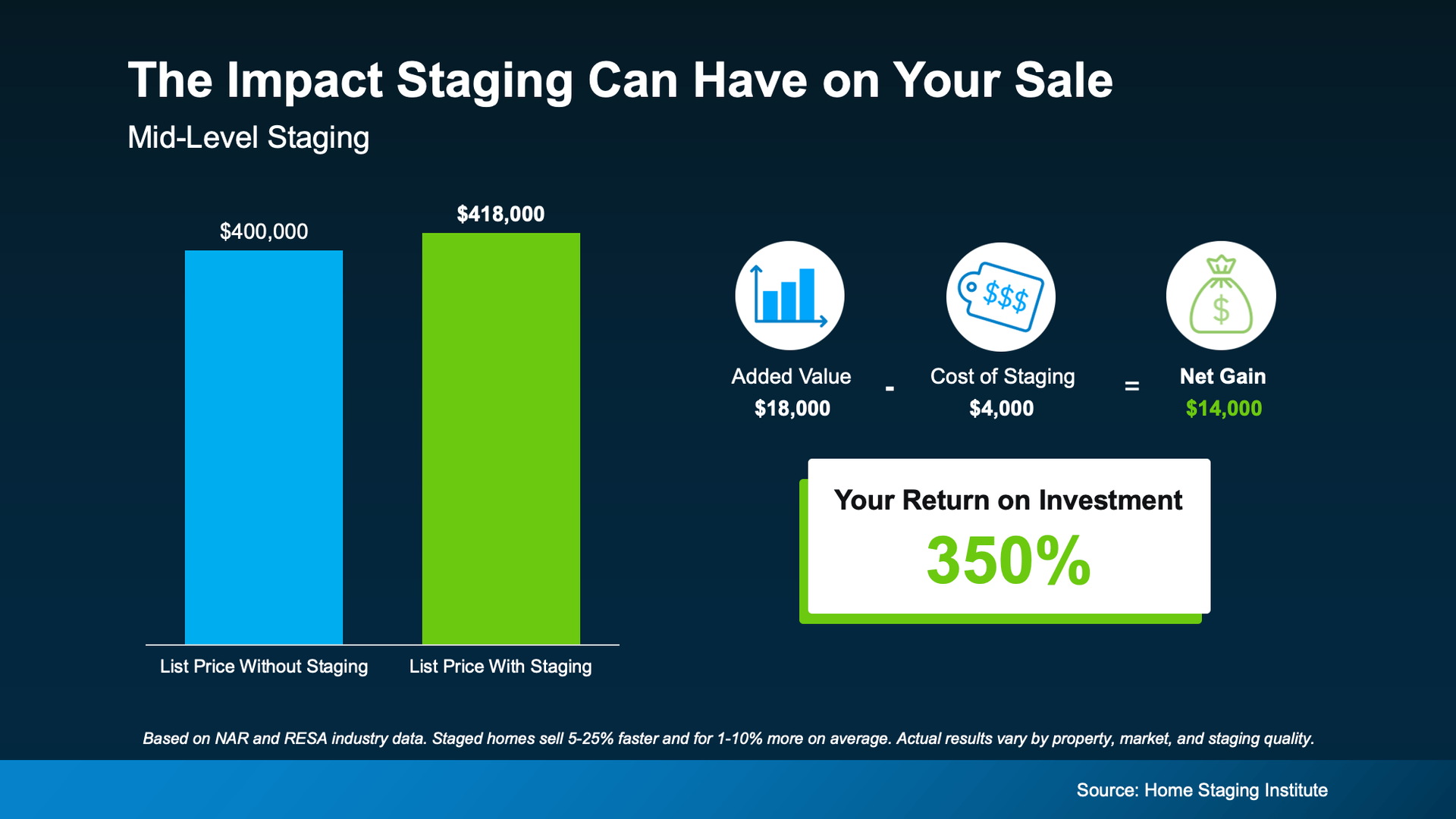
By that estimate, that’s an extra potential profit of about $14k – a meaningful boost when you’re trying to maximize what you walk away with at closing.


Your Staging Options


And just in case you’re seeing that $4k upfront investment above and thinking, “I’m not going to spend that,” here’s what you should know.


Staging doesn’t always have to mean hiring a full crew or filling your house with rented furniture. There are a few different paths you can take, depending on your budget and timeline. So, you could spend a lot less and still get a good return. 


Here are a few options:


  • Professional staging. A stager handles everything from layout to décor, often bringing in their own inventory. According to the Home Staging Institute, costs typically range from $500 to $5k or more, depending on the size of your house.
  • Virtual staging. Digital furniture and styling are added to your listing photos, which can be a budget-friendly option for vacant houses.
  • DIY staging. If your budget is tight and your home only needs minor updates, decluttering, deep cleaning, and arranging furniture for flow can still make a real difference.


Your agent can help you figure out which approach fits your house, your market, and your goals.


Agents see what buyers respond to in open houses and showings every week, so they can give you specific, personalized recommendations on what’s worth your time and money (and what isn’t).


That way you can get the most bang for your buck – no matter your budget.


Bottom Line


With more homes for sale right now, making a strong first impression matters. Staging can help your house sell faster and for more – and there's an option for almost every budget.


If you’re getting ready to list a home anywhere in the Sacramento Valley, including Granite Bay, Eldorado Hills and Roseville, let’s talk about what level of staging makes sense for your house and make a plan for attracting the right buyers to get you the most possible money in the shortest possible time.

November 18, 2026
When the homes you love keep landing outside your budget , it may be time to look at the ones other buyers skip. Our very first home was a light fixer in So Cal after I had graduated college. It was a great leaning experience. The house was livable, but super dated, and had no dual pane windows, no Central heat and air, just a wall heater, but it was clean enough to move in. During the 4 years we owned it we took it from under market value, to selling above market value as we put in the new HVAC, we redid the Stucco, put in the windows, and we did so much more. It was fun, and we grew from the experience both emotionally and financially. Plus, it helped me gain the knowledge I have today to help my clients with their homes. A fixer-upper won't be the right call for everyone. Plenty of buyers want a home that's ready on move-in day. But homes that need some updating could get you in the door for a lot less . More buyers are starting to realize it too. And Danielle Hale, Chief Economist at Realtor.com , explains why: “ Fixer-uppers give buyers a way to break into the housing market at a time when affordability is still stretched thin. For those with the vision. . . fixer-uppers provide both a starting point in the market and the chance to create a home that's truly their own.” If that sounds like you, here's why a fixer-upper could be worth a closer look. The Price Tag Is Usually Lower Because these homes need work, they tend to have a lower asking price up front. According to AmeriSave, fixer-uppers usually sell for 20% to 30% less than what they're worth on the market. Here's what that could look like. KCM applied a 25% discount – the middle of that range – to the median home price from the National Association of Realtors (NAR). This is an example, not the average price of a fixer-upper. But it shows the savings could top $100,000 (see graph below):
November 18, 2026
If selling your house is on your calendar for 2027, you may be thinking you've got plenty of time. Maybe you're aiming for January. Maybe you're waiting for spring. Either way, next year probably feels far enough away that getting ready can wait, too. But waiting until 2027 to sell doesn't mean waiting until 2027 to get started. Today's buyers have more homes to choose from than they've had in years. So, if you want your house to stand out when it's time to list, a little preparation now can make a big difference later. How Early Should You Start Getting Ready? As a general rule of thumb, Zillow recommends giving yourself about 2-3 months to get your house ready to list. And that makes sense when you consider that the vast majority of sellers (78%) did at least one home improvement project before their house hit the market . That gives you plenty of time to meet with me and put together a plan as to what to fix, find contractors, get on their schedules, actually make the updates, and get everything ready for me to schedule to have the professional photos done and prepare for live showings. Please don’t worry, not every seller has a big to-do list. The most common? Interior painting (see graph below): 
November 7, 2026
Quick, what credit score do you need to buy a home ? If a number pops into your head, there's a pretty good chance it's wrong. And the right answer is getting harder to pin down, because the way credit scores are determined and delivered is changing - for the better. Here's what you need to know in today's changing credit climate. #1 Most People Are Guessing Fannie Mae has been tracking consumer perceptions about mortgage requirements since 2015 and found that consumers consistently overestimated the minimum credit score lenders required to qualify for a mortgage. As recently as 2023, the average guess was 652. In reality, the long-standing benchmark for loans backed by Fannie Mae and Freddie Mac is lower, at 620, and today even that isn't a hard rule for every mortgage they back. Like the Fannie Mae research, a recent survey from Veterans United found consumers continue to overestimate what it takes to qualify for a home loan: 
November 3, 2026
When you’re planning a move , every monthly cost counts. That’s why it can be frustrating to see home insurance keep creeping up. According to Intercontinental Exchange, it now makes up 9.6% of the average monthly mortgage payment. But the latest numbers show some progress on that front – as the increases start to slow down. Here’s what you need to know and what you can do about it. Premiums Are Rising More Slowly Now A look at the past two years shows how much things have cooled down. In mid-2024, home insurance premiums rose 4.3% in a single quarter. By the second quarter of this year, that was down to 1.8%. That’s the smallest quarterly growth in almost 3 years – and that’s a good thing (see graph below):
October 31, 2026
When mortgage rates climb, buying a home can start to feel like trying to hit a moving target. Every jump in rates makes monthly payments bigger, and that pushes a lot of buyers to look for another way in. More and more of them are finding it in the adjustable-rate mortgage , or ARM. The ARM Option Here’s how an ARM differs from a more traditional mortgage. With a regular fixed-rate mortgage , your rate stays the same for your whole loan. But with an ARM , your rate is locked for the first few years, then it can move up or down based on market conditions . Some people don’t like that level of uncertainty – and that’s okay. But others are drawn to this option specifically because there’s usually a lower rate to start when you opt for an ARM. And in an affordability-strapped market, that’s going to gain popularity. Bankrate recently found that, in September, rates for ARM products were over a full percentage point lower than a regular fixed-rate loan. Depending on the ARM product, that can make a difference of $150-300 in the monthly payment on a median-priced home. And for some buyers, that’s enough to turn “not right now” into “let’s do this.” You can see it in the numbers. Data from the Mortgage Bankers Association (MBA) shows that, in October, roughly 1 in 10 people applying for a mortgage chose an ARM (see graph below): 
October 27, 2026
Here's something most homebuyers don't think about. When the housing market slows down , homeowners and builders don't always respond the same way. Think about it. If you're selling your house and aren't getting the offers you want, you could make the choice to take it off the market and stay put, and wait for things to improve. But builders ? They may be more motivated to stay the course. They've already invested money in building those houses. And every completed home that sits unsold means money tied up in a property, plus ongoing costs that can add up. That's why some builders may be more motivated to negotiate right now. And that could work in your favor. Fewer Buyers Are Making Moves. And Builders Are Feeling It. You’ve probably seen the headlines. According to the latest report from the National Association of Realtors (NAR), pending home sales – homes that have gone under contract but haven't closed yet – fell 7.3% in September and 11.3% compared to last year. Why? Higher mortgage rates are making it harder for buyers to make the numbers work. Now, that report tracks existing homes, not new construction. But we're seeing signs of the same slowdown on the builder side, too. According to the National Association of Home Builders (NAHB), builder confidence dropped to 29 in October , its lowest level since June 2012. Traffic from prospective buyers also dropped to its lowest level in more than a decade, excluding the start of the pandemic. 
October 24, 2026
What's the biggest payment you make every month? If you’re a renter , it's probably your rent. But did you know that you can pay your rent on time, every time, for years, and it may never show up in your credit history? It's pretty frustrating, especially if you'd like to buy a home someday and you’re trying to build your credit. The good thing is that’s changing right now. Here’s what you need to know and why it could open a door you thought was closed. The Problem for Would-Be Buyers You’re not the only one frustrated. According to Zillow, nearly a third of applicants (32.88%) get denied a mortgage due to insufficient credit history - not missed payments or too much debt. Just not enough credit history for a lender to say "yes." It’s the most common hurdle would-be buyers have. As Zillow explains: "Nearly one-third of mortgage applicants are denied a loan because of insufficient credit history , making it the most common reason for a denial .” 
October 21, 2026
When you picture buying your first home , chances are you’re imagining a traditional single-family house with its own yard, maybe a garage, and little extra room to grow. But with affordability still tight, getting everything on that list right away may come with a higher price tag than you’re comfortable with right now. So, if you’re running the numbers and buying a house like that feels like a stretch, there may be another way in. A condo. Because in a lot of markets, condos come with a significantly lower price tag. And that could make them a smart way to get your foot in the door. Condos Can Cost Less Than You Think According to a recent study by Zillow: “ Condos are the most commonly affordable home type in virtually every metro. At the starter level, the savings can be pretty significant. Nationally, starter condos average $197,468 — that’s about 6% less than the typical starter home. ” And depending on where you live, the difference can be much bigger. Zillow identified metro areas where typical starter condos are priced significantly below the estimated home price a median-income household could afford. Here are the top 10 according to that research ( see chart below ). In Houston, the gap is at its widest. There, a typical starter condo was valued at about $85,600 – 72% below the price considered affordable based on the area's median household income. 
October 17, 2026
You've spent years making your house feel like home, celebrating milestones, making each room your own, and turning neighbors into friends. As you look ahead to the next chapter of your life, it's natural to wonder if this is still the place you want to spend it. Whether you're leaning toward staying in your house as you get older or moving to a 55+ community, the goal is the same: a home that fits the life you want, with more time for the people and things you love. So, here's what to consider before you decide. What It Can Take To Stay Put Wanting to stay in a house you love and are familiar with makes sense. But most houses need at least some updates to make aging in place easier. In fact, the Joint Center for Housing Studies of Harvard University (JCHS) finds that fewer than 4% of homes have the basics, like single-floor living, no-step entries, and wide hallways and doorways (see graph below): 
October 13, 2026
With everything going on, it’s understandable if you’re wondering if you’d regret buying right now. Everyday expenses cost more. Mortgage rates are higher than you’d like. And when the economy feels uncertain, taking on a mortgage can feel like a much bigger leap. But here’s some perspective that may help… Most people who already made that leap would do it again. According to a recent survey from NerdWallet, the vast majority of recent buyers (74%) were glad they bought their current home. Only a very small 3% of people regret it: 
Show More
November 18, 2026
When the homes you love keep landing outside your budget , it may be time to look at the ones other buyers skip. Our very first home was a light fixer in So Cal after I had graduated college. It was a great leaning experience. The house was livable, but super dated, and had no dual pane windows, no Central heat and air, just a wall heater, but it was clean enough to move in. During the 4 years we owned it we took it from under market value, to selling above market value as we put in the new HVAC, we redid the Stucco, put in the windows, and we did so much more. It was fun, and we grew from the experience both emotionally and financially. Plus, it helped me gain the knowledge I have today to help my clients with their homes. A fixer-upper won't be the right call for everyone. Plenty of buyers want a home that's ready on move-in day. But homes that need some updating could get you in the door for a lot less . More buyers are starting to realize it too. And Danielle Hale, Chief Economist at Realtor.com , explains why: “ Fixer-uppers give buyers a way to break into the housing market at a time when affordability is still stretched thin. For those with the vision. . . fixer-uppers provide both a starting point in the market and the chance to create a home that's truly their own.” If that sounds like you, here's why a fixer-upper could be worth a closer look. The Price Tag Is Usually Lower Because these homes need work, they tend to have a lower asking price up front. According to AmeriSave, fixer-uppers usually sell for 20% to 30% less than what they're worth on the market. Here's what that could look like. KCM applied a 25% discount – the middle of that range – to the median home price from the National Association of Realtors (NAR). This is an example, not the average price of a fixer-upper. But it shows the savings could top $100,000 (see graph below):
November 18, 2026
If selling your house is on your calendar for 2027, you may be thinking you've got plenty of time. Maybe you're aiming for January. Maybe you're waiting for spring. Either way, next year probably feels far enough away that getting ready can wait, too. But waiting until 2027 to sell doesn't mean waiting until 2027 to get started. Today's buyers have more homes to choose from than they've had in years. So, if you want your house to stand out when it's time to list, a little preparation now can make a big difference later. How Early Should You Start Getting Ready? As a general rule of thumb, Zillow recommends giving yourself about 2-3 months to get your house ready to list. And that makes sense when you consider that the vast majority of sellers (78%) did at least one home improvement project before their house hit the market . That gives you plenty of time to meet with me and put together a plan as to what to fix, find contractors, get on their schedules, actually make the updates, and get everything ready for me to schedule to have the professional photos done and prepare for live showings. Please don’t worry, not every seller has a big to-do list. The most common? Interior painting (see graph below): 
November 7, 2026
Quick, what credit score do you need to buy a home ? If a number pops into your head, there's a pretty good chance it's wrong. And the right answer is getting harder to pin down, because the way credit scores are determined and delivered is changing - for the better. Here's what you need to know in today's changing credit climate. #1 Most People Are Guessing Fannie Mae has been tracking consumer perceptions about mortgage requirements since 2015 and found that consumers consistently overestimated the minimum credit score lenders required to qualify for a mortgage. As recently as 2023, the average guess was 652. In reality, the long-standing benchmark for loans backed by Fannie Mae and Freddie Mac is lower, at 620, and today even that isn't a hard rule for every mortgage they back. Like the Fannie Mae research, a recent survey from Veterans United found consumers continue to overestimate what it takes to qualify for a home loan: 
November 3, 2026
When you’re planning a move , every monthly cost counts. That’s why it can be frustrating to see home insurance keep creeping up. According to Intercontinental Exchange, it now makes up 9.6% of the average monthly mortgage payment. But the latest numbers show some progress on that front – as the increases start to slow down. Here’s what you need to know and what you can do about it. Premiums Are Rising More Slowly Now A look at the past two years shows how much things have cooled down. In mid-2024, home insurance premiums rose 4.3% in a single quarter. By the second quarter of this year, that was down to 1.8%. That’s the smallest quarterly growth in almost 3 years – and that’s a good thing (see graph below):
October 31, 2026
When mortgage rates climb, buying a home can start to feel like trying to hit a moving target. Every jump in rates makes monthly payments bigger, and that pushes a lot of buyers to look for another way in. More and more of them are finding it in the adjustable-rate mortgage , or ARM. The ARM Option Here’s how an ARM differs from a more traditional mortgage. With a regular fixed-rate mortgage , your rate stays the same for your whole loan. But with an ARM , your rate is locked for the first few years, then it can move up or down based on market conditions . Some people don’t like that level of uncertainty – and that’s okay. But others are drawn to this option specifically because there’s usually a lower rate to start when you opt for an ARM. And in an affordability-strapped market, that’s going to gain popularity. Bankrate recently found that, in September, rates for ARM products were over a full percentage point lower than a regular fixed-rate loan. Depending on the ARM product, that can make a difference of $150-300 in the monthly payment on a median-priced home. And for some buyers, that’s enough to turn “not right now” into “let’s do this.” You can see it in the numbers. Data from the Mortgage Bankers Association (MBA) shows that, in October, roughly 1 in 10 people applying for a mortgage chose an ARM (see graph below): 
October 27, 2026
Here's something most homebuyers don't think about. When the housing market slows down , homeowners and builders don't always respond the same way. Think about it. If you're selling your house and aren't getting the offers you want, you could make the choice to take it off the market and stay put, and wait for things to improve. But builders ? They may be more motivated to stay the course. They've already invested money in building those houses. And every completed home that sits unsold means money tied up in a property, plus ongoing costs that can add up. That's why some builders may be more motivated to negotiate right now. And that could work in your favor. Fewer Buyers Are Making Moves. And Builders Are Feeling It. You’ve probably seen the headlines. According to the latest report from the National Association of Realtors (NAR), pending home sales – homes that have gone under contract but haven't closed yet – fell 7.3% in September and 11.3% compared to last year. Why? Higher mortgage rates are making it harder for buyers to make the numbers work. Now, that report tracks existing homes, not new construction. But we're seeing signs of the same slowdown on the builder side, too. According to the National Association of Home Builders (NAHB), builder confidence dropped to 29 in October , its lowest level since June 2012. Traffic from prospective buyers also dropped to its lowest level in more than a decade, excluding the start of the pandemic. 
October 24, 2026
What's the biggest payment you make every month? If you’re a renter , it's probably your rent. But did you know that you can pay your rent on time, every time, for years, and it may never show up in your credit history? It's pretty frustrating, especially if you'd like to buy a home someday and you’re trying to build your credit. The good thing is that’s changing right now. Here’s what you need to know and why it could open a door you thought was closed. The Problem for Would-Be Buyers You’re not the only one frustrated. According to Zillow, nearly a third of applicants (32.88%) get denied a mortgage due to insufficient credit history - not missed payments or too much debt. Just not enough credit history for a lender to say "yes." It’s the most common hurdle would-be buyers have. As Zillow explains: "Nearly one-third of mortgage applicants are denied a loan because of insufficient credit history , making it the most common reason for a denial .” 
October 21, 2026
When you picture buying your first home , chances are you’re imagining a traditional single-family house with its own yard, maybe a garage, and little extra room to grow. But with affordability still tight, getting everything on that list right away may come with a higher price tag than you’re comfortable with right now. So, if you’re running the numbers and buying a house like that feels like a stretch, there may be another way in. A condo. Because in a lot of markets, condos come with a significantly lower price tag. And that could make them a smart way to get your foot in the door. Condos Can Cost Less Than You Think According to a recent study by Zillow: “ Condos are the most commonly affordable home type in virtually every metro. At the starter level, the savings can be pretty significant. Nationally, starter condos average $197,468 — that’s about 6% less than the typical starter home. ” And depending on where you live, the difference can be much bigger. Zillow identified metro areas where typical starter condos are priced significantly below the estimated home price a median-income household could afford. Here are the top 10 according to that research ( see chart below ). In Houston, the gap is at its widest. There, a typical starter condo was valued at about $85,600 – 72% below the price considered affordable based on the area's median household income. 
October 17, 2026
You've spent years making your house feel like home, celebrating milestones, making each room your own, and turning neighbors into friends. As you look ahead to the next chapter of your life, it's natural to wonder if this is still the place you want to spend it. Whether you're leaning toward staying in your house as you get older or moving to a 55+ community, the goal is the same: a home that fits the life you want, with more time for the people and things you love. So, here's what to consider before you decide. What It Can Take To Stay Put Wanting to stay in a house you love and are familiar with makes sense. But most houses need at least some updates to make aging in place easier. In fact, the Joint Center for Housing Studies of Harvard University (JCHS) finds that fewer than 4% of homes have the basics, like single-floor living, no-step entries, and wide hallways and doorways (see graph below): 
October 13, 2026
With everything going on, it’s understandable if you’re wondering if you’d regret buying right now. Everyday expenses cost more. Mortgage rates are higher than you’d like. And when the economy feels uncertain, taking on a mortgage can feel like a much bigger leap. But here’s some perspective that may help… Most people who already made that leap would do it again. According to a recent survey from NerdWallet, the vast majority of recent buyers (74%) were glad they bought their current home. Only a very small 3% of people regret it: 
Show More