Why Your House Will Shine in Today’s Market
October 29, 2024
Even though interest rates are lower than last year, the rates are still keeping buyers from buying a house unless they really like it a lot. There are more homes available for sale than there were at this time last year, there are more buyers than there are good houses to to keep up with the demand. So, know that if you’ve got moving on your mind, your house needs to be prepped and really stand out to make a buyer say “I want to buy it!” 
There are several key reasons why there aren’t enough homes to go around and understanding them will help you see why the market is working in your favor if you’re ready to make a move.
What’s Causing the Shortage?
1. Underproduction of Homes: For years, the industry hasn’t built enough homes to keep up with demand. As Zillow explains:
“In 2022, 1.4 million homes were built — at the time, the best year for home construction since the early stages of the Great Recession. However, the number of U.S. families increased by 1.8 million that year, meaning  the country did not even build enough to make a place for the new families, let alone begin chipping away at the deficit that has hampered housing affordability for more than a decade .”
2. Rising Costs: Building materials, labor shortages, and supply chain disruptions caused by the pandemic have all made it harder and more expensive to build homes. This can either limit or stop new home construction in some areas.
3. Regional Imbalances: Some markets are more affected by the shortage of homes than others. Popular and more desirable areas have more people moving in faster than new homes can be built. The number of new building permits issued doesn’t always keep pace with job growth in these regions, and that leads to even tighter markets and higher prices.
How Big Is the Problem?
According to estimates from Real Estate News, the U.S. is facing a housing shortfall of roughly 3.3 million homes, based on an average of several expert insights (see graph below):
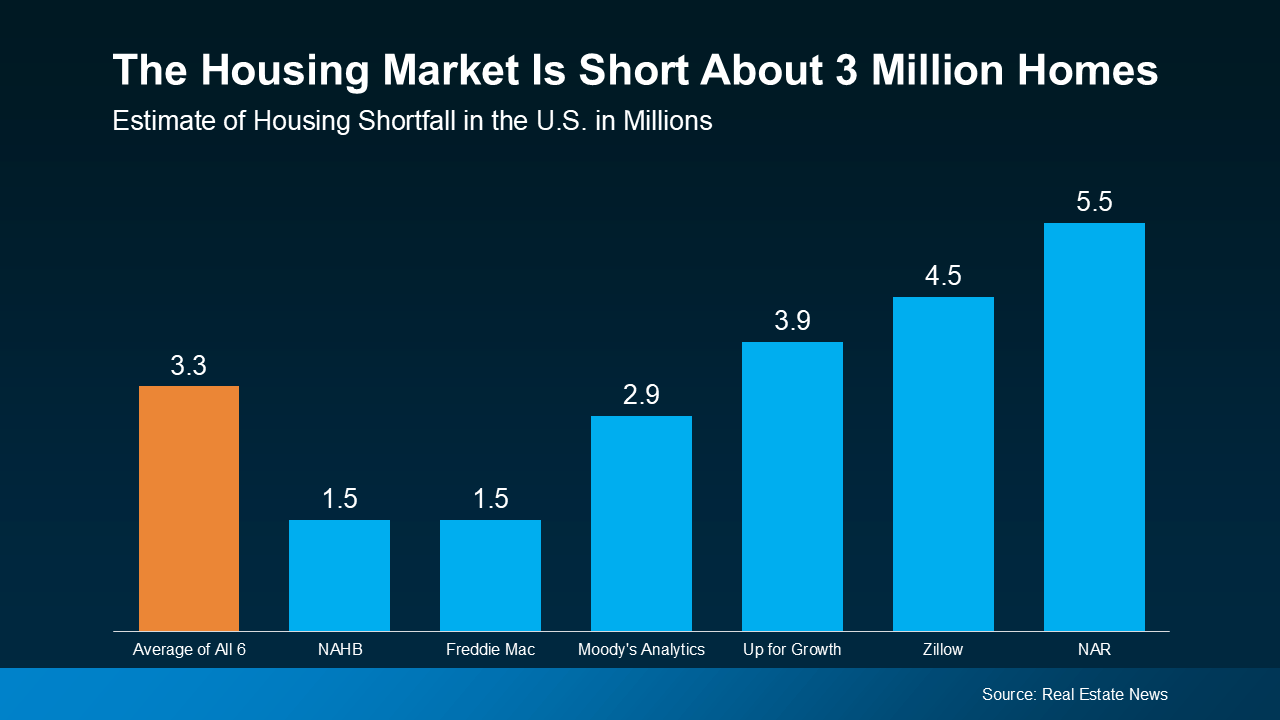
This shows there’s a significant number of homes that need to be built just to meet current demand from buyers. But what about future demand?

According to John Burns Research and Consulting (JBREC), over the next 10 years, the U.S. will need about 18 million new homes to meet projected demand, including homes for new households, second homes, and replacements for aging or unusable homes.

So, even though more homes are on the market compared to last year, there still aren’t enough of them to go around. This is where you can really win if you’re ready to sell your house.


What You Need To Remember


If you’re thinking about selling, the shortage of homes for sale means your house is likely to get some serious attention from buyers. It’ll take years to climb out of this inventory deficit, and the market is still very tight. So, when buyers are competing for relatively few homes like they are right now, that creates more interest in the houses that are on the market, putting upward pressure on prices and ultimately working in your favor.

And since every market is different, it’s important to work with a real estate agent who understands local trends. They can help you price your house right and create a strategy to attract the right buyers.


Bottom Line


While there are more homes for sale than there were at this time last year, the buyers are still picky and need to fall in love with the house to want to make it home. This puts you in the driver’s seat as a seller, but don’t get too demanding as the buyers will not over pay. We need to price your house appropriately to get it sold. Let’s connect so you have someone who can help you take advantage of today’s market.


September 12, 2026
You've been waiting for something to change before you buy. It just might not be the thing you expected… While everyone’s paying attention to mortgage rates , only the savviest buyers know that the changing season can start tipping things in their favor. Because every fall, buyers tend to get more to choose from, better prices, and more room to negotiate. And that’s why Hannah Jones, Senior Economist at Realtor.com , says : “ We always see that the best time to buy window usually falls in the early fall around October. ” And that’s exactly why, if you've been waiting for a better moment to buy, this season may be worth a closer look – even with rates where they are. 1. There Are More Homes To Choose From One of the biggest frustrations buyers have had over the past few years has been a lack of choices. Fall tends to help with that. Based on seasonal trends, Realtor.com data shows there are typically more homes available for sale in September through November than during any other season of the year ( see graph below ): 
September 10, 2026
For most first-time buyers, the hardest part of buying a home is making the numbers work . You budget, you save, and the finish line still feels far away. But your salary is only half the equation. Where you live shapes what you can afford just as much. And if you can work remotely, you have an advantage a lot of buyers don't. You're not tied to living where the jobs are, so you can look where your money goes further. Where You Work Doesn’t Have To Dictate Where You Live Remote job openings are on the rise. According to FlexJobs, remote job postings climbed 22% from the quarter before. That’s the second quarter in a row of double-digit growth. More remote roles mean more people can choose a home base around the life they want to build. As Forbes puts it : “ Remote employees, freelancers, consultants, entrepreneurs, and business owners have the flexibility to choose a home base based on the life they want to build, whether that means more space, a lower cost of living, better access to nature, or simply somewhere new." And you can use that freedom to look somewhere more affordable . Your Paycheck Goes Much Further in Some States Your cost of living – what you spend on housing, groceries, utilities, and the rest of daily life – varies a lot from one state to the next. In some, according to data from Extra Space, it runs far enough below the national average to change what you can afford ( see map below ):
September 5, 2026
You're scrolling through listings on your phone and everything looks good until you see the price (or the estimated monthly payment). Then you close the app. Because even if you love the house, the numbers feel impossible. But here's the thing, they may not be. Nationally, there are more homes sitting on the market than there are people out there looking. And when sellers need buyers more than buyers need sellers , that shows up in the price. Lower asking prices. More price cuts. And homes priced for what buyers can actually afford – not what sellers hope someone might pay. And it may be enough to make buying more doable than you’d think. 4 Out of 10 Sellers Are Cutting Their Price One of the clearest signs sellers are adjusting? Price cuts. HousingWire Data shows more than 40% of sellers are dropping this price. That’s just slightly behind the volume we saw last year ( see graph below ): 
September 3, 2026
Lately, headlines have floated an eye-catching idea about tapping into your 401(k) to cover a down payment on a home. Maybe you've caught the buzz and wondered whether that money could get you into a home faster, especially with affordability as tough as it is. Here’s what you need to remember. Pulling from your retirement savings is a big decision, so take time to weigh all your options first and be sure to talk with a financial expert before you do anything. A lot of buyers ask if they can use retirement money for a down payment. The short answer is: sometimes. The better answer is: there are a few different ways to do it, and they are not all the same. 1. 401(k) loan (borrowing from yourself) If your employer plan allows it, this is usually the cleanest option. You borrow from your own 401(k), typically up to 50% of your vested balance or $50,000, whichever is less. There is generally no income tax and no 10% penalty as long as you repay it on schedule. The interest you pay goes back into your own account. Two things to watch: If you leave your job before the loan is paid off, the remaining balance can become taxable. Some plans allow a longer payoff period when the loan is used to buy a primary residence. 2. 401(k) hardship withdrawal Some plans allow a withdrawal for costs tied to buying a principal residence. This is not a loan. You do not pay it back. You will usually owe income tax, and if you’re under 59½ the 10% penalty often still applies. There is no special first-time homebuyer penalty exception for 401(k)s. 3. IRA first-time homebuyer exception IRAs work differently. You generally cannot take a loan from an IRA, but first-time buyers (no principal residence in the last two years) may withdraw up to $10,000 penalty-free. A married couple can often use $10,000 each. Traditional IRA withdrawals are still taxable. Roth IRA contributions can usually come out tax- and penalty-free; earnings have extra rules Why Dipping into a 401(k) Can Be Tempting Data from Empower shows many Americans have built up considerable retirement savings. The median 401(k) amount for anyone in their 40s-60s is six figures (see graph below  ):
August 29, 2026
When's the last time someone told you what your house is worth? Not what some online valuation tool guessed. Not what your neighbor's house sold for. What yours is actually worth right now . For a lot of homeowners, it's been years. And if you've been thinking about moving , but higher home prices or mortgage rates have made you hesitate, here’s why it’s time to take a second look at that number. Your House May Be Worth More Than You Think Home values have climbed significantly over the past 5-10 years. And even though today's market is more balanced , homeowners are building wealth every day just by owning their homes. That’s how equity works. As home values rise, and as you make your monthly payments, your equity grows. And it adds up fast. According to Cotality , the typical homeowner with a mortgage now has $310,500 in equity. That's not a small number. It’s six figures. And that’s only the national average. In many states, homeowners have built even more equity than that. Take a look at the map below and see where your state stands. The darker the blue, the more equity the typical homeowner has there (see map below): 
August 26, 2026
Few things are as rattling as the thought of your home sale falling through at the last minute, right before closing. All that waiting, all that progress, out the window. But if you’re getting ready to sell, here’s what you should know. Even in today’s market, it rarely comes to that. Buyers who are moving at today’s rates and prices are generally moving because of some big life change. That means they’re motivated, and eager to get all the way to the closing table. According to the latest data from Redfin , only about 1 in 7 pending sales are falling through . Meaning the vast majority make it all the way to closing. And the single biggest thing that puts a deal at risk is the one you have the most power to prevent. It just takes a little smart planning before your house hits the market. Why Some Deals Fall Apart Before Closing A Redfin survey sheds light on the most common things that trip up a sale ( see visual below ):
August 22, 2026
Ask around and almost every homebuyer out there wants to know if there’s a way to get a better deal . And just about every seller wants to know if they'll still get top dollar . The interesting thing is... both can be right at the exact same time . It just depends on where you live. That's because today's housing market isn't moving in one direction anymore. Some markets clearly favor buyers. Others still favor sellers. But most are sitting somewhere in the middle. And knowing which market you're actually in can completely change the strategy you use to buy or sell (and what expectations you should have). Let’s break it down. One Number Tells You Who's Got Leverage So how do you know which market you're in? There's one number that tells the story faster than anything else: the months' supply of homes for sale. It's the clearest signal of who's got leverage – and what strategy you'll need. Think of it like this. Imagine no additional homes were listed starting today. Months' supply tells us how long it would take to sell everything that's currently on the market based on today’s demand. Generally speaking, if months’ supply is: Fewer than 4 months: Sellers usually have the advantage. 4 to 6 months: Buyers and sellers are on more equal footing. More than 6 months: Buyers can usually negotiate for a better deal. Right now, the National Association of Realtors (NAR) data says that number is 4.6 and that puts the overall market back in balanced territory ( see graph below ):
August 20, 2026
That spare room on the main floor. The finished basement with a kitchenette and its own entrance. The bonus room you've been using for storage. To you, it's extra space. But to a growing pool of buyers, it's the reason they'd pick your house . Here’s why. Multi-generational homebuying is on the rise. Millions of Families Are Living Multi-Generationally The number of multi-generational households is climbing. That’s when 3 or more generations live under one roof. And data shows those households grew from 3.2 million to almost 4 million between 2014 and 2024, according to Realtor.com . And each year, more people are shopping for a larger home that fits their combined needs. While the appetite for this type of house is rising across the board, data from USAFacts shows multi-generational living is more common in some states than others. The darker the state in the map below, the more common it is in that area ( see map below ): 
August 15, 2026
Imagine waiting a year to buy a home, only to find mortgage rates haven't changed much. That may sound frustrating.But it's a real possibility. A lot of people are putting their plans on hold because they believe much lower mortgage rates are right around the corner. But, based on today's forecasts, that may not happen. And you should know that before you decide what to do. Let's look at why experts don't expect a dramatic drop in rates – and the options that could help you buy anyway. Because even if rates don’t fall, you can still move. Here’s how. 1. Mortgage Rates Aren’t Expected To Fall in a Meaningful Way If you're waiting for rates to fall, you're not alone. A recent survey from Clever-Best Interest found 42% of people believe mortgage rates will drop below 5% this year. The challenge is, that's not what the experts who study mortgage rates every day are expecting. Forecasts from Fannie Mae , the Mortgage Bankers Association , and Wells Fargo all show mortgage rates staying relatively steady in the low-to-mid 6% range through at least mid-2027 ( see graph below ):
August 12, 2026
If you’re planning to buy your next home soon, you’ve probably heard the old rule about saving 20% for your down payment. The truth is, you usually don’t have to. Plenty of loan options let qualified buyers put down much less. But a lot of repeat buyers are choosing to put down 20% anyway. So, why are they if they don’t have to? Two reasons. They know a bigger down payment pays off, and after years in their current house, they’ve built up enough equity that it’s finally possible. Repeat Buyers Put More Money Down According to the National Association of Realtors (NAR), the typical repeat buyer puts down 23% when they buy a home ( see graph below ):
Show More
September 12, 2026
You've been waiting for something to change before you buy. It just might not be the thing you expected… While everyone’s paying attention to mortgage rates , only the savviest buyers know that the changing season can start tipping things in their favor. Because every fall, buyers tend to get more to choose from, better prices, and more room to negotiate. And that’s why Hannah Jones, Senior Economist at Realtor.com , says : “ We always see that the best time to buy window usually falls in the early fall around October. ” And that’s exactly why, if you've been waiting for a better moment to buy, this season may be worth a closer look – even with rates where they are. 1. There Are More Homes To Choose From One of the biggest frustrations buyers have had over the past few years has been a lack of choices. Fall tends to help with that. Based on seasonal trends, Realtor.com data shows there are typically more homes available for sale in September through November than during any other season of the year ( see graph below ): 
September 10, 2026
For most first-time buyers, the hardest part of buying a home is making the numbers work . You budget, you save, and the finish line still feels far away. But your salary is only half the equation. Where you live shapes what you can afford just as much. And if you can work remotely, you have an advantage a lot of buyers don't. You're not tied to living where the jobs are, so you can look where your money goes further. Where You Work Doesn’t Have To Dictate Where You Live Remote job openings are on the rise. According to FlexJobs, remote job postings climbed 22% from the quarter before. That’s the second quarter in a row of double-digit growth. More remote roles mean more people can choose a home base around the life they want to build. As Forbes puts it : “ Remote employees, freelancers, consultants, entrepreneurs, and business owners have the flexibility to choose a home base based on the life they want to build, whether that means more space, a lower cost of living, better access to nature, or simply somewhere new." And you can use that freedom to look somewhere more affordable . Your Paycheck Goes Much Further in Some States Your cost of living – what you spend on housing, groceries, utilities, and the rest of daily life – varies a lot from one state to the next. In some, according to data from Extra Space, it runs far enough below the national average to change what you can afford ( see map below ):
September 5, 2026
You're scrolling through listings on your phone and everything looks good until you see the price (or the estimated monthly payment). Then you close the app. Because even if you love the house, the numbers feel impossible. But here's the thing, they may not be. Nationally, there are more homes sitting on the market than there are people out there looking. And when sellers need buyers more than buyers need sellers , that shows up in the price. Lower asking prices. More price cuts. And homes priced for what buyers can actually afford – not what sellers hope someone might pay. And it may be enough to make buying more doable than you’d think. 4 Out of 10 Sellers Are Cutting Their Price One of the clearest signs sellers are adjusting? Price cuts. HousingWire Data shows more than 40% of sellers are dropping this price. That’s just slightly behind the volume we saw last year ( see graph below ): 
September 3, 2026
Lately, headlines have floated an eye-catching idea about tapping into your 401(k) to cover a down payment on a home. Maybe you've caught the buzz and wondered whether that money could get you into a home faster, especially with affordability as tough as it is. Here’s what you need to remember. Pulling from your retirement savings is a big decision, so take time to weigh all your options first and be sure to talk with a financial expert before you do anything. A lot of buyers ask if they can use retirement money for a down payment. The short answer is: sometimes. The better answer is: there are a few different ways to do it, and they are not all the same. 1. 401(k) loan (borrowing from yourself) If your employer plan allows it, this is usually the cleanest option. You borrow from your own 401(k), typically up to 50% of your vested balance or $50,000, whichever is less. There is generally no income tax and no 10% penalty as long as you repay it on schedule. The interest you pay goes back into your own account. Two things to watch: If you leave your job before the loan is paid off, the remaining balance can become taxable. Some plans allow a longer payoff period when the loan is used to buy a primary residence. 2. 401(k) hardship withdrawal Some plans allow a withdrawal for costs tied to buying a principal residence. This is not a loan. You do not pay it back. You will usually owe income tax, and if you’re under 59½ the 10% penalty often still applies. There is no special first-time homebuyer penalty exception for 401(k)s. 3. IRA first-time homebuyer exception IRAs work differently. You generally cannot take a loan from an IRA, but first-time buyers (no principal residence in the last two years) may withdraw up to $10,000 penalty-free. A married couple can often use $10,000 each. Traditional IRA withdrawals are still taxable. Roth IRA contributions can usually come out tax- and penalty-free; earnings have extra rules Why Dipping into a 401(k) Can Be Tempting Data from Empower shows many Americans have built up considerable retirement savings. The median 401(k) amount for anyone in their 40s-60s is six figures (see graph below  ):
August 29, 2026
When's the last time someone told you what your house is worth? Not what some online valuation tool guessed. Not what your neighbor's house sold for. What yours is actually worth right now . For a lot of homeowners, it's been years. And if you've been thinking about moving , but higher home prices or mortgage rates have made you hesitate, here’s why it’s time to take a second look at that number. Your House May Be Worth More Than You Think Home values have climbed significantly over the past 5-10 years. And even though today's market is more balanced , homeowners are building wealth every day just by owning their homes. That’s how equity works. As home values rise, and as you make your monthly payments, your equity grows. And it adds up fast. According to Cotality , the typical homeowner with a mortgage now has $310,500 in equity. That's not a small number. It’s six figures. And that’s only the national average. In many states, homeowners have built even more equity than that. Take a look at the map below and see where your state stands. The darker the blue, the more equity the typical homeowner has there (see map below): 
August 26, 2026
Few things are as rattling as the thought of your home sale falling through at the last minute, right before closing. All that waiting, all that progress, out the window. But if you’re getting ready to sell, here’s what you should know. Even in today’s market, it rarely comes to that. Buyers who are moving at today’s rates and prices are generally moving because of some big life change. That means they’re motivated, and eager to get all the way to the closing table. According to the latest data from Redfin , only about 1 in 7 pending sales are falling through . Meaning the vast majority make it all the way to closing. And the single biggest thing that puts a deal at risk is the one you have the most power to prevent. It just takes a little smart planning before your house hits the market. Why Some Deals Fall Apart Before Closing A Redfin survey sheds light on the most common things that trip up a sale ( see visual below ):
August 22, 2026
Ask around and almost every homebuyer out there wants to know if there’s a way to get a better deal . And just about every seller wants to know if they'll still get top dollar . The interesting thing is... both can be right at the exact same time . It just depends on where you live. That's because today's housing market isn't moving in one direction anymore. Some markets clearly favor buyers. Others still favor sellers. But most are sitting somewhere in the middle. And knowing which market you're actually in can completely change the strategy you use to buy or sell (and what expectations you should have). Let’s break it down. One Number Tells You Who's Got Leverage So how do you know which market you're in? There's one number that tells the story faster than anything else: the months' supply of homes for sale. It's the clearest signal of who's got leverage – and what strategy you'll need. Think of it like this. Imagine no additional homes were listed starting today. Months' supply tells us how long it would take to sell everything that's currently on the market based on today’s demand. Generally speaking, if months’ supply is: Fewer than 4 months: Sellers usually have the advantage. 4 to 6 months: Buyers and sellers are on more equal footing. More than 6 months: Buyers can usually negotiate for a better deal. Right now, the National Association of Realtors (NAR) data says that number is 4.6 and that puts the overall market back in balanced territory ( see graph below ):
August 20, 2026
That spare room on the main floor. The finished basement with a kitchenette and its own entrance. The bonus room you've been using for storage. To you, it's extra space. But to a growing pool of buyers, it's the reason they'd pick your house . Here’s why. Multi-generational homebuying is on the rise. Millions of Families Are Living Multi-Generationally The number of multi-generational households is climbing. That’s when 3 or more generations live under one roof. And data shows those households grew from 3.2 million to almost 4 million between 2014 and 2024, according to Realtor.com . And each year, more people are shopping for a larger home that fits their combined needs. While the appetite for this type of house is rising across the board, data from USAFacts shows multi-generational living is more common in some states than others. The darker the state in the map below, the more common it is in that area ( see map below ): 
August 15, 2026
Imagine waiting a year to buy a home, only to find mortgage rates haven't changed much. That may sound frustrating.But it's a real possibility. A lot of people are putting their plans on hold because they believe much lower mortgage rates are right around the corner. But, based on today's forecasts, that may not happen. And you should know that before you decide what to do. Let's look at why experts don't expect a dramatic drop in rates – and the options that could help you buy anyway. Because even if rates don’t fall, you can still move. Here’s how. 1. Mortgage Rates Aren’t Expected To Fall in a Meaningful Way If you're waiting for rates to fall, you're not alone. A recent survey from Clever-Best Interest found 42% of people believe mortgage rates will drop below 5% this year. The challenge is, that's not what the experts who study mortgage rates every day are expecting. Forecasts from Fannie Mae , the Mortgage Bankers Association , and Wells Fargo all show mortgage rates staying relatively steady in the low-to-mid 6% range through at least mid-2027 ( see graph below ):
August 12, 2026
If you’re planning to buy your next home soon, you’ve probably heard the old rule about saving 20% for your down payment. The truth is, you usually don’t have to. Plenty of loan options let qualified buyers put down much less. But a lot of repeat buyers are choosing to put down 20% anyway. So, why are they if they don’t have to? Two reasons. They know a bigger down payment pays off, and after years in their current house, they’ve built up enough equity that it’s finally possible. Repeat Buyers Put More Money Down According to the National Association of Realtors (NAR), the typical repeat buyer puts down 23% when they buy a home ( see graph below ):
Show More