The Remodel You’ve Been Dreaming About May Be Closer Than You Think

March 30, 2026

That kitchen you’ve been mentally redesigning...


The bathroom that really needs a refresh...


Or the outdoor space you keep saying you’ll get to someday...


What if you already have what you need to finally make it happen? Because a growing number of homeowners are realizing just that.


Homeowners are expected to spend over $522 billion on home improvements by the end of 2026 – and they’re not draining their savings accounts to get it done. Many are using their home equity.


And if you’ve owned your home for 10+ years, there’s a chance you could use your equity to fund some home upgrades too. Let’s break down what you need to know first.


What Is Equity? And How Does It Help?


Equity is the difference between what your house is worth and what you owe on your mortgage.


And according to Cotality, the average homeowner has about $313,000 worth of equity today. That’s more than enough to finally knock some projects off your list. And more people are realizing they can use that to give their home a little TLC.


Research coming out of Meridian Link says home improvements are the top thing people are using their equity for today.


Top Motivations for Equity-Based Borrowing:


  • Funding home improvements (45%)
  • Using it to pay down other debts / debt consolidation (16%)
  • Investing in other properties (16%)


Maybe it makes sense for you to do the same. But here’s what’s important. Just because you can use your equity doesn’t mean you have to. It also doesn’t mean every project makes sense.


What Projects Are Actually Worth It?


If you’re going to go this route, you’ll want to focus on upgrades that actually pay off. A good renovation should be something that improves the value of your home. Because, even if you’re not planning to sell soon, you want to make sure you’re setting yourself up for success when you do.


And an agent is the best resource as you weigh your options. They know what other homeowners are doing and what buyers in your area like. And that can be really helpful as you narrow down your project list. As the National Association of Realtors (NAR) puts it:


“Being able to help sellers prioritize home improvements and maximize their net on the sale is a key value real estate agents offer.”


Here’s a quick rundown of the projects with the best potential to recoup your costs according to NAR (see graph below). While it’s a good starting point, just remember it can’t match the expertise an agent can provide.
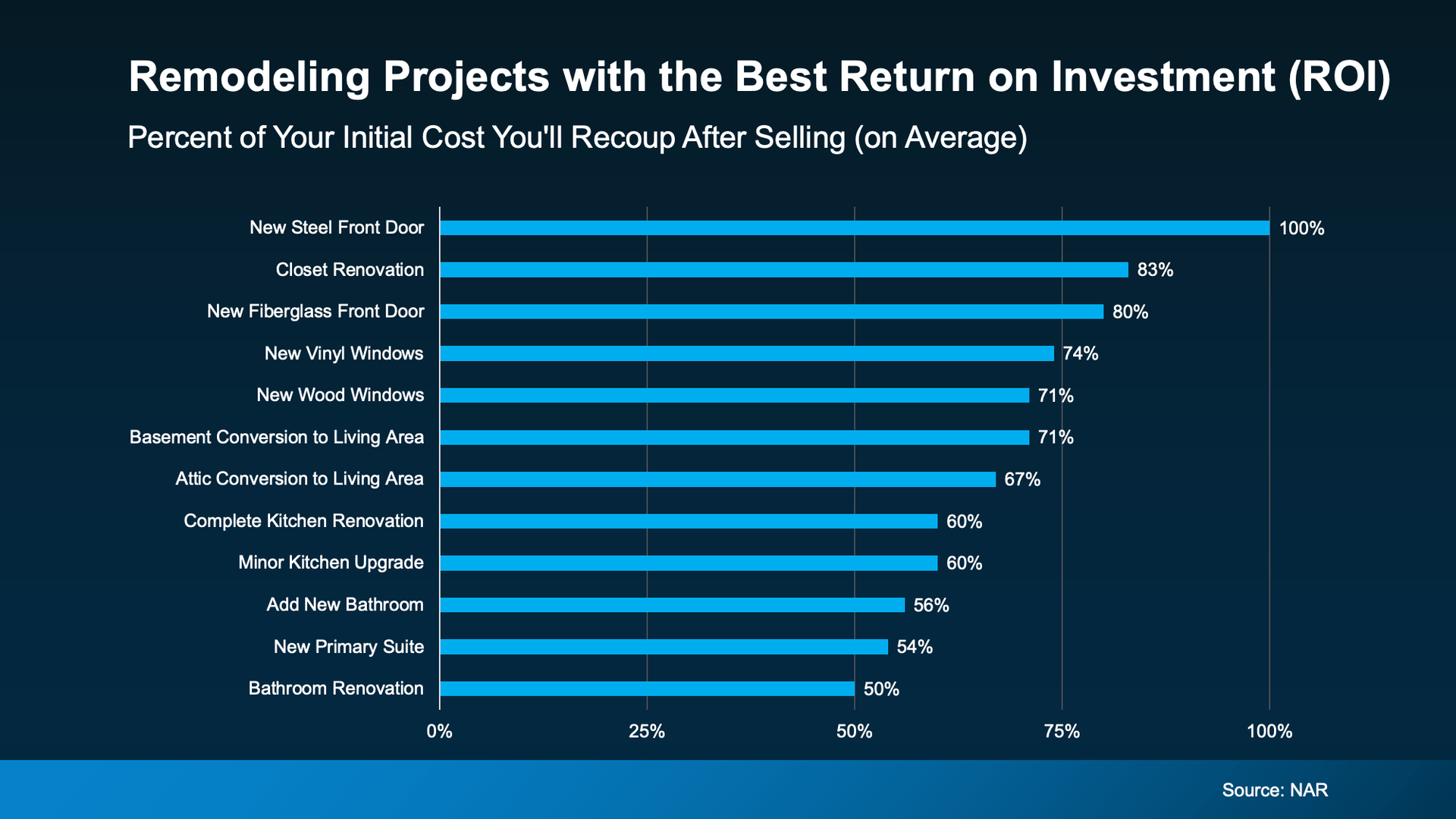
As you can see, there’s a wide range of projects on that list. Yes, some are bigger-ticket items, like kitchens or baths. But others are smaller updates with surprisingly strong ROI.


A new front door is a great project. But it’s not something to use your equity for. But revamping your kitchen? That’s where your equity can come in and lighten the load.


Where To Go from Here


Whether the project you’ve been thinking about is on this list or not, chat with an agent to make sure it’s worth the time, money, and effort before calling in any contractors.


Because the goal isn’t to do everything, it’s to invest where it counts.


And if you want to use your equity to get one of the bigger projects done, meet with a financial advisor too. Because you’ll want to make sure you’ll maintain a good loan-to-value (LTV) threshold even after using your equity. That way you have all the information you need to make your decision.


Bottom Line


Whether you’re selling next year or just giving your house some TLC, the right home improvements today can set you up for success tomorrow. And the best part? Your equity may be the key to making it happen.


What’s one upgrade you’ve been thinking about – and wondering if it’s worth it?


Let’s have a quick conversation about whether it’s the right decision for your home.
March 30, 2026
The body content of your post goes here. To edit this text, click on it and delete this default text and start typing your own or paste your own from a different source.
March 13, 2026
Homeowners looking to sell usually want three things: plenty of interested buyers, strong offers, and a short timeline. Spring is the season that most often delivers all three. So, if a move has been on your mind this year, this is the window where momentum tends to work in your favor. Here’s what makes this season so powerful for sellers. 1. More Buyers Will Be Looking Typically speaking, in the housing market, there’s no more popular time to move than the Spring. Historically, data coming out of ShowingTime proves that’s when buyer activity peaks each year. Take a look for yourself ( see graph below ):
March 11, 2026
Mortgage rates have already dropped into the upper 5s twice this year. But after just a few days, they ticked back up into the low 6% range. If you saw that and thought, “Great. I missed it,” you’re not the only one. A lot of buyers are treating the 5s like some kind of magic number. As if moving from 6.1% to 5.99% suddenly changes everything . And from a mindset perspective, it does feel different. But here’s the part most people don’t actually run the math on. The Payment Difference Isn’t What You Think ' Let’s say you’re looking at a $500,000 home loan. At 6.1% , generally speaking, your principal and interest payment is roughly $3,030 per month. At 5.9%, it’s about $2,966 per month. That’s a difference of only $64 a month. Not $300. Not $500. Sixty dollars. Let that sink in for just a moment. 
February 28, 2026
There’s one decision you're going to make when you sell that determines whether your house sells quickly, or it sits. Whether buyers make an offer, or scroll past it. Whether you walk away with the maximum return, or you end up cutting the price later. And that’s your asking price . The #1 Mistake Sellers Make Today: Trusting the Wrong Number If you’re thinking of moving and trying to figure out what your house may sell for, it’s tempting to start with an online home value tool. They’re fast, free, and easy. And you don’t have to talk to anyone. But here’s the problem: they don’t know your house. And that can be a bigger drawback than you realize. Where Online Estimates Fall Short Online tools often lag behind the market. They look in the rearview mirror, relying on closed sales and delayed information. And in that sense, they’re using incomplete data . That’s not a miss in how these systems are built. Some information just isn’t available online. Bankrate explains: “ While these tools can be a useful starting point, keep in mind that they typically do not provide the most accurate pricing. Algorithms can only rely on the information available; they can’t account for things like a home’s condition or renovations made since the last public information was updated.” They can’t see: The unique features that make your house special All the work you’ve put in to keep it in good condition Or, how in-demand your specific neighborhood is right now So, while they may do a good job in some cases, they can’t be as accurate as a local agent who has boots on the ground day in and day out. In a market where buyers have more options, a seemingly small margin of error can cost you thousands if you price too low, or weeks of lost momentum and time if you price too high. If you want to sell for the most money and in the least amount of time, you don’t want the fast answer on how to price your house. You want the right one. That’s why the savviest homeowners today don’t rely on algorithms when it actually matters. They rely on people like me, your local Realtor who is in the trenches daily buying and selling homes for my clients. What an Expert Agent Brings to the Table According to 1000WATT , sellers overwhelmingly believe real estate agents have the best sense of a home’s true value, far more than any automated tools.
February 25, 2026
For a lot of parents or grandparents, watching a family member struggle to buy their first home right now is hard. That's because you saw firsthand how homeownership gave your life more stability and helped grow your net worth – and you want your loved ones to have those same opportunities. But with all the affordability challenges in recent years, that can feel like an uphill battle – even though it’s slowly improving lately. Here’s what you may not realize. You may be in a unique position to help (thanks to the equity in your current house). The Equity Advantage You May Not Be Thinking About You’ve likely owned your home for years, maybe even decades. And during that time, two things happened: Home values rose Your mortgage balance shrank (or you paid it off entirely) That combination has created substantial equity for many homeowners like you. And while you may think of that equity as something you want to have in your pocket for retirement, it can also serve another purpose: helping the next generation clear the biggest hurdle in their way. The #1 Thing Holding Young Buyers Back When John Burns Research & Consulting (JBREC) asked renters what’s keeping them from buying, the top answer wasn’t mortgage rates or home prices. It was the upfront cost, particularly saving enough for their down payment ( see graph below ): 
February 21, 2026
You may have heard homeowners today have a lot of equity built up. But what does that really mean? Let’s break it down. Because your equity isn’t just a number, it’s a powerful asset that can help you take your next big step in life. How Much Equity Does the Typical Homeowner Have? Here’s how it works. As you pay down your loan and home prices rise through the years, the share of your home that you own free and clear grows. That’s your equity . And according to data from the Census and ATTOM , two-thirds of homeowners have a substantial amount of it today. 39% own their home outright without owing anything on it. And another 27% have at least 50% equity in their homes ( see chart below ): 
February 18, 2026
At some point, a house that once felt perfect just… doesn’t anymore. Maybe you need more space. Maybe working from home turned your dining room into a permanent office. Maybe the layout just doesn’t match how you live now. If your current house is starting to feel like it’s holding you back instead of supporting your life, it’s natural to think about making a move . But that brings up the next big question: once you sell, where do you go ? For a growing number of buyers , the answer is something brand new. New Construction Is a More Popular Choice Lately According to the National Association of Realtors (NAR), more people are buying new homes than they have in years. The latest annual data available shows 16% of homes purchased were newly built. At first glance you may not see why that’s a big deal. But that’s actually the highest share of new home purchases in almost two decades. Why More Buyers Are Choosing a Brand-New Construction For many buyers, especially move-up buyers, new construction isn’t just about aesthetics. It’s about lifestyle, convenience, and peace of mind. 1. Everything Is Brand New You’re not inheriting someone else’s projects. No wondering how old the roof is. No budgeting for a new HVAC right after move-in. No big surprises when the previous owners patch job fails. For move-up buyers who’ve been dumping money into updating their current house, that’s a win. 2. You Can Customize Before Move In If you choose a home that's still under construction, you could have the chance to pick the flooring, counters, cabinets, hardware, lighting, and so much more. That level of personalization can be a draw for move-up buyers like you, because it allows you to hand pick the fit and finishes you've been wanting for so long. 3. A Home Designed for How People Live Today Most new construction homes are built to current building standards and buyer preferences, which means you could see built-in smart home features, better energy efficiency (which can lower utility bills), and even more modern floor plans and features. And if your layout just isn’t working for you anymore, you may find exactly what you need now in a new home. 4. Neighborhood Amenities New developments often include shared community spaces like walking trails, parks, playgrounds, or even pools and gyms. For families and active households, that’s a big bonus to have that just a few steps out of their front door. 5. Builder Incentives Not to mention, since there are more new homes on the market than the norm, builders are motivated to sell what they have. So, you may find they’re more willing to negotiate than you’d expect on things like price, upgrades, and more. Bottom Line I know, you may be reading this and wondering how come I am posting a blog about new construction when I’m a resale agent. The reality is I actually sell brand new homes as well as resale homes. Many of my clients would prefer to buy a new home for many different reasons as listed above. If you’re looking to make a move within Roseville, Rocklin, Sacramento, Folsom, or even El Dorado Hills or Granite Bay. There are some new home builders available that have some great options for many different price points. If your current house isn’t meeting your needs anymore, don’t assume your only choice is an existing home. New construction is becoming a real contender, especially for move-up buyers who want space, features, and a home that works for how they live now. Curious whether new construction might be a fit for you? Let’s chat. 
February 14, 2026
If you’re planning to buy a home this year, you may be focused on the spring market. And hoping that when spring does hit, you’ll see: Mortgage rates drop a little more. More homes hit the market. But here’s what most buyers don’t realize. Buying just a few weeks earlier could mean paying less, dealing with less stress, and feeling less rushed. Here are three reasons why accelerating your timeline over the next few weeks could actually be a better play. 1. Holding Out for Lower Rates May Not Pay Off A lot of buyers are hoping mortgage rates will fall even further. But that’s not the best strategy. Here’s why. Experts are pretty aligned on this: rates are expected to stay roughly where they are. Forecasts throughout the industry all point to the same thing: rates are projected to be in the low-6% range this year ( see graph below ) : 
February 12, 2026
There’s finally a little good news for anyone who’s been priced out or sitting on the sidelines. Buying a home is getting more affordable. Monthly payments have started to come down, and the squeeze buyers have been feeling for the past few years is slowly loosening. Now, that doesn’t mean everyone can suddenly afford a home, but with how tough the market’s been, the improvement we’re seeing matters. Affordability Is Finally Moving in the Right Direction One of the best ways to see this shift is by looking at how much of a household’s income it takes to buy a home. According to Zillow , housing is typically considered affordable when it takes 30% or less of your monthly income to cover your expenses. That includes your mortgage payment, taxes, insurance , and basic maintenance. For the past few years, the math was well above that threshold, and it made buying a home unachievable for many. But now, we’re slowly moving back toward a balance. Zillow research shows it’s taking less of a typical household’s income to buy a home than it did just a few years ago ( see graph below ): 
February 7, 2026
For a growing number of homeowners, retirement isn’t some distant idea anymore. It’s starting to feel very real. According to Realtor.com and the Census , nearly 12,000 people will turn 65 every day for the next two years . And the latest data shows as many as 15% of those older Americans are planning to retire in 2026. And another 23% will do the same in 2027. If you’re considering retiring soon too, here’s what you should be thinking about. Why Downsize? Now's the perfect time to reflect on what you want your life to look like in retirement. Because even though your finances will be going through a big change, you don’t necessarily want to feel like you’re living with less . But odds are, what you do want is for life to feel easier . Easier to enjoy. Easier to manage. Easier to maintain day-to-day. The Top Reasons People Over 60 Move You can see these benefits show up in the data when you look at why people over 60 are moving. The National Association of Realtors (NAR) finds the top 4 reasons aren’t about timing the market or chasing top dollar. They’re about lifestyle: Being closer to children, grandchildren, or long-time friends so it’s easier to spend more time with the people who matter most Wanting a smaller, more functional home with fewer stairs and easier upkeep Retiring and no longer needing to live near the office, so it’s easier to move wherever you want Opting for something smaller to reduce monthly expenses tied to utilities, insurance, and maintenance 
Show More
March 30, 2026
The body content of your post goes here. To edit this text, click on it and delete this default text and start typing your own or paste your own from a different source.
March 13, 2026
Homeowners looking to sell usually want three things: plenty of interested buyers, strong offers, and a short timeline. Spring is the season that most often delivers all three. So, if a move has been on your mind this year, this is the window where momentum tends to work in your favor. Here’s what makes this season so powerful for sellers. 1. More Buyers Will Be Looking Typically speaking, in the housing market, there’s no more popular time to move than the Spring. Historically, data coming out of ShowingTime proves that’s when buyer activity peaks each year. Take a look for yourself ( see graph below ):
March 11, 2026
Mortgage rates have already dropped into the upper 5s twice this year. But after just a few days, they ticked back up into the low 6% range. If you saw that and thought, “Great. I missed it,” you’re not the only one. A lot of buyers are treating the 5s like some kind of magic number. As if moving from 6.1% to 5.99% suddenly changes everything . And from a mindset perspective, it does feel different. But here’s the part most people don’t actually run the math on. The Payment Difference Isn’t What You Think ' Let’s say you’re looking at a $500,000 home loan. At 6.1% , generally speaking, your principal and interest payment is roughly $3,030 per month. At 5.9%, it’s about $2,966 per month. That’s a difference of only $64 a month. Not $300. Not $500. Sixty dollars. Let that sink in for just a moment. 
February 28, 2026
There’s one decision you're going to make when you sell that determines whether your house sells quickly, or it sits. Whether buyers make an offer, or scroll past it. Whether you walk away with the maximum return, or you end up cutting the price later. And that’s your asking price . The #1 Mistake Sellers Make Today: Trusting the Wrong Number If you’re thinking of moving and trying to figure out what your house may sell for, it’s tempting to start with an online home value tool. They’re fast, free, and easy. And you don’t have to talk to anyone. But here’s the problem: they don’t know your house. And that can be a bigger drawback than you realize. Where Online Estimates Fall Short Online tools often lag behind the market. They look in the rearview mirror, relying on closed sales and delayed information. And in that sense, they’re using incomplete data . That’s not a miss in how these systems are built. Some information just isn’t available online. Bankrate explains: “ While these tools can be a useful starting point, keep in mind that they typically do not provide the most accurate pricing. Algorithms can only rely on the information available; they can’t account for things like a home’s condition or renovations made since the last public information was updated.” They can’t see: The unique features that make your house special All the work you’ve put in to keep it in good condition Or, how in-demand your specific neighborhood is right now So, while they may do a good job in some cases, they can’t be as accurate as a local agent who has boots on the ground day in and day out. In a market where buyers have more options, a seemingly small margin of error can cost you thousands if you price too low, or weeks of lost momentum and time if you price too high. If you want to sell for the most money and in the least amount of time, you don’t want the fast answer on how to price your house. You want the right one. That’s why the savviest homeowners today don’t rely on algorithms when it actually matters. They rely on people like me, your local Realtor who is in the trenches daily buying and selling homes for my clients. What an Expert Agent Brings to the Table According to 1000WATT , sellers overwhelmingly believe real estate agents have the best sense of a home’s true value, far more than any automated tools.
February 25, 2026
For a lot of parents or grandparents, watching a family member struggle to buy their first home right now is hard. That's because you saw firsthand how homeownership gave your life more stability and helped grow your net worth – and you want your loved ones to have those same opportunities. But with all the affordability challenges in recent years, that can feel like an uphill battle – even though it’s slowly improving lately. Here’s what you may not realize. You may be in a unique position to help (thanks to the equity in your current house). The Equity Advantage You May Not Be Thinking About You’ve likely owned your home for years, maybe even decades. And during that time, two things happened: Home values rose Your mortgage balance shrank (or you paid it off entirely) That combination has created substantial equity for many homeowners like you. And while you may think of that equity as something you want to have in your pocket for retirement, it can also serve another purpose: helping the next generation clear the biggest hurdle in their way. The #1 Thing Holding Young Buyers Back When John Burns Research & Consulting (JBREC) asked renters what’s keeping them from buying, the top answer wasn’t mortgage rates or home prices. It was the upfront cost, particularly saving enough for their down payment ( see graph below ): 
February 21, 2026
You may have heard homeowners today have a lot of equity built up. But what does that really mean? Let’s break it down. Because your equity isn’t just a number, it’s a powerful asset that can help you take your next big step in life. How Much Equity Does the Typical Homeowner Have? Here’s how it works. As you pay down your loan and home prices rise through the years, the share of your home that you own free and clear grows. That’s your equity . And according to data from the Census and ATTOM , two-thirds of homeowners have a substantial amount of it today. 39% own their home outright without owing anything on it. And another 27% have at least 50% equity in their homes ( see chart below ): 
February 18, 2026
At some point, a house that once felt perfect just… doesn’t anymore. Maybe you need more space. Maybe working from home turned your dining room into a permanent office. Maybe the layout just doesn’t match how you live now. If your current house is starting to feel like it’s holding you back instead of supporting your life, it’s natural to think about making a move . But that brings up the next big question: once you sell, where do you go ? For a growing number of buyers , the answer is something brand new. New Construction Is a More Popular Choice Lately According to the National Association of Realtors (NAR), more people are buying new homes than they have in years. The latest annual data available shows 16% of homes purchased were newly built. At first glance you may not see why that’s a big deal. But that’s actually the highest share of new home purchases in almost two decades. Why More Buyers Are Choosing a Brand-New Construction For many buyers, especially move-up buyers, new construction isn’t just about aesthetics. It’s about lifestyle, convenience, and peace of mind. 1. Everything Is Brand New You’re not inheriting someone else’s projects. No wondering how old the roof is. No budgeting for a new HVAC right after move-in. No big surprises when the previous owners patch job fails. For move-up buyers who’ve been dumping money into updating their current house, that’s a win. 2. You Can Customize Before Move In If you choose a home that's still under construction, you could have the chance to pick the flooring, counters, cabinets, hardware, lighting, and so much more. That level of personalization can be a draw for move-up buyers like you, because it allows you to hand pick the fit and finishes you've been wanting for so long. 3. A Home Designed for How People Live Today Most new construction homes are built to current building standards and buyer preferences, which means you could see built-in smart home features, better energy efficiency (which can lower utility bills), and even more modern floor plans and features. And if your layout just isn’t working for you anymore, you may find exactly what you need now in a new home. 4. Neighborhood Amenities New developments often include shared community spaces like walking trails, parks, playgrounds, or even pools and gyms. For families and active households, that’s a big bonus to have that just a few steps out of their front door. 5. Builder Incentives Not to mention, since there are more new homes on the market than the norm, builders are motivated to sell what they have. So, you may find they’re more willing to negotiate than you’d expect on things like price, upgrades, and more. Bottom Line I know, you may be reading this and wondering how come I am posting a blog about new construction when I’m a resale agent. The reality is I actually sell brand new homes as well as resale homes. Many of my clients would prefer to buy a new home for many different reasons as listed above. If you’re looking to make a move within Roseville, Rocklin, Sacramento, Folsom, or even El Dorado Hills or Granite Bay. There are some new home builders available that have some great options for many different price points. If your current house isn’t meeting your needs anymore, don’t assume your only choice is an existing home. New construction is becoming a real contender, especially for move-up buyers who want space, features, and a home that works for how they live now. Curious whether new construction might be a fit for you? Let’s chat. 
February 14, 2026
If you’re planning to buy a home this year, you may be focused on the spring market. And hoping that when spring does hit, you’ll see: Mortgage rates drop a little more. More homes hit the market. But here’s what most buyers don’t realize. Buying just a few weeks earlier could mean paying less, dealing with less stress, and feeling less rushed. Here are three reasons why accelerating your timeline over the next few weeks could actually be a better play. 1. Holding Out for Lower Rates May Not Pay Off A lot of buyers are hoping mortgage rates will fall even further. But that’s not the best strategy. Here’s why. Experts are pretty aligned on this: rates are expected to stay roughly where they are. Forecasts throughout the industry all point to the same thing: rates are projected to be in the low-6% range this year ( see graph below ) : 
February 12, 2026
There’s finally a little good news for anyone who’s been priced out or sitting on the sidelines. Buying a home is getting more affordable. Monthly payments have started to come down, and the squeeze buyers have been feeling for the past few years is slowly loosening. Now, that doesn’t mean everyone can suddenly afford a home, but with how tough the market’s been, the improvement we’re seeing matters. Affordability Is Finally Moving in the Right Direction One of the best ways to see this shift is by looking at how much of a household’s income it takes to buy a home. According to Zillow , housing is typically considered affordable when it takes 30% or less of your monthly income to cover your expenses. That includes your mortgage payment, taxes, insurance , and basic maintenance. For the past few years, the math was well above that threshold, and it made buying a home unachievable for many. But now, we’re slowly moving back toward a balance. Zillow research shows it’s taking less of a typical household’s income to buy a home than it did just a few years ago ( see graph below ): 
February 7, 2026
For a growing number of homeowners, retirement isn’t some distant idea anymore. It’s starting to feel very real. According to Realtor.com and the Census , nearly 12,000 people will turn 65 every day for the next two years . And the latest data shows as many as 15% of those older Americans are planning to retire in 2026. And another 23% will do the same in 2027. If you’re considering retiring soon too, here’s what you should be thinking about. Why Downsize? Now's the perfect time to reflect on what you want your life to look like in retirement. Because even though your finances will be going through a big change, you don’t necessarily want to feel like you’re living with less . But odds are, what you do want is for life to feel easier . Easier to enjoy. Easier to manage. Easier to maintain day-to-day. The Top Reasons People Over 60 Move You can see these benefits show up in the data when you look at why people over 60 are moving. The National Association of Realtors (NAR) finds the top 4 reasons aren’t about timing the market or chasing top dollar. They’re about lifestyle: Being closer to children, grandchildren, or long-time friends so it’s easier to spend more time with the people who matter most Wanting a smaller, more functional home with fewer stairs and easier upkeep Retiring and no longer needing to live near the office, so it’s easier to move wherever you want Opting for something smaller to reduce monthly expenses tied to utilities, insurance, and maintenance 
Show More