The #1 Thing Sellers Need To Know About Their Asking Price
April 11, 2025

When you put your house on the market, you want to sell it quickly and for the best price possible; that's generally the goal. But too many sellers are shooting too high right now. They don’t realize the market has shifted as inventory has grown. The side effect? Price cuts are on the rise, but they really don’t have to be. Here’s why.


According to data from Realtor.com, in February, price cuts were the highest they’ve been in any other February since 2019 (see graph below):
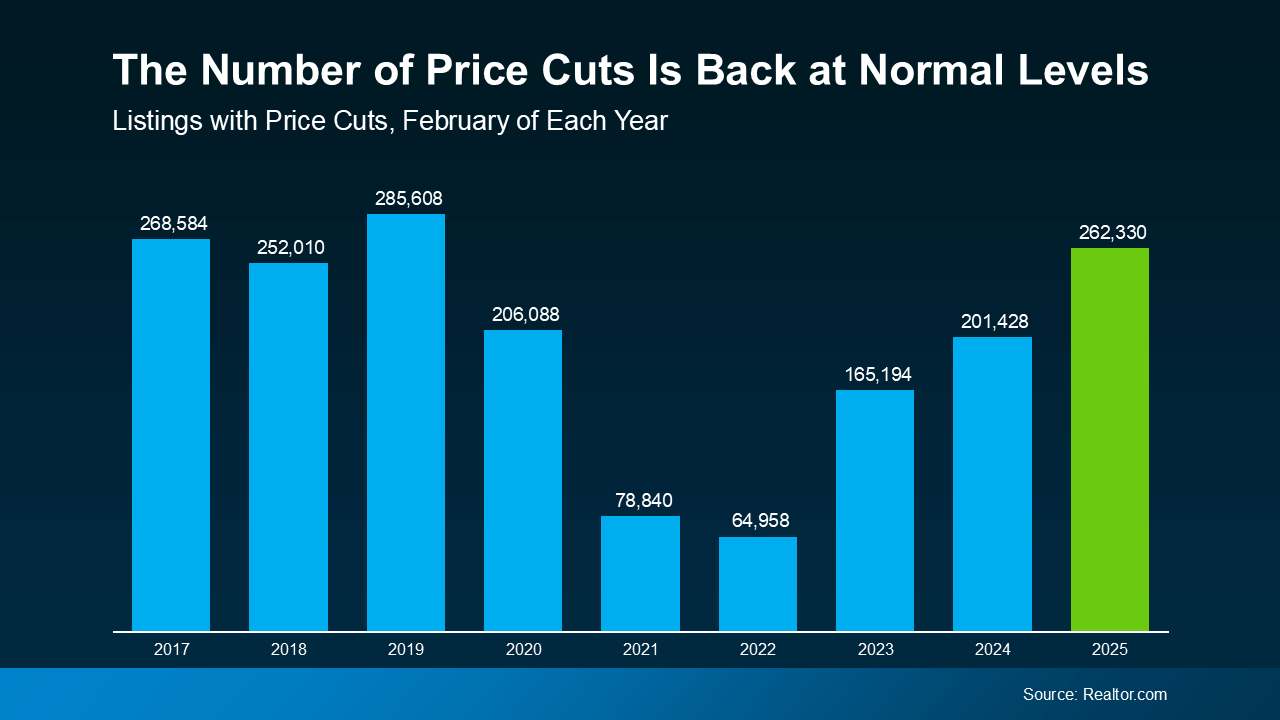
If you consider that 2019 was the last true normal year for the housing market – that's a big deal. We’re getting back to what’s typical for the market.


This isn’t the same frenzied seller’s market we saw a few years ago. You may not get the same price your neighbor did at the height of the pandemic. And that means you may need to reset your expectations.


Because here’s the reality. If you shoot too high and have to lower your price after the fact, you could actually end up walking away with lower offers than if you’d priced it right from the start. So, how do you avoid that? You lean on your agent.


How an Agent Helps You Nail the Right Price


A great agent doesn’t just pull a number out of thin air. They’ll use real data and market trends to make sure your house is priced based on what your specific home is valued at today. So, you’re setting a realistic price – one that’ll draw in serious buyers.


And based on your agent’s analysis of your local market, they may even recommend strategically pricing slightly below market value to help your house attract more eyes and more competitive offers. Here’s how your agent will determine the right number for your house:


  • They look at recent sales. What did similar homes in your area actually sell for? Not list for, sell for.
  • They analyze local market trends. Your home’s value isn’t just about what you want for it, it’s about what buyers in your area are willing to pay.
  • They craft the right strategy. 
  • They’ll make sure your home is priced to attract attention and create a sense of urgency among buyers.


Why Overpricing Backfires


Unfortunately, some sellers still ignore their agent’s advice and prefer to start high just to see what happens. The hope being maybe they get their full asking price, or they at least have more wiggle room for negotiation. But pricing high usually ends up costing you, and here’s why:


  • Buyers may not even look at it. Today’s buyers are more budget-conscious than ever. If they see a home that seems overpriced, they’re likely to skip it completely rather than try to negotiate.
  • It could sit on the market for too long. The longer your home sits unsold, the more buyers will assume something’s wrong with it. That can make it even harder to sell down the line.
  • You might end up getting less
  • . Homes that require a price cut often sell for less than they would have if they had been priced right from the start.


You can see that shake out in the graph below. It uses data from the National Association of Realtors (NAR) to show that the longer a house sits, the less it’ll sell for:
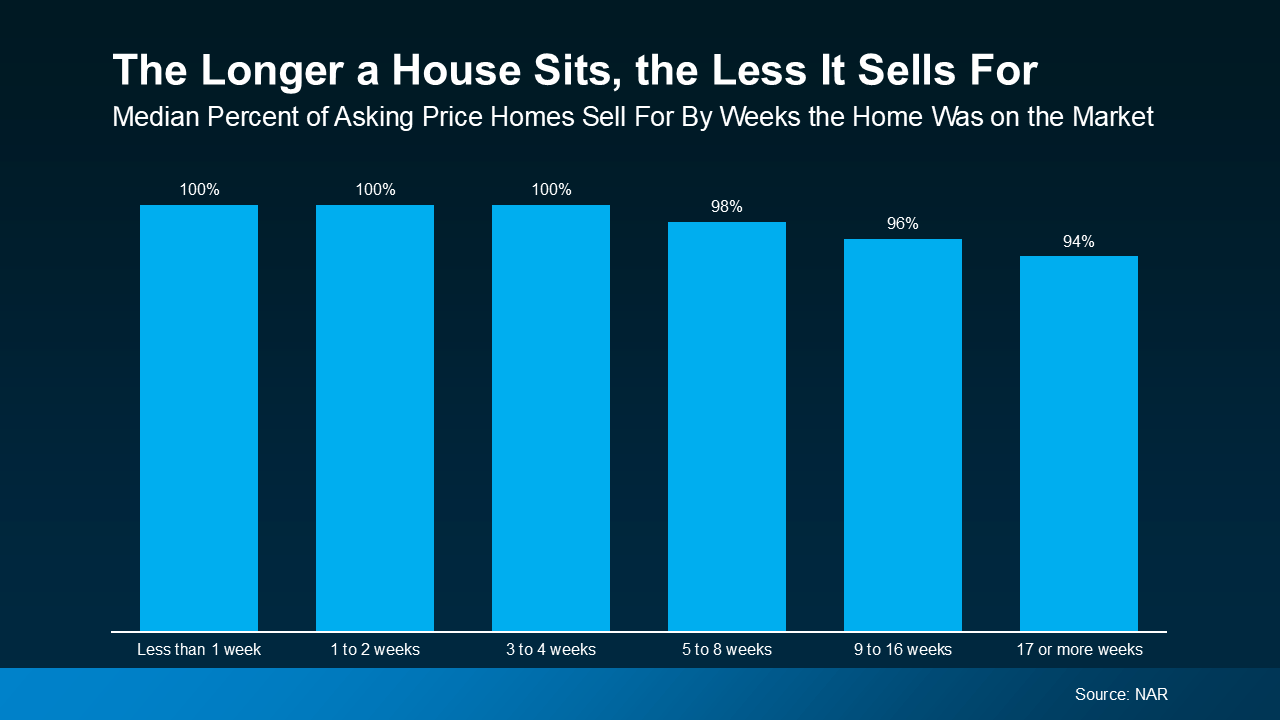
This graph shows that if a house sells within the first 4 weeks it is listed, it usually goes for full price. Based on experience, that's what usually happens to homes that are priced at or just below current market value. If it’s priced right, buyers will be interested, and, ultimately, willing to pay the asking price – or compete with other buyers and even go over asking.


But if a house isn’t priced right, it doesn’t sell as quickly. And this graph shows that, after the first 4 weeks on the market, the price starts to drop from there. That’s because buyer interest falls off the longer it sits. So, it becomes more likely a seller will either accept a lower offer because that’s all they have, or opt to do a price drop to draw people back in.


Bottom Line


The last thing you want is to list too high, watch your house sit, and then have to drop the price just to get attention. Let’s connect so that doesn’t happen to you.


Want to make sure your home sells quickly and for the best price? Let’s go over the right pricing strategy for your house.


March 13, 2026
Homeowners looking to sell usually want three things: plenty of interested buyers, strong offers, and a short timeline. Spring is the season that most often delivers all three. So, if a move has been on your mind this year, this is the window where momentum tends to work in your favor. Here’s what makes this season so powerful for sellers. 1. More Buyers Will Be Looking Typically speaking, in the housing market, there’s no more popular time to move than the Spring. Historically, data coming out of ShowingTime proves that’s when buyer activity peaks each year. Take a look for yourself ( see graph below ):
March 11, 2026
Mortgage rates have already dropped into the upper 5s twice this year. But after just a few days, they ticked back up into the low 6% range. If you saw that and thought, “Great. I missed it,” you’re not the only one. A lot of buyers are treating the 5s like some kind of magic number. As if moving from 6.1% to 5.99% suddenly changes everything . And from a mindset perspective, it does feel different. But here’s the part most people don’t actually run the math on. The Payment Difference Isn’t What You Think ' Let’s say you’re looking at a $500,000 home loan. At 6.1% , generally speaking, your principal and interest payment is roughly $3,030 per month. At 5.9%, it’s about $2,966 per month. That’s a difference of only $64 a month. Not $300. Not $500. Sixty dollars. Let that sink in for just a moment. 
February 28, 2026
There’s one decision you're going to make when you sell that determines whether your house sells quickly, or it sits. Whether buyers make an offer, or scroll past it. Whether you walk away with the maximum return, or you end up cutting the price later. And that’s your asking price . The #1 Mistake Sellers Make Today: Trusting the Wrong Number If you’re thinking of moving and trying to figure out what your house may sell for, it’s tempting to start with an online home value tool. They’re fast, free, and easy. And you don’t have to talk to anyone. But here’s the problem: they don’t know your house. And that can be a bigger drawback than you realize. Where Online Estimates Fall Short Online tools often lag behind the market. They look in the rearview mirror, relying on closed sales and delayed information. And in that sense, they’re using incomplete data . That’s not a miss in how these systems are built. Some information just isn’t available online. Bankrate explains: “ While these tools can be a useful starting point, keep in mind that they typically do not provide the most accurate pricing. Algorithms can only rely on the information available; they can’t account for things like a home’s condition or renovations made since the last public information was updated.” They can’t see: The unique features that make your house special All the work you’ve put in to keep it in good condition Or, how in-demand your specific neighborhood is right now So, while they may do a good job in some cases, they can’t be as accurate as a local agent who has boots on the ground day in and day out. In a market where buyers have more options, a seemingly small margin of error can cost you thousands if you price too low, or weeks of lost momentum and time if you price too high. If you want to sell for the most money and in the least amount of time, you don’t want the fast answer on how to price your house. You want the right one. That’s why the savviest homeowners today don’t rely on algorithms when it actually matters. They rely on people like me, your local Realtor who is in the trenches daily buying and selling homes for my clients. What an Expert Agent Brings to the Table According to 1000WATT , sellers overwhelmingly believe real estate agents have the best sense of a home’s true value, far more than any automated tools.
February 25, 2026
For a lot of parents or grandparents, watching a family member struggle to buy their first home right now is hard. That's because you saw firsthand how homeownership gave your life more stability and helped grow your net worth – and you want your loved ones to have those same opportunities. But with all the affordability challenges in recent years, that can feel like an uphill battle – even though it’s slowly improving lately. Here’s what you may not realize. You may be in a unique position to help (thanks to the equity in your current house). The Equity Advantage You May Not Be Thinking About You’ve likely owned your home for years, maybe even decades. And during that time, two things happened: Home values rose Your mortgage balance shrank (or you paid it off entirely) That combination has created substantial equity for many homeowners like you. And while you may think of that equity as something you want to have in your pocket for retirement, it can also serve another purpose: helping the next generation clear the biggest hurdle in their way. The #1 Thing Holding Young Buyers Back When John Burns Research & Consulting (JBREC) asked renters what’s keeping them from buying, the top answer wasn’t mortgage rates or home prices. It was the upfront cost, particularly saving enough for their down payment ( see graph below ): 
February 21, 2026
You may have heard homeowners today have a lot of equity built up. But what does that really mean? Let’s break it down. Because your equity isn’t just a number, it’s a powerful asset that can help you take your next big step in life. How Much Equity Does the Typical Homeowner Have? Here’s how it works. As you pay down your loan and home prices rise through the years, the share of your home that you own free and clear grows. That’s your equity . And according to data from the Census and ATTOM , two-thirds of homeowners have a substantial amount of it today. 39% own their home outright without owing anything on it. And another 27% have at least 50% equity in their homes ( see chart below ): 
February 18, 2026
At some point, a house that once felt perfect just… doesn’t anymore. Maybe you need more space. Maybe working from home turned your dining room into a permanent office. Maybe the layout just doesn’t match how you live now. If your current house is starting to feel like it’s holding you back instead of supporting your life, it’s natural to think about making a move . But that brings up the next big question: once you sell, where do you go ? For a growing number of buyers , the answer is something brand new. New Construction Is a More Popular Choice Lately According to the National Association of Realtors (NAR), more people are buying new homes than they have in years. The latest annual data available shows 16% of homes purchased were newly built. At first glance you may not see why that’s a big deal. But that’s actually the highest share of new home purchases in almost two decades. Why More Buyers Are Choosing a Brand-New Construction For many buyers, especially move-up buyers, new construction isn’t just about aesthetics. It’s about lifestyle, convenience, and peace of mind. 1. Everything Is Brand New You’re not inheriting someone else’s projects. No wondering how old the roof is. No budgeting for a new HVAC right after move-in. No big surprises when the previous owners patch job fails. For move-up buyers who’ve been dumping money into updating their current house, that’s a win. 2. You Can Customize Before Move In If you choose a home that's still under construction, you could have the chance to pick the flooring, counters, cabinets, hardware, lighting, and so much more. That level of personalization can be a draw for move-up buyers like you, because it allows you to hand pick the fit and finishes you've been wanting for so long. 3. A Home Designed for How People Live Today Most new construction homes are built to current building standards and buyer preferences, which means you could see built-in smart home features, better energy efficiency (which can lower utility bills), and even more modern floor plans and features. And if your layout just isn’t working for you anymore, you may find exactly what you need now in a new home. 4. Neighborhood Amenities New developments often include shared community spaces like walking trails, parks, playgrounds, or even pools and gyms. For families and active households, that’s a big bonus to have that just a few steps out of their front door. 5. Builder Incentives Not to mention, since there are more new homes on the market than the norm, builders are motivated to sell what they have. So, you may find they’re more willing to negotiate than you’d expect on things like price, upgrades, and more. Bottom Line I know, you may be reading this and wondering how come I am posting a blog about new construction when I’m a resale agent. The reality is I actually sell brand new homes as well as resale homes. Many of my clients would prefer to buy a new home for many different reasons as listed above. If you’re looking to make a move within Roseville, Rocklin, Sacramento, Folsom, or even El Dorado Hills or Granite Bay. There are some new home builders available that have some great options for many different price points. If your current house isn’t meeting your needs anymore, don’t assume your only choice is an existing home. New construction is becoming a real contender, especially for move-up buyers who want space, features, and a home that works for how they live now. Curious whether new construction might be a fit for you? Let’s chat. 
February 14, 2026
If you’re planning to buy a home this year, you may be focused on the spring market. And hoping that when spring does hit, you’ll see: Mortgage rates drop a little more. More homes hit the market. But here’s what most buyers don’t realize. Buying just a few weeks earlier could mean paying less, dealing with less stress, and feeling less rushed. Here are three reasons why accelerating your timeline over the next few weeks could actually be a better play. 1. Holding Out for Lower Rates May Not Pay Off A lot of buyers are hoping mortgage rates will fall even further. But that’s not the best strategy. Here’s why. Experts are pretty aligned on this: rates are expected to stay roughly where they are. Forecasts throughout the industry all point to the same thing: rates are projected to be in the low-6% range this year ( see graph below ) : 
February 12, 2026
There’s finally a little good news for anyone who’s been priced out or sitting on the sidelines. Buying a home is getting more affordable. Monthly payments have started to come down, and the squeeze buyers have been feeling for the past few years is slowly loosening. Now, that doesn’t mean everyone can suddenly afford a home, but with how tough the market’s been, the improvement we’re seeing matters. Affordability Is Finally Moving in the Right Direction One of the best ways to see this shift is by looking at how much of a household’s income it takes to buy a home. According to Zillow , housing is typically considered affordable when it takes 30% or less of your monthly income to cover your expenses. That includes your mortgage payment, taxes, insurance , and basic maintenance. For the past few years, the math was well above that threshold, and it made buying a home unachievable for many. But now, we’re slowly moving back toward a balance. Zillow research shows it’s taking less of a typical household’s income to buy a home than it did just a few years ago ( see graph below ): 
February 7, 2026
For a growing number of homeowners, retirement isn’t some distant idea anymore. It’s starting to feel very real. According to Realtor.com and the Census , nearly 12,000 people will turn 65 every day for the next two years . And the latest data shows as many as 15% of those older Americans are planning to retire in 2026. And another 23% will do the same in 2027. If you’re considering retiring soon too, here’s what you should be thinking about. Why Downsize? Now's the perfect time to reflect on what you want your life to look like in retirement. Because even though your finances will be going through a big change, you don’t necessarily want to feel like you’re living with less . But odds are, what you do want is for life to feel easier . Easier to enjoy. Easier to manage. Easier to maintain day-to-day. The Top Reasons People Over 60 Move You can see these benefits show up in the data when you look at why people over 60 are moving. The National Association of Realtors (NAR) finds the top 4 reasons aren’t about timing the market or chasing top dollar. They’re about lifestyle: Being closer to children, grandchildren, or long-time friends so it’s easier to spend more time with the people who matter most Wanting a smaller, more functional home with fewer stairs and easier upkeep Retiring and no longer needing to live near the office, so it’s easier to move wherever you want Opting for something smaller to reduce monthly expenses tied to utilities, insurance, and maintenance 
February 3, 2026
Buying a home is one of the biggest purchases you’ll ever make. And homeowner’s insurance is what protects that investment. Think of it as your safety net. NerdWallet explains it: Covers Repairs and Rebuilding Costs : If your home is damaged by fire, storms, or other covered events, it helps pay for repairs and possibly even a full rebuild, if that’s deemed necessary. Protects Your Belongings : It can also cover personal items like furniture, electronics, jewelry, and clothing if they’re stolen or damaged. Provides Liability Coverage : And, if someone gets injured on your property, your policy can help cover medical bills or legal expenses. But that peace of mind does come with a cost, and lately those costs have been rising. Why Home Insurance Premiums Are Going Up There are a number of factors causing insurance premiums to rise today. But, in the simplest sense, here’s what’s driving prices up according to the Insurance Research Council (IRC). Severe weather events and natural disasters are happening increasingly often, leading to more claims. At the same time, homebuilding materials and labor are more expensive. So, when it comes time to work on those claims, insurers have to manage higher costs to repair or rebuild the affected homes. That combination adds up to higher premiums. You can see how it’s climbed recently in the graph below. Each bar marks the percentage increase in insurance costs for that calendar year. 
Show More
March 13, 2026
Homeowners looking to sell usually want three things: plenty of interested buyers, strong offers, and a short timeline. Spring is the season that most often delivers all three. So, if a move has been on your mind this year, this is the window where momentum tends to work in your favor. Here’s what makes this season so powerful for sellers. 1. More Buyers Will Be Looking Typically speaking, in the housing market, there’s no more popular time to move than the Spring. Historically, data coming out of ShowingTime proves that’s when buyer activity peaks each year. Take a look for yourself ( see graph below ):
March 11, 2026
Mortgage rates have already dropped into the upper 5s twice this year. But after just a few days, they ticked back up into the low 6% range. If you saw that and thought, “Great. I missed it,” you’re not the only one. A lot of buyers are treating the 5s like some kind of magic number. As if moving from 6.1% to 5.99% suddenly changes everything . And from a mindset perspective, it does feel different. But here’s the part most people don’t actually run the math on. The Payment Difference Isn’t What You Think ' Let’s say you’re looking at a $500,000 home loan. At 6.1% , generally speaking, your principal and interest payment is roughly $3,030 per month. At 5.9%, it’s about $2,966 per month. That’s a difference of only $64 a month. Not $300. Not $500. Sixty dollars. Let that sink in for just a moment. 
February 28, 2026
There’s one decision you're going to make when you sell that determines whether your house sells quickly, or it sits. Whether buyers make an offer, or scroll past it. Whether you walk away with the maximum return, or you end up cutting the price later. And that’s your asking price . The #1 Mistake Sellers Make Today: Trusting the Wrong Number If you’re thinking of moving and trying to figure out what your house may sell for, it’s tempting to start with an online home value tool. They’re fast, free, and easy. And you don’t have to talk to anyone. But here’s the problem: they don’t know your house. And that can be a bigger drawback than you realize. Where Online Estimates Fall Short Online tools often lag behind the market. They look in the rearview mirror, relying on closed sales and delayed information. And in that sense, they’re using incomplete data . That’s not a miss in how these systems are built. Some information just isn’t available online. Bankrate explains: “ While these tools can be a useful starting point, keep in mind that they typically do not provide the most accurate pricing. Algorithms can only rely on the information available; they can’t account for things like a home’s condition or renovations made since the last public information was updated.” They can’t see: The unique features that make your house special All the work you’ve put in to keep it in good condition Or, how in-demand your specific neighborhood is right now So, while they may do a good job in some cases, they can’t be as accurate as a local agent who has boots on the ground day in and day out. In a market where buyers have more options, a seemingly small margin of error can cost you thousands if you price too low, or weeks of lost momentum and time if you price too high. If you want to sell for the most money and in the least amount of time, you don’t want the fast answer on how to price your house. You want the right one. That’s why the savviest homeowners today don’t rely on algorithms when it actually matters. They rely on people like me, your local Realtor who is in the trenches daily buying and selling homes for my clients. What an Expert Agent Brings to the Table According to 1000WATT , sellers overwhelmingly believe real estate agents have the best sense of a home’s true value, far more than any automated tools.
February 25, 2026
For a lot of parents or grandparents, watching a family member struggle to buy their first home right now is hard. That's because you saw firsthand how homeownership gave your life more stability and helped grow your net worth – and you want your loved ones to have those same opportunities. But with all the affordability challenges in recent years, that can feel like an uphill battle – even though it’s slowly improving lately. Here’s what you may not realize. You may be in a unique position to help (thanks to the equity in your current house). The Equity Advantage You May Not Be Thinking About You’ve likely owned your home for years, maybe even decades. And during that time, two things happened: Home values rose Your mortgage balance shrank (or you paid it off entirely) That combination has created substantial equity for many homeowners like you. And while you may think of that equity as something you want to have in your pocket for retirement, it can also serve another purpose: helping the next generation clear the biggest hurdle in their way. The #1 Thing Holding Young Buyers Back When John Burns Research & Consulting (JBREC) asked renters what’s keeping them from buying, the top answer wasn’t mortgage rates or home prices. It was the upfront cost, particularly saving enough for their down payment ( see graph below ): 
February 21, 2026
You may have heard homeowners today have a lot of equity built up. But what does that really mean? Let’s break it down. Because your equity isn’t just a number, it’s a powerful asset that can help you take your next big step in life. How Much Equity Does the Typical Homeowner Have? Here’s how it works. As you pay down your loan and home prices rise through the years, the share of your home that you own free and clear grows. That’s your equity . And according to data from the Census and ATTOM , two-thirds of homeowners have a substantial amount of it today. 39% own their home outright without owing anything on it. And another 27% have at least 50% equity in their homes ( see chart below ): 
February 18, 2026
At some point, a house that once felt perfect just… doesn’t anymore. Maybe you need more space. Maybe working from home turned your dining room into a permanent office. Maybe the layout just doesn’t match how you live now. If your current house is starting to feel like it’s holding you back instead of supporting your life, it’s natural to think about making a move . But that brings up the next big question: once you sell, where do you go ? For a growing number of buyers , the answer is something brand new. New Construction Is a More Popular Choice Lately According to the National Association of Realtors (NAR), more people are buying new homes than they have in years. The latest annual data available shows 16% of homes purchased were newly built. At first glance you may not see why that’s a big deal. But that’s actually the highest share of new home purchases in almost two decades. Why More Buyers Are Choosing a Brand-New Construction For many buyers, especially move-up buyers, new construction isn’t just about aesthetics. It’s about lifestyle, convenience, and peace of mind. 1. Everything Is Brand New You’re not inheriting someone else’s projects. No wondering how old the roof is. No budgeting for a new HVAC right after move-in. No big surprises when the previous owners patch job fails. For move-up buyers who’ve been dumping money into updating their current house, that’s a win. 2. You Can Customize Before Move In If you choose a home that's still under construction, you could have the chance to pick the flooring, counters, cabinets, hardware, lighting, and so much more. That level of personalization can be a draw for move-up buyers like you, because it allows you to hand pick the fit and finishes you've been wanting for so long. 3. A Home Designed for How People Live Today Most new construction homes are built to current building standards and buyer preferences, which means you could see built-in smart home features, better energy efficiency (which can lower utility bills), and even more modern floor plans and features. And if your layout just isn’t working for you anymore, you may find exactly what you need now in a new home. 4. Neighborhood Amenities New developments often include shared community spaces like walking trails, parks, playgrounds, or even pools and gyms. For families and active households, that’s a big bonus to have that just a few steps out of their front door. 5. Builder Incentives Not to mention, since there are more new homes on the market than the norm, builders are motivated to sell what they have. So, you may find they’re more willing to negotiate than you’d expect on things like price, upgrades, and more. Bottom Line I know, you may be reading this and wondering how come I am posting a blog about new construction when I’m a resale agent. The reality is I actually sell brand new homes as well as resale homes. Many of my clients would prefer to buy a new home for many different reasons as listed above. If you’re looking to make a move within Roseville, Rocklin, Sacramento, Folsom, or even El Dorado Hills or Granite Bay. There are some new home builders available that have some great options for many different price points. If your current house isn’t meeting your needs anymore, don’t assume your only choice is an existing home. New construction is becoming a real contender, especially for move-up buyers who want space, features, and a home that works for how they live now. Curious whether new construction might be a fit for you? Let’s chat. 
February 14, 2026
If you’re planning to buy a home this year, you may be focused on the spring market. And hoping that when spring does hit, you’ll see: Mortgage rates drop a little more. More homes hit the market. But here’s what most buyers don’t realize. Buying just a few weeks earlier could mean paying less, dealing with less stress, and feeling less rushed. Here are three reasons why accelerating your timeline over the next few weeks could actually be a better play. 1. Holding Out for Lower Rates May Not Pay Off A lot of buyers are hoping mortgage rates will fall even further. But that’s not the best strategy. Here’s why. Experts are pretty aligned on this: rates are expected to stay roughly where they are. Forecasts throughout the industry all point to the same thing: rates are projected to be in the low-6% range this year ( see graph below ) : 
February 12, 2026
There’s finally a little good news for anyone who’s been priced out or sitting on the sidelines. Buying a home is getting more affordable. Monthly payments have started to come down, and the squeeze buyers have been feeling for the past few years is slowly loosening. Now, that doesn’t mean everyone can suddenly afford a home, but with how tough the market’s been, the improvement we’re seeing matters. Affordability Is Finally Moving in the Right Direction One of the best ways to see this shift is by looking at how much of a household’s income it takes to buy a home. According to Zillow , housing is typically considered affordable when it takes 30% or less of your monthly income to cover your expenses. That includes your mortgage payment, taxes, insurance , and basic maintenance. For the past few years, the math was well above that threshold, and it made buying a home unachievable for many. But now, we’re slowly moving back toward a balance. Zillow research shows it’s taking less of a typical household’s income to buy a home than it did just a few years ago ( see graph below ): 
February 7, 2026
For a growing number of homeowners, retirement isn’t some distant idea anymore. It’s starting to feel very real. According to Realtor.com and the Census , nearly 12,000 people will turn 65 every day for the next two years . And the latest data shows as many as 15% of those older Americans are planning to retire in 2026. And another 23% will do the same in 2027. If you’re considering retiring soon too, here’s what you should be thinking about. Why Downsize? Now's the perfect time to reflect on what you want your life to look like in retirement. Because even though your finances will be going through a big change, you don’t necessarily want to feel like you’re living with less . But odds are, what you do want is for life to feel easier . Easier to enjoy. Easier to manage. Easier to maintain day-to-day. The Top Reasons People Over 60 Move You can see these benefits show up in the data when you look at why people over 60 are moving. The National Association of Realtors (NAR) finds the top 4 reasons aren’t about timing the market or chasing top dollar. They’re about lifestyle: Being closer to children, grandchildren, or long-time friends so it’s easier to spend more time with the people who matter most Wanting a smaller, more functional home with fewer stairs and easier upkeep Retiring and no longer needing to live near the office, so it’s easier to move wherever you want Opting for something smaller to reduce monthly expenses tied to utilities, insurance, and maintenance 
February 3, 2026
Buying a home is one of the biggest purchases you’ll ever make. And homeowner’s insurance is what protects that investment. Think of it as your safety net. NerdWallet explains it: Covers Repairs and Rebuilding Costs : If your home is damaged by fire, storms, or other covered events, it helps pay for repairs and possibly even a full rebuild, if that’s deemed necessary. Protects Your Belongings : It can also cover personal items like furniture, electronics, jewelry, and clothing if they’re stolen or damaged. Provides Liability Coverage : And, if someone gets injured on your property, your policy can help cover medical bills or legal expenses. But that peace of mind does come with a cost, and lately those costs have been rising. Why Home Insurance Premiums Are Going Up There are a number of factors causing insurance premiums to rise today. But, in the simplest sense, here’s what’s driving prices up according to the Insurance Research Council (IRC). Severe weather events and natural disasters are happening increasingly often, leading to more claims. At the same time, homebuilding materials and labor are more expensive. So, when it comes time to work on those claims, insurers have to manage higher costs to repair or rebuild the affected homes. That combination adds up to higher premiums. You can see how it’s climbed recently in the graph below. Each bar marks the percentage increase in insurance costs for that calendar year. 
Show More