Two Big Reasons To Move This Summer

June 20, 2026

A lot of people who want to move are telling themselves the same thing: "Maybe I'll just wait until later this year once things calm down." 


While waiting sounds like a good plan, there's something worth knowing before you decide. Rates aren’t expected to change much, so if that’s the #1 reason you’re waiting, it may not pay off. And there may be other things you miss out on in the meantime. 


Historically, Summer is one of the strongest seasons of the year for both buyers and sellers. And if you delay your move until Fall or Winter, some of those opportunities may already be fading.


Buyers: Fresh Inventory Is Your Real Summer Advantage


One of the biggest frustrations buyers have faced over the past few years has been a lack of affordable options. Maybe you’ve run into that yourself:


  • You find a house you like, but it's out of your budget.
  • You find something in your budget, but you don’t like it.
  • Or worse, nothing interesting hits the market for weeks.


Historically, Summer helps with that.


Looking at data from the last few years, Summer months consistently bring more sellers into the market than later in the year. And that gives buyers a real window of fresh choices.


According to Realtor.com, any given Summer month typically sees about 32% more fresh options than the average month from September-December.
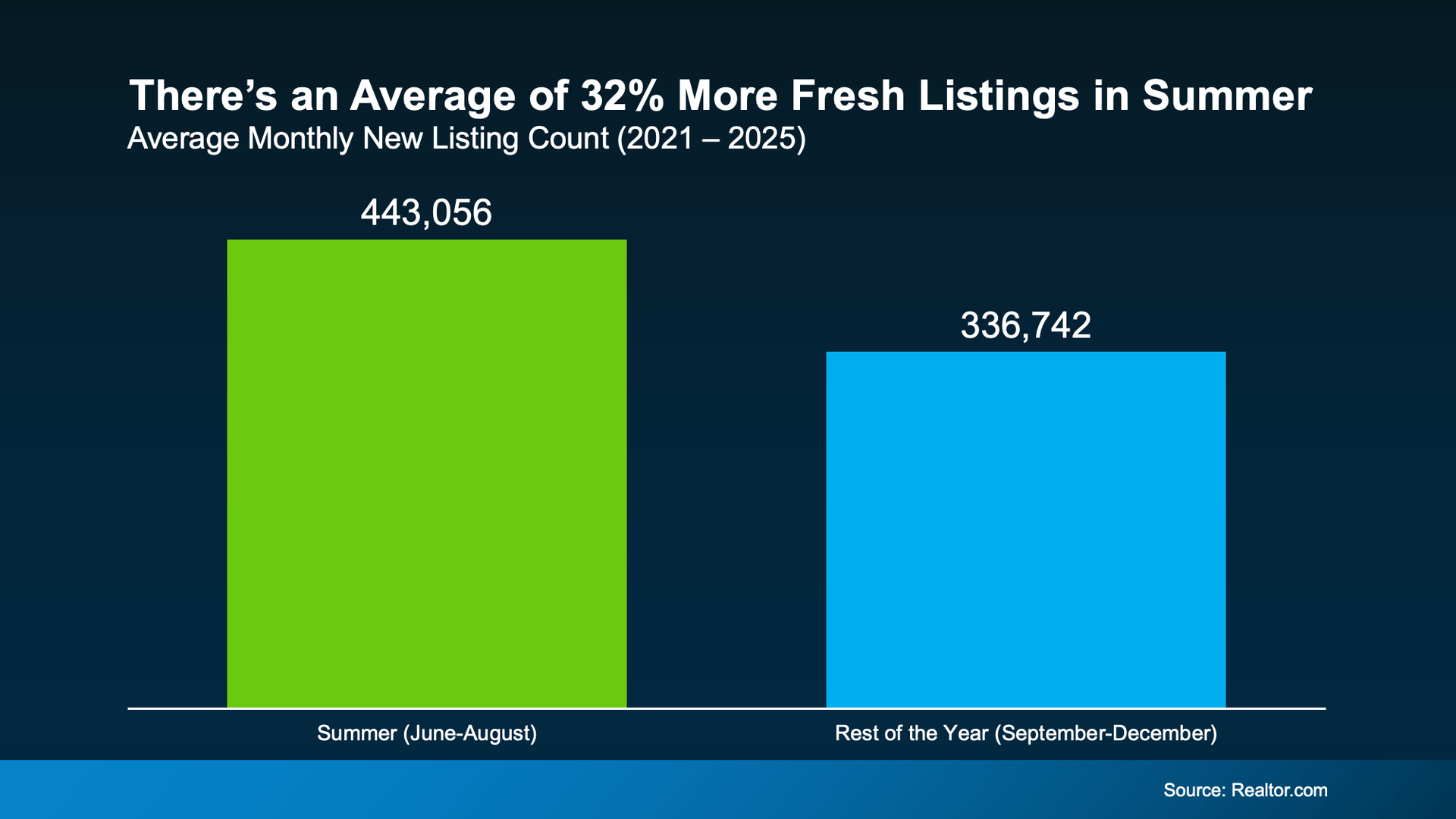
With more newly listed homes, there’s a better chance of finding one you like where the numbers actually work.


Because all it really takes is one home to completely change your search. And if you’ve got more popping onto the market to choose from, maybe one of those is exactly what you need. 


But keep in mind, this seasonal window isn’t open forever. Fresh inventory tends to slow down once Summer ends.


Many homeowners who planned to sell this year have already listed by then. Families who wanted to move before school starts have often already gotten it done, or at least, set it into motion. So, new listing activity usually cools as we head into Fall and Winter.


Of course, every year is different. But if finding the right home at the right price has been your biggest challenge, waiting until later in the year may not necessarily give you more options. In fact, recent history suggests it may do just the opposite.


Sellers: Homes Usually Sell for More in the Summer


If you're thinking of selling, you may be considering holding off because you've seen headlines about lower asking prices, price cuts, and softer conditions in some markets. But those headlines don’t tell the whole story or convey just how much it varies by area.


Here’s what you really need to know. Even though the market’s becoming more balanced and some pockets are experiencing price declines, that doesn’t mean you’ve missed your chance to sell. 


Seasonality can still work in your favor no matter where you are. And this Summer could still give you the chance to sell for a good price.


According to the National Association of Realtors (NAR), homes sold during a Summer month usually sell for about 4% more than homes sold during the typical month from September-December:
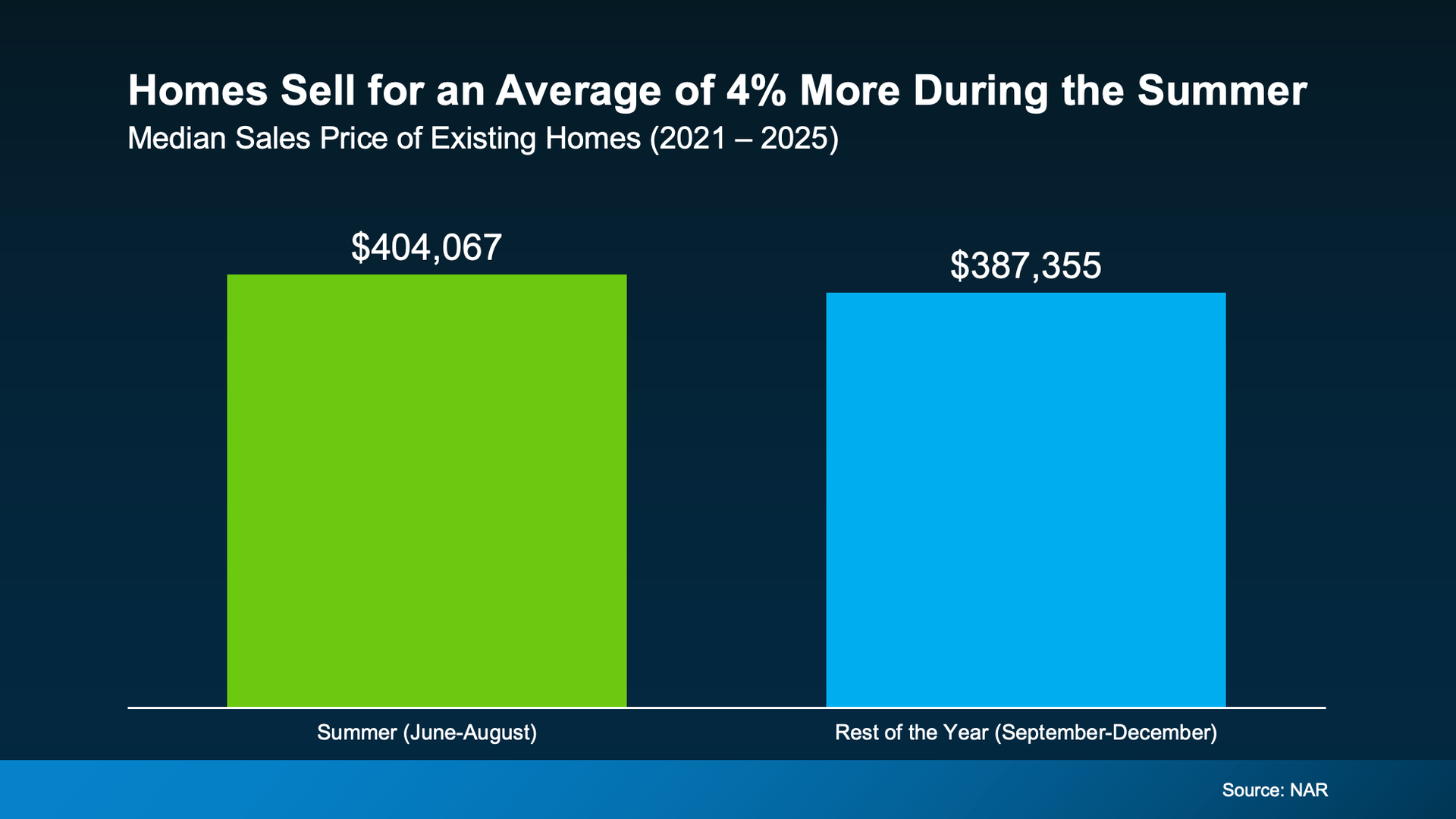
Why? Summer buyers are usually operating on a set timeframe. They’re trying to move before the next school year or when they have more PTO and warmer weather to tour houses. That urgency can translate into better offers.


Now, that doesn’t mean you should price your house 4% higher this Summer. That would actually be a mistake in today’s market.


It just means if you’re looking to get as much for your house as you reasonably can, a Summer move could be a smarter play than waiting until later this year. 


Because based on typical seasonality, you may get more for your house than you would if you waited until the Fall or Winter (when there are typically fewer buyers active).


And if you're considering a move anyway, that’s worth factoring in.


Bottom Line


Could waiting until later this year work out? Sure. But it's important to understand what you may gain by moving now too – that way you have the full picture before you decide.


If a 2026 move is on your radar, let’s connect and talk about what matters most to you. Depending on your priorities, Summer could be your moment.


June 17, 2026
A few years ago, sellers could get away with saying "no" to just about everything. No repairs. No concessions. No negotiation. If buyers wanted the house, they pretty much had to take it on the seller's terms. But now that inventory’s grown, negotiations are becoming a normal part of the process again. That's why one of the most important things sellers need to understand right now is this: The goal isn't to “win” every negotiation. Sometimes, it’s worth meeting buyers where they are to get a deal done, fast. One example? Helping with a buyer's closing costs. Let’s break that down, so you know what to expect if it comes up in your sale. What Are Buyer Closing Costs? Closing costs are the extra expenses buyers pay on top of their down payment when they purchase a home. Freddie Mac gives some examples : Loan origination fees Appraisal and inspection costs Title and attorney fees Survey fees and more Typically, buyer closing costs range from about 2% to 5% of the home’s purchase price. So, on the typical $400,000 home, that could mean anywhere from $8,000 to $20,000 out of pocket. And in today’s affordability-challenged market, that upfront cash can be a major hurdle for some buyers – even if they can comfortably afford the monthly mortgage payment itself. That’s why more people are asking sellers for help. And More Sellers Are Saying “Yes” According to the latest data from Zillow , 67% of sellers reported paying some or all of the buyer’s closing costs in 2025 (see chart below) :
June 12, 2026
Data shows inflation is moving in the wrong direction. But before the headlines send anyone into a panic, here's what's actually going on, why it matters for the housing market, and what it means if you're thinking about buying or selling. Inflation Went Up – Here’s What That Actually Means The government tracks inflation in a variety of ways. One is something called PCE – the Personal Consumption Expenditures Price Index. It measures how much more (or less) people are paying for goods and services compared to a year ago. And just based on your own expenses, you can probably guess which way that’s trending. That’s the one everyone is talking about right now. Check out the yellow line to see how that’s spiked since February ( see graph below ). A big driver of this jump is the ongoing conflict in the Middle East, which has pushed gas and energy prices significantly higher.
June 10, 2026
Whether you're dreaming about buying your first home or wondering if it’s time to move on from the one you're in, affordability is probably weighing on your mind. Home prices are still high in many markets, and even though things have improved a bit over the past year, making the numbers work can still feel like a stretch. But the people finding ways to move right now usually have one thing in common. They didn't wait for affordability to come to them. They went looking for it. According to PODS , 61% of people across all generations say affordability is the biggest factor when deciding where to move. And it's led a growing number of people to do one thing – broaden their search to include more affordable areas they hadn't seriously considered before. As PODS , put it: ". . . moving is increasingly driven by affordability, connection, and quality of life. As economic pressures persist, Americans are taking a more intentional, values-driven approach to where they choose to live.” It’s Not Just the Home Price – It’s the Whole Cost of Living Here's where it gets really interesting. When people talk about moving for affordability, they're not just talking about finding a cheaper house. They're thinking about the full picture. What does it actually cost to live somewhere? WalletHub looked at exactly this, measuring housing costs as a share of median monthly household income across every state ( see map below ). Take a look at where you live on that map. The lighter the blue, the more affordable it generally is to live there. The darker the blue? Just the opposite. 
June 6, 2026
You may be telling yourself you’re going to wait to move – maybe you’re hoping mortgage rates will come down, prices will fall, or the market will feel a little easier. And honestly? A lot of people feel that way right now. But here’s what some are starting to realize. Waiting doesn’t usually fix the thing that made you want to move in the first place. Your family still desperately needs more room. Your empty nest still feels too...empty. Your parents or grandparents still need you to live closer. You just got married... or divorced. Your vision of retirement has you living somewhere else. Eventually, life can reach a point where waiting feels harder than moving. That’s why some people are still deciding to buy right now, even in today’s market. Not because conditions are perfect . But because the life changes behind their move never really went away. And maybe that’s exactly where you are too. If so, you’re certainly not alone. The Real Reasons People Move Data from the National Association of Realtors (NAR) shows 1 in 5 buyers last year said they felt like they had to purchase a home at that time, no matter the market. That's an important reminder right now. Sure, the dollars and cents of your move have to make sense for you. But big life changes happen whether mortgage rates and home prices are high, low, or somewhere in between. And those big life events happen more than you may think. NAR says roughly 22.5 million people experience major life changes in a typical two-year span ( see graph below ): 
June 2, 2026
You started shopping with a specific mental image of your future home in your mind. Then the houses in your budget came in smaller than you pictured. That’s the reality for a lot of buyers right now. Affordability is tight. But don’t let that discourage you. Going smaller might actually be a smart play in today’s market – and the upside can be bigger than you'd think. Let’s break down two places to look where smaller won’t necessarily feel like a compromise. Homebuilders Are Focused on Smaller Options Lately For starters, smaller is kind of on trend right now. Newly built homes have been shrinking for years. According to the latest data from the Census , the median square footage of new single-family homes has been falling overall since 2014 ( see graph below ):
May 30, 2026
If you’ve always assumed a newly built home is just not in your budget , you should know the math just got a little friendlier. The median sale price of a newly built home is now at its lowest level since 2021, according to the latest data from the Census . And on top of that, builders are still rolling out incentives to bring buyers through the door. Here's what's happening, and what it means if you're shopping right now. Prices on Newly Built Homes Have Come Down After a steep climb during the pandemic years, prices have eased a bit. The median sale price of newly built homes is sitting at about $390,000 nationwide. That’s the lowest it's been in nearly five years ( see graph below ):
May 27, 2026
Nearly half of Veterans (49%) feel homeownership is currently out of reach, according to a recent survey from NewDay USA . But many are closer than they think. And you might be, too. If you’re a Veteran, you probably know the Veterans Affairs (VA) home loan benefit exists – it's been around for over 80 years. What you might not know is what it actually covers. Three misconceptions trip up Veterans the most (see graph below): 
May 23, 2026
Most sellers come into the market with one number in mind. And it’s often the one that costs them the most. That's their asking price . A survey from Realtor.com shows about 8 in 10 (80%) of sellers expect to sell at or above their asking price today. But here’s where things get interesting. In reality, only about 4 out of every 10 (roughly 40% ) actually do. That’s a big gap. And it’s where a lot of sellers get caught off guard. So, why the disconnect? And how can you set yourself up to be one of the 4 in 10 that get top dollar? Let’s break it down. What Should You Really Expect To Get for Your House? That 40% may sound low at first, but it’s not. If you look back to the last typical year for the housing market (2019), what we're really seeing is a return to what’s normal ( see chart below ). If anything, slightly more homeowners are able to sell above list price today compared to 2019:
May 19, 2026
Have you been thinking of mutual f a new home in Roseville, Granite Bay, or another one of our amazing Sacramento valley cities? One of the biggest hold ups some buyers have right now is thinking to themselves: “ What if I buy, and home prices go down ?” With everything in the news, that concern makes some sense. No one wants to make a big financial decision at the wrong time. But here’s what’s important to know. You don’t want to get hung up on the few places seeing slight declines right now. When you zoom out and look at the full picture, home prices usually rise over time. What the Data Really Shows Take a look at the visual below. It uses data from Case-Shiller and Bilello to show how home prices have changed year by year going all the way back to the 1950s. Here’s the key takeaway. Outside of the housing crash, home prices have either held steady or increased in just about every year for decades ( see visual below ) :
May 16, 2026
For a lot of would-be first-time buyers , affordability is the thing that’s standing in the way. But some buyers are getting creative and finding a way to still make the numbers work – and that’s through co-buying . The Dream Is Still Alive. The Math Just Isn’t Working for Everyone. Young people haven’t given up on the dream of owning a home – not even close. According to FirstHome IQ, homeownership still ranks among the top life goals for the next generation. The problem? 73% of Gen Z and millennial buyers cite affordability as the reason for not making homeownership a priority. And it shows. First-time buyers now make up just 21% of all home purchases , the lowest share since the National Association of Realtors (NAR) started tracking the data in 1981. But still, some buyers are making it happen. And a portion of them are turning to co-buying to get their foot in the door. So, What’s Co-Buying? Co-buying means purchasing a home with someone else, like a friend, sibling, or unmarried partner. You combine incomes, split the down payment, and share monthly costs. For some people, it’s a creative way to turn “someday” into a concrete move-in date that’s just around the corner. And it's catching on fast, just look at where things stand today. According to CoBuy.io , 64 million Americans now co-own a home with someone they’re not married to. In fact, 31.5% of home purchases involve co-buyers ( see graph below ):
Show More
June 17, 2026
A few years ago, sellers could get away with saying "no" to just about everything. No repairs. No concessions. No negotiation. If buyers wanted the house, they pretty much had to take it on the seller's terms. But now that inventory’s grown, negotiations are becoming a normal part of the process again. That's why one of the most important things sellers need to understand right now is this: The goal isn't to “win” every negotiation. Sometimes, it’s worth meeting buyers where they are to get a deal done, fast. One example? Helping with a buyer's closing costs. Let’s break that down, so you know what to expect if it comes up in your sale. What Are Buyer Closing Costs? Closing costs are the extra expenses buyers pay on top of their down payment when they purchase a home. Freddie Mac gives some examples : Loan origination fees Appraisal and inspection costs Title and attorney fees Survey fees and more Typically, buyer closing costs range from about 2% to 5% of the home’s purchase price. So, on the typical $400,000 home, that could mean anywhere from $8,000 to $20,000 out of pocket. And in today’s affordability-challenged market, that upfront cash can be a major hurdle for some buyers – even if they can comfortably afford the monthly mortgage payment itself. That’s why more people are asking sellers for help. And More Sellers Are Saying “Yes” According to the latest data from Zillow , 67% of sellers reported paying some or all of the buyer’s closing costs in 2025 (see chart below) :
June 12, 2026
Data shows inflation is moving in the wrong direction. But before the headlines send anyone into a panic, here's what's actually going on, why it matters for the housing market, and what it means if you're thinking about buying or selling. Inflation Went Up – Here’s What That Actually Means The government tracks inflation in a variety of ways. One is something called PCE – the Personal Consumption Expenditures Price Index. It measures how much more (or less) people are paying for goods and services compared to a year ago. And just based on your own expenses, you can probably guess which way that’s trending. That’s the one everyone is talking about right now. Check out the yellow line to see how that’s spiked since February ( see graph below ). A big driver of this jump is the ongoing conflict in the Middle East, which has pushed gas and energy prices significantly higher.
June 10, 2026
Whether you're dreaming about buying your first home or wondering if it’s time to move on from the one you're in, affordability is probably weighing on your mind. Home prices are still high in many markets, and even though things have improved a bit over the past year, making the numbers work can still feel like a stretch. But the people finding ways to move right now usually have one thing in common. They didn't wait for affordability to come to them. They went looking for it. According to PODS , 61% of people across all generations say affordability is the biggest factor when deciding where to move. And it's led a growing number of people to do one thing – broaden their search to include more affordable areas they hadn't seriously considered before. As PODS , put it: ". . . moving is increasingly driven by affordability, connection, and quality of life. As economic pressures persist, Americans are taking a more intentional, values-driven approach to where they choose to live.” It’s Not Just the Home Price – It’s the Whole Cost of Living Here's where it gets really interesting. When people talk about moving for affordability, they're not just talking about finding a cheaper house. They're thinking about the full picture. What does it actually cost to live somewhere? WalletHub looked at exactly this, measuring housing costs as a share of median monthly household income across every state ( see map below ). Take a look at where you live on that map. The lighter the blue, the more affordable it generally is to live there. The darker the blue? Just the opposite. 
June 6, 2026
You may be telling yourself you’re going to wait to move – maybe you’re hoping mortgage rates will come down, prices will fall, or the market will feel a little easier. And honestly? A lot of people feel that way right now. But here’s what some are starting to realize. Waiting doesn’t usually fix the thing that made you want to move in the first place. Your family still desperately needs more room. Your empty nest still feels too...empty. Your parents or grandparents still need you to live closer. You just got married... or divorced. Your vision of retirement has you living somewhere else. Eventually, life can reach a point where waiting feels harder than moving. That’s why some people are still deciding to buy right now, even in today’s market. Not because conditions are perfect . But because the life changes behind their move never really went away. And maybe that’s exactly where you are too. If so, you’re certainly not alone. The Real Reasons People Move Data from the National Association of Realtors (NAR) shows 1 in 5 buyers last year said they felt like they had to purchase a home at that time, no matter the market. That's an important reminder right now. Sure, the dollars and cents of your move have to make sense for you. But big life changes happen whether mortgage rates and home prices are high, low, or somewhere in between. And those big life events happen more than you may think. NAR says roughly 22.5 million people experience major life changes in a typical two-year span ( see graph below ): 
June 2, 2026
You started shopping with a specific mental image of your future home in your mind. Then the houses in your budget came in smaller than you pictured. That’s the reality for a lot of buyers right now. Affordability is tight. But don’t let that discourage you. Going smaller might actually be a smart play in today’s market – and the upside can be bigger than you'd think. Let’s break down two places to look where smaller won’t necessarily feel like a compromise. Homebuilders Are Focused on Smaller Options Lately For starters, smaller is kind of on trend right now. Newly built homes have been shrinking for years. According to the latest data from the Census , the median square footage of new single-family homes has been falling overall since 2014 ( see graph below ):
May 30, 2026
If you’ve always assumed a newly built home is just not in your budget , you should know the math just got a little friendlier. The median sale price of a newly built home is now at its lowest level since 2021, according to the latest data from the Census . And on top of that, builders are still rolling out incentives to bring buyers through the door. Here's what's happening, and what it means if you're shopping right now. Prices on Newly Built Homes Have Come Down After a steep climb during the pandemic years, prices have eased a bit. The median sale price of newly built homes is sitting at about $390,000 nationwide. That’s the lowest it's been in nearly five years ( see graph below ):
May 27, 2026
Nearly half of Veterans (49%) feel homeownership is currently out of reach, according to a recent survey from NewDay USA . But many are closer than they think. And you might be, too. If you’re a Veteran, you probably know the Veterans Affairs (VA) home loan benefit exists – it's been around for over 80 years. What you might not know is what it actually covers. Three misconceptions trip up Veterans the most (see graph below): 
May 23, 2026
Most sellers come into the market with one number in mind. And it’s often the one that costs them the most. That's their asking price . A survey from Realtor.com shows about 8 in 10 (80%) of sellers expect to sell at or above their asking price today. But here’s where things get interesting. In reality, only about 4 out of every 10 (roughly 40% ) actually do. That’s a big gap. And it’s where a lot of sellers get caught off guard. So, why the disconnect? And how can you set yourself up to be one of the 4 in 10 that get top dollar? Let’s break it down. What Should You Really Expect To Get for Your House? That 40% may sound low at first, but it’s not. If you look back to the last typical year for the housing market (2019), what we're really seeing is a return to what’s normal ( see chart below ). If anything, slightly more homeowners are able to sell above list price today compared to 2019:
May 19, 2026
Have you been thinking of mutual f a new home in Roseville, Granite Bay, or another one of our amazing Sacramento valley cities? One of the biggest hold ups some buyers have right now is thinking to themselves: “ What if I buy, and home prices go down ?” With everything in the news, that concern makes some sense. No one wants to make a big financial decision at the wrong time. But here’s what’s important to know. You don’t want to get hung up on the few places seeing slight declines right now. When you zoom out and look at the full picture, home prices usually rise over time. What the Data Really Shows Take a look at the visual below. It uses data from Case-Shiller and Bilello to show how home prices have changed year by year going all the way back to the 1950s. Here’s the key takeaway. Outside of the housing crash, home prices have either held steady or increased in just about every year for decades ( see visual below ) :
May 16, 2026
For a lot of would-be first-time buyers , affordability is the thing that’s standing in the way. But some buyers are getting creative and finding a way to still make the numbers work – and that’s through co-buying . The Dream Is Still Alive. The Math Just Isn’t Working for Everyone. Young people haven’t given up on the dream of owning a home – not even close. According to FirstHome IQ, homeownership still ranks among the top life goals for the next generation. The problem? 73% of Gen Z and millennial buyers cite affordability as the reason for not making homeownership a priority. And it shows. First-time buyers now make up just 21% of all home purchases , the lowest share since the National Association of Realtors (NAR) started tracking the data in 1981. But still, some buyers are making it happen. And a portion of them are turning to co-buying to get their foot in the door. So, What’s Co-Buying? Co-buying means purchasing a home with someone else, like a friend, sibling, or unmarried partner. You combine incomes, split the down payment, and share monthly costs. For some people, it’s a creative way to turn “someday” into a concrete move-in date that’s just around the corner. And it's catching on fast, just look at where things stand today. According to CoBuy.io , 64 million Americans now co-own a home with someone they’re not married to. In fact, 31.5% of home purchases involve co-buyers ( see graph below ):
Show More