The Kind of House Buyers Are Willing To Pay More For

August 20, 2026

That spare room on the main floor. The finished basement with a kitchenette and its own entrance. The bonus room you've been using for storage.


To you, it's extra space. But to a growing pool of buyers, it's the reason they'd pick your house. Here’s why. Multi-generational homebuying is on the rise.


Millions of Families Are Living Multi-Generationally


The number of multi-generational households is climbing. That’s when 3 or more generations live under one roof. And data shows those households grew from 3.2 million to almost 4 million between 2014 and 2024, according to Realtor.com.


And each year, more people are shopping for a larger home that fits their combined needs.


While the appetite for this type of house is rising across the board, data from USAFacts shows multi-generational living is more common in some states than others. The darker the state in the map below, the more common it is in that area (see map below):
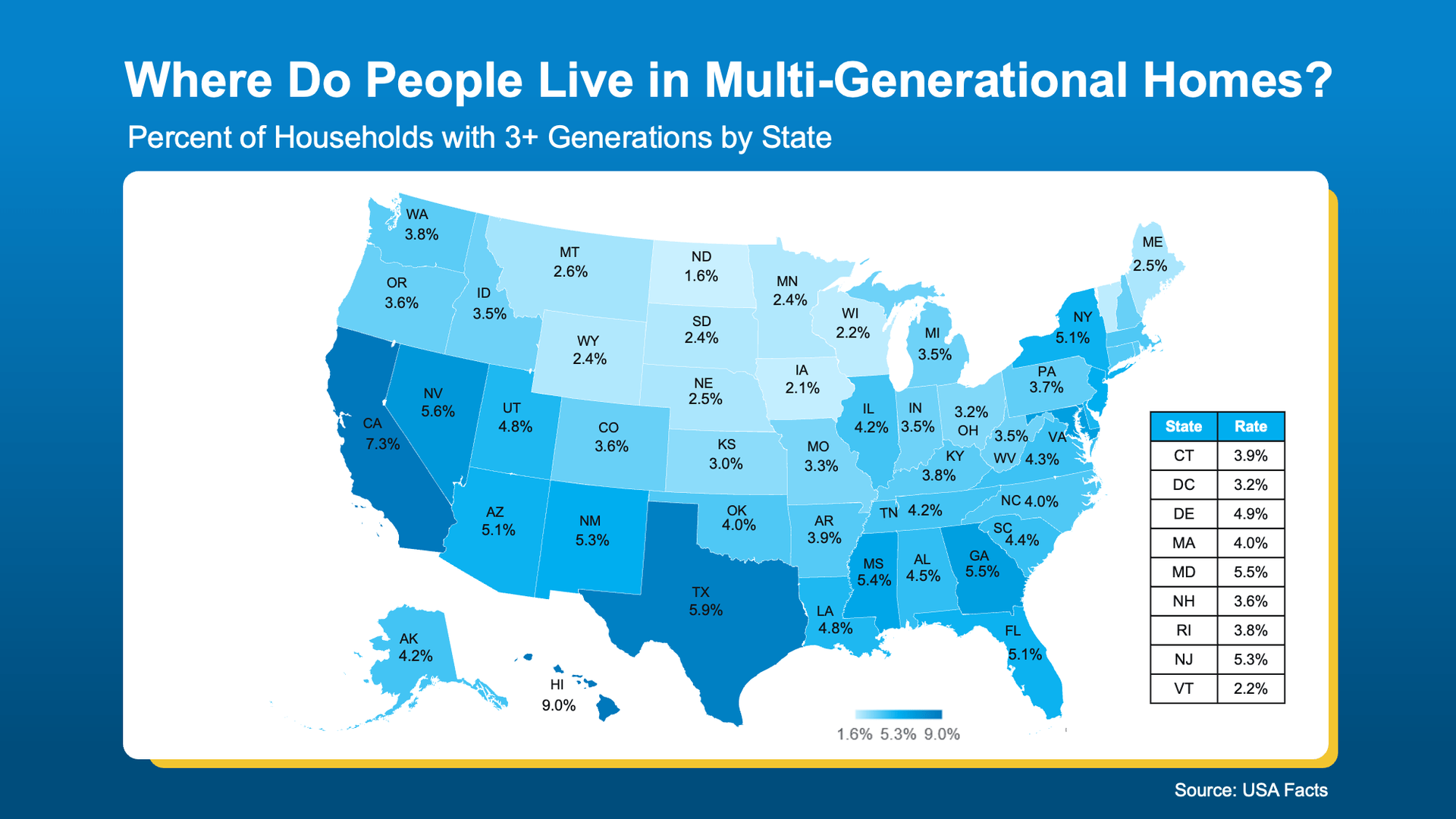
Where does your state fall? Depending on where you are, the pool of buyers looking for a house like yours could be even bigger than you’d think. But the overall bottom line is this.


There’s a real market out there for larger homes with room for multiple generations under one roof, especially since affordability is still so tight. And if you own a house like that, it’s in demand.


Multi-Generational Houses Sell at a Premium


And that extra room carries real value with the right buyer. According to Realtor.com, in 2025 the median asking price for a multi-generational house was $709,000 – roughly 65% higher than the $429,900 median for a standard house.


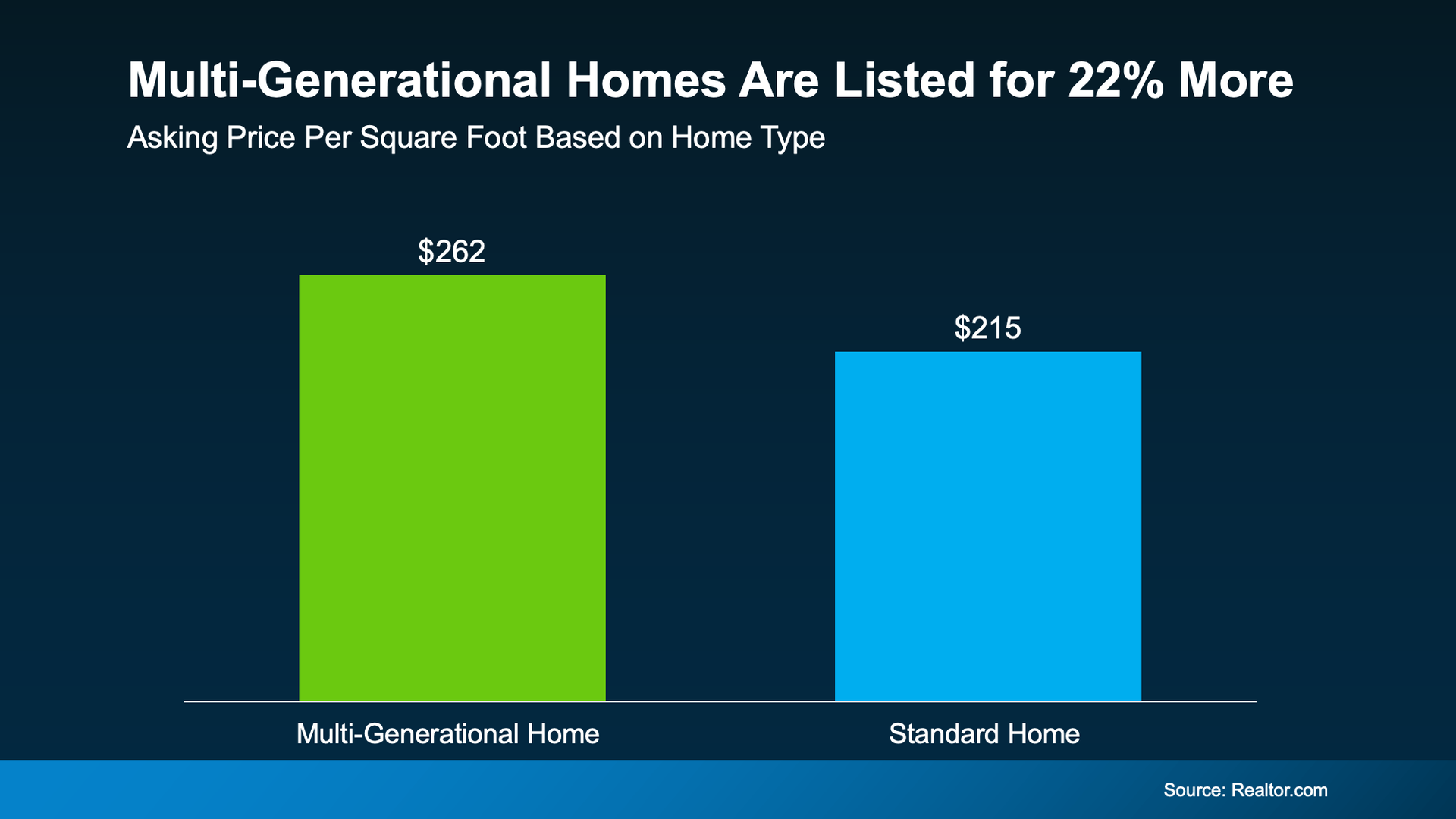
Some of that is simply size. But compare multi-generational homes to regular homes with the same amount of square footage, and they still come out on top – $262 per square foot versus $215.


That’s a 22% premium you could command for special features like in-law suites, second kitchens, and separate entries (see graph below):
When you sell, this could help you walk away with more money in your pocket, especially when your agent highlights your home’s multi-generational-friendly features in your listing.


And Buyers Aren’t Getting Sticker Shock


And even with slightly higher price tags, buyers aren't flinching. Multi-generational houses drew 13.5% more online views than standard ones, and they still sold just as fast – in about 59 days – per the same Realtor.com report.


Hannah Jones, Senior Economic Research Analyst at Realtor.com, explains:


"The strong demand and steep premiums we are seeing in inventory-constrained markets point to a real mismatch between what buyers are looking for and what is actually available. For sellers in these markets, this type of home can be a significant asset."


Basically, when buyers want something that's very specific, the house that checks the box tends to stand out.


Bottom Line


Your multi-generational-friendly, or simply larger-than-average, house might meet criteria a lot of buyers can't find in a standard one. That's what gets attention. And offers. So, let’s chat about what it could get you in our market right now. A house that is too big for you now is a perfect size for somebody else. What’s not perfect for one person is always perfect for somebody else. If you looking to downsize, or upsize a new home and property in Granite Bay, Roseville, Folsom, or anywhere within the Sacramento Valley let me know and we can start the process.

November 18, 2026
When the homes you love keep landing outside your budget , it may be time to look at the ones other buyers skip. Our very first home was a light fixer in So Cal after I had graduated college. It was a great leaning experience. The house was livable, but super dated, and had no dual pane windows, no Central heat and air, just a wall heater, but it was clean enough to move in. During the 4 years we owned it we took it from under market value, to selling above market value as we put in the new HVAC, we redid the Stucco, put in the windows, and we did so much more. It was fun, and we grew from the experience both emotionally and financially. Plus, it helped me gain the knowledge I have today to help my clients with their homes. A fixer-upper won't be the right call for everyone. Plenty of buyers want a home that's ready on move-in day. But homes that need some updating could get you in the door for a lot less . More buyers are starting to realize it too. And Danielle Hale, Chief Economist at Realtor.com , explains why: “ Fixer-uppers give buyers a way to break into the housing market at a time when affordability is still stretched thin. For those with the vision. . . fixer-uppers provide both a starting point in the market and the chance to create a home that's truly their own.” If that sounds like you, here's why a fixer-upper could be worth a closer look. The Price Tag Is Usually Lower Because these homes need work, they tend to have a lower asking price up front. According to AmeriSave, fixer-uppers usually sell for 20% to 30% less than what they're worth on the market. Here's what that could look like. KCM applied a 25% discount – the middle of that range – to the median home price from the National Association of Realtors (NAR). This is an example, not the average price of a fixer-upper. But it shows the savings could top $100,000 (see graph below):
November 18, 2026
If selling your house is on your calendar for 2027, you may be thinking you've got plenty of time. Maybe you're aiming for January. Maybe you're waiting for spring. Either way, next year probably feels far enough away that getting ready can wait, too. But waiting until 2027 to sell doesn't mean waiting until 2027 to get started. Today's buyers have more homes to choose from than they've had in years. So, if you want your house to stand out when it's time to list, a little preparation now can make a big difference later. How Early Should You Start Getting Ready? As a general rule of thumb, Zillow recommends giving yourself about 2-3 months to get your house ready to list. And that makes sense when you consider that the vast majority of sellers (78%) did at least one home improvement project before their house hit the market . That gives you plenty of time to meet with me and put together a plan as to what to fix, find contractors, get on their schedules, actually make the updates, and get everything ready for me to schedule to have the professional photos done and prepare for live showings. Please don’t worry, not every seller has a big to-do list. The most common? Interior painting (see graph below): 
November 7, 2026
Quick, what credit score do you need to buy a home ? If a number pops into your head, there's a pretty good chance it's wrong. And the right answer is getting harder to pin down, because the way credit scores are determined and delivered is changing - for the better. Here's what you need to know in today's changing credit climate. #1 Most People Are Guessing Fannie Mae has been tracking consumer perceptions about mortgage requirements since 2015 and found that consumers consistently overestimated the minimum credit score lenders required to qualify for a mortgage. As recently as 2023, the average guess was 652. In reality, the long-standing benchmark for loans backed by Fannie Mae and Freddie Mac is lower, at 620, and today even that isn't a hard rule for every mortgage they back. Like the Fannie Mae research, a recent survey from Veterans United found consumers continue to overestimate what it takes to qualify for a home loan: 
November 3, 2026
When you’re planning a move , every monthly cost counts. That’s why it can be frustrating to see home insurance keep creeping up. According to Intercontinental Exchange, it now makes up 9.6% of the average monthly mortgage payment. But the latest numbers show some progress on that front – as the increases start to slow down. Here’s what you need to know and what you can do about it. Premiums Are Rising More Slowly Now A look at the past two years shows how much things have cooled down. In mid-2024, home insurance premiums rose 4.3% in a single quarter. By the second quarter of this year, that was down to 1.8%. That’s the smallest quarterly growth in almost 3 years – and that’s a good thing (see graph below):
October 31, 2026
When mortgage rates climb, buying a home can start to feel like trying to hit a moving target. Every jump in rates makes monthly payments bigger, and that pushes a lot of buyers to look for another way in. More and more of them are finding it in the adjustable-rate mortgage , or ARM. The ARM Option Here’s how an ARM differs from a more traditional mortgage. With a regular fixed-rate mortgage , your rate stays the same for your whole loan. But with an ARM , your rate is locked for the first few years, then it can move up or down based on market conditions . Some people don’t like that level of uncertainty – and that’s okay. But others are drawn to this option specifically because there’s usually a lower rate to start when you opt for an ARM. And in an affordability-strapped market, that’s going to gain popularity. Bankrate recently found that, in September, rates for ARM products were over a full percentage point lower than a regular fixed-rate loan. Depending on the ARM product, that can make a difference of $150-300 in the monthly payment on a median-priced home. And for some buyers, that’s enough to turn “not right now” into “let’s do this.” You can see it in the numbers. Data from the Mortgage Bankers Association (MBA) shows that, in October, roughly 1 in 10 people applying for a mortgage chose an ARM (see graph below): 
October 27, 2026
Here's something most homebuyers don't think about. When the housing market slows down , homeowners and builders don't always respond the same way. Think about it. If you're selling your house and aren't getting the offers you want, you could make the choice to take it off the market and stay put, and wait for things to improve. But builders ? They may be more motivated to stay the course. They've already invested money in building those houses. And every completed home that sits unsold means money tied up in a property, plus ongoing costs that can add up. That's why some builders may be more motivated to negotiate right now. And that could work in your favor. Fewer Buyers Are Making Moves. And Builders Are Feeling It. You’ve probably seen the headlines. According to the latest report from the National Association of Realtors (NAR), pending home sales – homes that have gone under contract but haven't closed yet – fell 7.3% in September and 11.3% compared to last year. Why? Higher mortgage rates are making it harder for buyers to make the numbers work. Now, that report tracks existing homes, not new construction. But we're seeing signs of the same slowdown on the builder side, too. According to the National Association of Home Builders (NAHB), builder confidence dropped to 29 in October , its lowest level since June 2012. Traffic from prospective buyers also dropped to its lowest level in more than a decade, excluding the start of the pandemic. 
October 24, 2026
What's the biggest payment you make every month? If you’re a renter , it's probably your rent. But did you know that you can pay your rent on time, every time, for years, and it may never show up in your credit history? It's pretty frustrating, especially if you'd like to buy a home someday and you’re trying to build your credit. The good thing is that’s changing right now. Here’s what you need to know and why it could open a door you thought was closed. The Problem for Would-Be Buyers You’re not the only one frustrated. According to Zillow, nearly a third of applicants (32.88%) get denied a mortgage due to insufficient credit history - not missed payments or too much debt. Just not enough credit history for a lender to say "yes." It’s the most common hurdle would-be buyers have. As Zillow explains: "Nearly one-third of mortgage applicants are denied a loan because of insufficient credit history , making it the most common reason for a denial .” 
October 21, 2026
When you picture buying your first home , chances are you’re imagining a traditional single-family house with its own yard, maybe a garage, and little extra room to grow. But with affordability still tight, getting everything on that list right away may come with a higher price tag than you’re comfortable with right now. So, if you’re running the numbers and buying a house like that feels like a stretch, there may be another way in. A condo. Because in a lot of markets, condos come with a significantly lower price tag. And that could make them a smart way to get your foot in the door. Condos Can Cost Less Than You Think According to a recent study by Zillow: “ Condos are the most commonly affordable home type in virtually every metro. At the starter level, the savings can be pretty significant. Nationally, starter condos average $197,468 — that’s about 6% less than the typical starter home. ” And depending on where you live, the difference can be much bigger. Zillow identified metro areas where typical starter condos are priced significantly below the estimated home price a median-income household could afford. Here are the top 10 according to that research ( see chart below ). In Houston, the gap is at its widest. There, a typical starter condo was valued at about $85,600 – 72% below the price considered affordable based on the area's median household income. 
October 17, 2026
You've spent years making your house feel like home, celebrating milestones, making each room your own, and turning neighbors into friends. As you look ahead to the next chapter of your life, it's natural to wonder if this is still the place you want to spend it. Whether you're leaning toward staying in your house as you get older or moving to a 55+ community, the goal is the same: a home that fits the life you want, with more time for the people and things you love. So, here's what to consider before you decide. What It Can Take To Stay Put Wanting to stay in a house you love and are familiar with makes sense. But most houses need at least some updates to make aging in place easier. In fact, the Joint Center for Housing Studies of Harvard University (JCHS) finds that fewer than 4% of homes have the basics, like single-floor living, no-step entries, and wide hallways and doorways (see graph below): 
October 13, 2026
With everything going on, it’s understandable if you’re wondering if you’d regret buying right now. Everyday expenses cost more. Mortgage rates are higher than you’d like. And when the economy feels uncertain, taking on a mortgage can feel like a much bigger leap. But here’s some perspective that may help… Most people who already made that leap would do it again. According to a recent survey from NerdWallet, the vast majority of recent buyers (74%) were glad they bought their current home. Only a very small 3% of people regret it: 
Show More
November 18, 2026
When the homes you love keep landing outside your budget , it may be time to look at the ones other buyers skip. Our very first home was a light fixer in So Cal after I had graduated college. It was a great leaning experience. The house was livable, but super dated, and had no dual pane windows, no Central heat and air, just a wall heater, but it was clean enough to move in. During the 4 years we owned it we took it from under market value, to selling above market value as we put in the new HVAC, we redid the Stucco, put in the windows, and we did so much more. It was fun, and we grew from the experience both emotionally and financially. Plus, it helped me gain the knowledge I have today to help my clients with their homes. A fixer-upper won't be the right call for everyone. Plenty of buyers want a home that's ready on move-in day. But homes that need some updating could get you in the door for a lot less . More buyers are starting to realize it too. And Danielle Hale, Chief Economist at Realtor.com , explains why: “ Fixer-uppers give buyers a way to break into the housing market at a time when affordability is still stretched thin. For those with the vision. . . fixer-uppers provide both a starting point in the market and the chance to create a home that's truly their own.” If that sounds like you, here's why a fixer-upper could be worth a closer look. The Price Tag Is Usually Lower Because these homes need work, they tend to have a lower asking price up front. According to AmeriSave, fixer-uppers usually sell for 20% to 30% less than what they're worth on the market. Here's what that could look like. KCM applied a 25% discount – the middle of that range – to the median home price from the National Association of Realtors (NAR). This is an example, not the average price of a fixer-upper. But it shows the savings could top $100,000 (see graph below):
November 18, 2026
If selling your house is on your calendar for 2027, you may be thinking you've got plenty of time. Maybe you're aiming for January. Maybe you're waiting for spring. Either way, next year probably feels far enough away that getting ready can wait, too. But waiting until 2027 to sell doesn't mean waiting until 2027 to get started. Today's buyers have more homes to choose from than they've had in years. So, if you want your house to stand out when it's time to list, a little preparation now can make a big difference later. How Early Should You Start Getting Ready? As a general rule of thumb, Zillow recommends giving yourself about 2-3 months to get your house ready to list. And that makes sense when you consider that the vast majority of sellers (78%) did at least one home improvement project before their house hit the market . That gives you plenty of time to meet with me and put together a plan as to what to fix, find contractors, get on their schedules, actually make the updates, and get everything ready for me to schedule to have the professional photos done and prepare for live showings. Please don’t worry, not every seller has a big to-do list. The most common? Interior painting (see graph below): 
November 7, 2026
Quick, what credit score do you need to buy a home ? If a number pops into your head, there's a pretty good chance it's wrong. And the right answer is getting harder to pin down, because the way credit scores are determined and delivered is changing - for the better. Here's what you need to know in today's changing credit climate. #1 Most People Are Guessing Fannie Mae has been tracking consumer perceptions about mortgage requirements since 2015 and found that consumers consistently overestimated the minimum credit score lenders required to qualify for a mortgage. As recently as 2023, the average guess was 652. In reality, the long-standing benchmark for loans backed by Fannie Mae and Freddie Mac is lower, at 620, and today even that isn't a hard rule for every mortgage they back. Like the Fannie Mae research, a recent survey from Veterans United found consumers continue to overestimate what it takes to qualify for a home loan: 
November 3, 2026
When you’re planning a move , every monthly cost counts. That’s why it can be frustrating to see home insurance keep creeping up. According to Intercontinental Exchange, it now makes up 9.6% of the average monthly mortgage payment. But the latest numbers show some progress on that front – as the increases start to slow down. Here’s what you need to know and what you can do about it. Premiums Are Rising More Slowly Now A look at the past two years shows how much things have cooled down. In mid-2024, home insurance premiums rose 4.3% in a single quarter. By the second quarter of this year, that was down to 1.8%. That’s the smallest quarterly growth in almost 3 years – and that’s a good thing (see graph below):
October 31, 2026
When mortgage rates climb, buying a home can start to feel like trying to hit a moving target. Every jump in rates makes monthly payments bigger, and that pushes a lot of buyers to look for another way in. More and more of them are finding it in the adjustable-rate mortgage , or ARM. The ARM Option Here’s how an ARM differs from a more traditional mortgage. With a regular fixed-rate mortgage , your rate stays the same for your whole loan. But with an ARM , your rate is locked for the first few years, then it can move up or down based on market conditions . Some people don’t like that level of uncertainty – and that’s okay. But others are drawn to this option specifically because there’s usually a lower rate to start when you opt for an ARM. And in an affordability-strapped market, that’s going to gain popularity. Bankrate recently found that, in September, rates for ARM products were over a full percentage point lower than a regular fixed-rate loan. Depending on the ARM product, that can make a difference of $150-300 in the monthly payment on a median-priced home. And for some buyers, that’s enough to turn “not right now” into “let’s do this.” You can see it in the numbers. Data from the Mortgage Bankers Association (MBA) shows that, in October, roughly 1 in 10 people applying for a mortgage chose an ARM (see graph below): 
October 27, 2026
Here's something most homebuyers don't think about. When the housing market slows down , homeowners and builders don't always respond the same way. Think about it. If you're selling your house and aren't getting the offers you want, you could make the choice to take it off the market and stay put, and wait for things to improve. But builders ? They may be more motivated to stay the course. They've already invested money in building those houses. And every completed home that sits unsold means money tied up in a property, plus ongoing costs that can add up. That's why some builders may be more motivated to negotiate right now. And that could work in your favor. Fewer Buyers Are Making Moves. And Builders Are Feeling It. You’ve probably seen the headlines. According to the latest report from the National Association of Realtors (NAR), pending home sales – homes that have gone under contract but haven't closed yet – fell 7.3% in September and 11.3% compared to last year. Why? Higher mortgage rates are making it harder for buyers to make the numbers work. Now, that report tracks existing homes, not new construction. But we're seeing signs of the same slowdown on the builder side, too. According to the National Association of Home Builders (NAHB), builder confidence dropped to 29 in October , its lowest level since June 2012. Traffic from prospective buyers also dropped to its lowest level in more than a decade, excluding the start of the pandemic. 
October 24, 2026
What's the biggest payment you make every month? If you’re a renter , it's probably your rent. But did you know that you can pay your rent on time, every time, for years, and it may never show up in your credit history? It's pretty frustrating, especially if you'd like to buy a home someday and you’re trying to build your credit. The good thing is that’s changing right now. Here’s what you need to know and why it could open a door you thought was closed. The Problem for Would-Be Buyers You’re not the only one frustrated. According to Zillow, nearly a third of applicants (32.88%) get denied a mortgage due to insufficient credit history - not missed payments or too much debt. Just not enough credit history for a lender to say "yes." It’s the most common hurdle would-be buyers have. As Zillow explains: "Nearly one-third of mortgage applicants are denied a loan because of insufficient credit history , making it the most common reason for a denial .” 
October 21, 2026
When you picture buying your first home , chances are you’re imagining a traditional single-family house with its own yard, maybe a garage, and little extra room to grow. But with affordability still tight, getting everything on that list right away may come with a higher price tag than you’re comfortable with right now. So, if you’re running the numbers and buying a house like that feels like a stretch, there may be another way in. A condo. Because in a lot of markets, condos come with a significantly lower price tag. And that could make them a smart way to get your foot in the door. Condos Can Cost Less Than You Think According to a recent study by Zillow: “ Condos are the most commonly affordable home type in virtually every metro. At the starter level, the savings can be pretty significant. Nationally, starter condos average $197,468 — that’s about 6% less than the typical starter home. ” And depending on where you live, the difference can be much bigger. Zillow identified metro areas where typical starter condos are priced significantly below the estimated home price a median-income household could afford. Here are the top 10 according to that research ( see chart below ). In Houston, the gap is at its widest. There, a typical starter condo was valued at about $85,600 – 72% below the price considered affordable based on the area's median household income. 
October 17, 2026
You've spent years making your house feel like home, celebrating milestones, making each room your own, and turning neighbors into friends. As you look ahead to the next chapter of your life, it's natural to wonder if this is still the place you want to spend it. Whether you're leaning toward staying in your house as you get older or moving to a 55+ community, the goal is the same: a home that fits the life you want, with more time for the people and things you love. So, here's what to consider before you decide. What It Can Take To Stay Put Wanting to stay in a house you love and are familiar with makes sense. But most houses need at least some updates to make aging in place easier. In fact, the Joint Center for Housing Studies of Harvard University (JCHS) finds that fewer than 4% of homes have the basics, like single-floor living, no-step entries, and wide hallways and doorways (see graph below): 
October 13, 2026
With everything going on, it’s understandable if you’re wondering if you’d regret buying right now. Everyday expenses cost more. Mortgage rates are higher than you’d like. And when the economy feels uncertain, taking on a mortgage can feel like a much bigger leap. But here’s some perspective that may help… Most people who already made that leap would do it again. According to a recent survey from NerdWallet, the vast majority of recent buyers (74%) were glad they bought their current home. Only a very small 3% of people regret it: 
Show More