Here’s Where To Start if You’re Selling and Buying at the Same Time

August 4, 2026

If you're a homeowner getting ready to move, one question usually comes first: should you buy your next home before you sell, or sell your current house before you start looking?


There's no single right answer. The best call depends on your finances, your local market, and your timeline. And a trusted agent can help you weigh all of it.


But in a lot of cases these days, selling first puts you in the stronger spot.


The Advantages of Selling First


Selling is usually the trickier half of a move today, so getting it done first clears your biggest hurdle. And that’s especially true right now, because there are more homes for sale than there are buyers, which means houses are taking longer to sell than they did a year or two ago.


So how does leading with your sale pay off? Let’s start with the money.


1. You Won’t Get Stuck Paying Two Mortgages


Buy before you sell, and you could end up carrying two mortgages at once. Houses are staying on the market longer these days, that overlap may drag on for more time than you’d planned. And if unexpected repairs come up, it could get even more expensive. Plus, you need to have the financial ability to qualify to carry both homes at the same time. 


Selling first takes that risk off the table, so you’re not multitasking homeownership. As Ramsey Solutions puts it:


"It's best to sell your old home before buying a new one to avoid unnecessary risks and possible headaches."


2. You Can Use Your Equity To Fuel Your Move


This is always true, but one of the biggest perks of selling first is that you’ll know exactly how much money you're walking away with. And one of the big figures that matters in that conversation is how much equity you have in your current place.


Equity is basically your house’s value minus what you still owe on your mortgage. And it adds up fast. According to Realtor.com, homeowners who’ve been in their home for 5 years have about $180,000 in equity on average. And those who’ve had their home for 6-10 years? They have over $340,000.


After you sell, you can use that money to cover your down payment or even buy your next home in cash. And knowing that profit up front helps you plan your next move.


3. Your Offer Will Be Hard To Pass Up


When your house is already sold, you don’t have to make your offer contingent on that sale. In a market where buyers are taking their time, that’s exactly what a seller wants to see.


Picture it from the seller’s side. If their house has been sitting for a while, they’ll gravitate toward the offer most likely to close without a snag.


That can also give you room to ask for a little more, like repairs, since a motivated seller would rather keep things moving than lose you and wait for another offer to come in. Your agent can help you make the most of your upper hand in that scenario.


Is There a Catch?


Selling first has its tradeoffs too, and it helps to see the pros and cons side by side before you decide. Here’s a quick breakdown based on information from Zillow (see visual below):
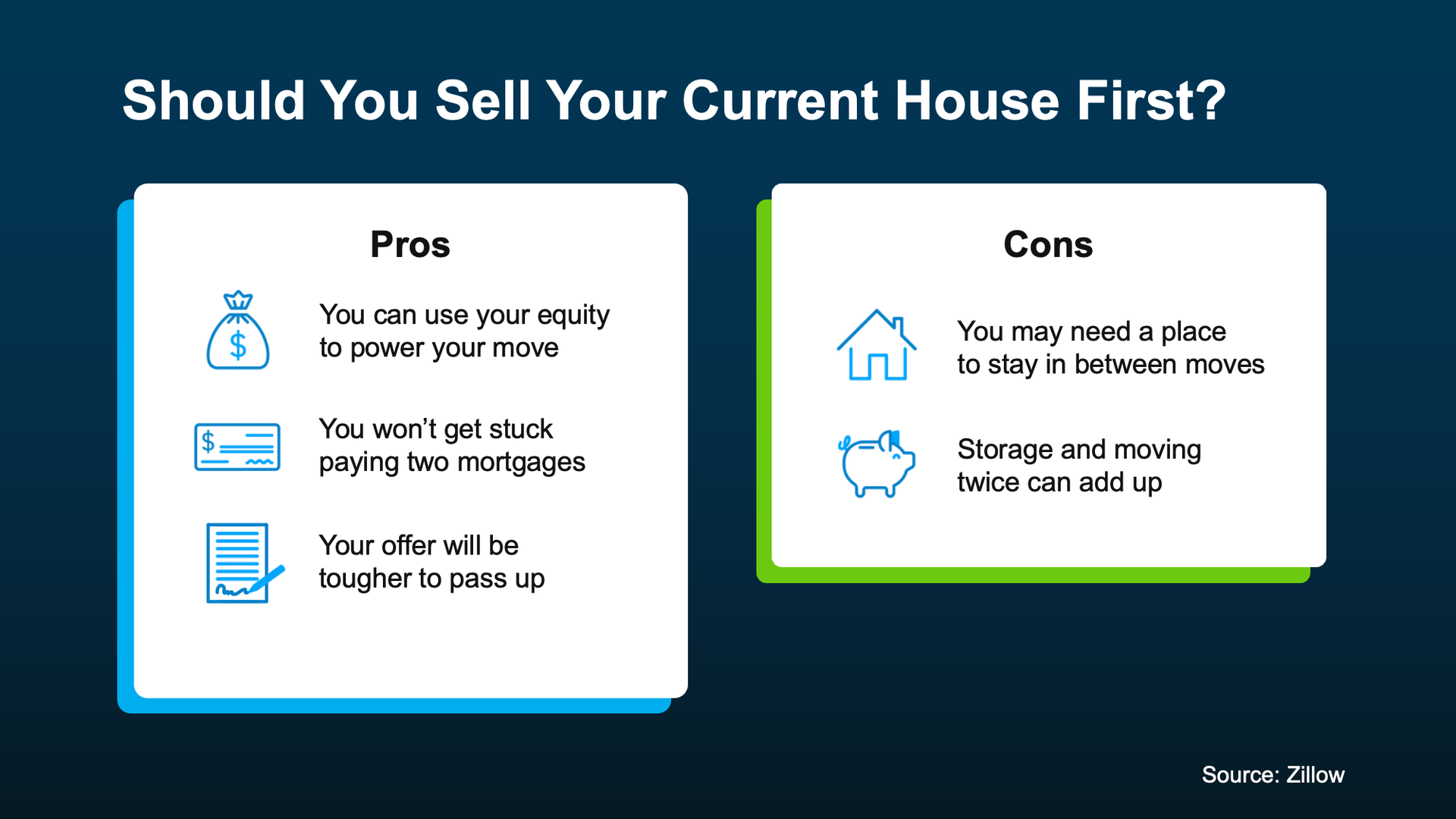
The cons are manageable with the right plan, so talk about them with your agent. They can help you negotiate things like a rent-back, where you stay in your house for a set time after closing, or line up flexible closing dates to keep the transition smooth.


Bottom Line


There's no one-size-fits-all answer to buying and selling at one time, or to purchase, and then sell when you're buying a house anywhere. But for a lot of homeowners, leading with the sale makes moving easier on their mind and their wallet while also making your offer stringer. Most sellers dont want to accept an offer when it is contingent on selling a house. 


Let’s connect, so you can navigate selling and buying with more confidence her win Granite Bay, Roseville, Eldorado Hills, or anywhere in the Sacramento valley. 
July 31, 2026
Remember how exciting it was to buy your first place? It felt like crossing a long-awaited finish line. It gave you a place to build your life. Maybe it’s where you lived when you got married. Or where you welcomed a child or a pet into the family. But that was just the beginning. For most people, your first house was never meant to be your forever home. It’s a stepping stone for what comes next. And if your life looks different today than it did when you got the keys, you’re not stuck. Moving may be more realistic than you think. Starter Home Inventory Is Still Relatively Low If you've been wondering whether now is the right time to move up, here's something worth knowing. Starter homes remain one of the hardest types of homes to find. And that's good news if you're thinking about selling your first place. Historically, we haven’t been building enough homes for first-time buyers. And even though homebuilders have shifted more attention toward smaller, entry-level homes lately, the Census shows there’s a long way to go to re-build supply ( see graph below ): 
July 28, 2026
If you own a luxury house, you're in a stronger spot than most sellers right now. While much of the market has cooled, the high-end tier hasn't. Sale prices and buyer demand are both up. So if you're considering selling, now could be a great time to make your move. Luxury Is Leading on Price Let’s start with prices . But before we get into it – what actually counts as a luxury home? Generally, these are homes in the top 5% price range for the area, so it varies depending on where you live, and what part of the country. But what’s interesting is that according to the latest data from Redfin , sale prices for luxury houses have risen about three times faster than for non-luxury. Right now, the typical home’s sale price is up about 1.5% year-over-year. But high-end homes? Their sale prices have gone up nearly 5% since last year ( see graph below ): 
July 25, 2026
Quick gut reaction. Which investment do Americans trust more than stocks, gold, savings accounts, and bonds? The answer hasn't changed in 14 years. It's real estate. And this year, that answer comes with even more conviction behind it. New data shows people aren't just saying homeownership is a smart move, they're feeling better about it than they have in years. Let's dig into why. Real Estate Takes the Top Spot – Again Every year, Gallup asks Americans to name the best long-term investment. And for the 14th year in a row, real estate came out on top ( see graph below ):
July 21, 2026
If you’ve thought about buying a home in the past few years, you may have run into two frustrations: asking prices that kept climbing and too few homes to choose from. In many places, both sticking points are letting up this summer, with lower asking prices and more homes for sale. Let’s look at the trends, and what they mean for your search. Sellers Are Pricing To Attract Buyers According to Realtor.com , the national median asking price was $430,000 in June, nearly $11,000 under what it was the year before ( see graph below ):
July 10, 2026
Saving for a down payment can feel like the hardest part of buying a home. And with affordability as tight as it’s been lately, it’s fair to wonder how anyone manages it right now. Here’s something you may not have seen coming.  Some people are getting their foot in the door with a smaller down payment. According to Realtor.com, the typical buyer put down about $23,400 in early 2026 – that's around $5,000 below what was typical the year before (a 19% drop year over year). That’s the lowest down payments have been since 2021 (see graph below):
July 10, 2026
Buying or selling a home is a big financial decision. And right now, it feels even bigger. Inflation is high, costs are high, and you want to be sure the timing is right before you make your move. But if you do decide to go for it, whether you're buying or selling , here's something reassuring to hold onto. Not only does your move change your own life, but it also gives your whole community a boost. Real estate is a huge part of the economy. In 2025, it added up to about $5.6 trillion, according to the National Association of Realtors (NAR). A good share of that comes from everyday people buying and selling homes, just like you. Your Move Puts Real Money Into the Local Economy Every sale sends money flowing through your area. NAR data shows that buying an existing home (one that's already been lived in) adds about $64,000 to the local economy. Buy a newly built home , and that number climbs to more than $134,000 (see graph below):
July 4, 2026
When your house doesn’t sell, it’s not just disappointing. It messes with your timing. Your plans. Your confidence. You start second-guessing everything, including the decision to move in the first place. And that raises 2 big questions: Do you try again? Is it even worth it to sell and move? Here’s the secret to getting a better outcome the second time around. Different Agent. Different Results. Most sellers who re-list and ultimately sell don’t wait for market to magically change. They change their approach. And there’s data to back that up. Research from REDX shows homeowners who put their house back on the market with a different agent are more likely to sell than homeowners who re-used the same agent. Not to mention, they see their homes sell faster (see graph below ): 
July 1, 2026
You've probably heard that home prices are cooling off. And that's true – nationally. But zoom in on individual markets across the country, and the picture looks completely different depending on where you are. Some areas are still seeing solid price growth . Others have gone flat. A few have actually dipped slightly negative. So, what's causing all of that variation? It All Comes Down to Inventory Here's the simple version: When there are more homes for sale, buyers have options. More options, means more competition for sellers, less competition for buyers. More competition for sellers means that the sellers can't push prices as high. On the flip side, when inventory is tight, buyers are competing over a small pool of homes, and that pushes prices up. That dynamic is playing out right now in a really visible way across the country. Markets where inventory has climbed back to, or above, normal pre-pandemic levels are seeing prices flatten or fall slightly. Markets where inventory is still well below those 2019 benchmarks are still seeing prices rise. As Lance Lambert, CEO of ResiClub , puts it : "Home prices are still climbing a little year-over-year in many regions where active inventory remains well below pre-pandemic 2019 levels, such as pockets of the Northeast and Midwest. In contrast, some pockets in states like Texas, Florida, and Colorado — where active inventory exceeds pre-pandemic 2019 levels by a solid clip — are seeing modest home price pullbacks or flat pricing." The Maps Say It All Take a look at where inventory stands today compared to 2019. In most places (the states in gray below), inventory still falls short of where we were back then. And that’s exactly why prices are climbing, albeit moderately, in the vast majority of states. But you’re probably more interested in where prices are falling a bit, since that’s what is making headlines. So, let’s prove out how much inventory affects prices in those spots. According to Realtor.com , 15 states and Washington, D.C. are now back above pre-pandemic inventory levels, and some by a wide margin ( see the orange in the map below ): 
June 26, 2026
Remember a few years back when sellers held all the power and buyers were stuck offering way over asking or waiving inspections just to get a chance at the house? In many markets, those days are behind us. While it’s going to vary by area, more metros are slowly shifting to favor buyers, and the market is starting to look a lot more like a two-way street again. And that balance is something we haven’t had in a while. Whether you're buying or selling, here's what you need to know about what's changing and what it means for your move. The Most Buyer-Friendly Market in Years The national data tells an interesting story right now. According to Realtor.com : "The national housing market is balanced but gradually loosening as the cycle moves in a more buyer-friendly direction . . . " That’s because, over the past few years, more and more metros have been flipping back to more buyer-friendly terms as inventory’s grown. And when you zoom in on the latest Realtor.com data for the top 50 metro markets over time, the trend becomes really clear ( see graph below ). Back in 2021, almost all major metros were seller's markets. By the end of 2025, only 1 in 3 still favored sellers. That's an obvious shift.
June 24, 2026
Open up a home search and you'll see them. Listings that have been on the market for two months. Three. Some longer. Most buyers scroll right past them, assuming something’s wrong with the house. But that instinct could be costing you, since the longer a home sits, the more motivated the seller usually gets. Where Some Buyers Are Finding Better Deals If affordability has been your #1 hurdle to buying, here’s a surprisingly simple strategy that could help you finally get your foot in the door. Start with the homes that have been sitting the longest. That’s often where the best deals are. Here’s why. Data from Realtor.com shows there’s a connection between longer time on the market and lower sales prices. Basically, the longer a house sits, the more likely it is that the seller will reduce the price (see graph below): 
Show More
July 31, 2026
Remember how exciting it was to buy your first place? It felt like crossing a long-awaited finish line. It gave you a place to build your life. Maybe it’s where you lived when you got married. Or where you welcomed a child or a pet into the family. But that was just the beginning. For most people, your first house was never meant to be your forever home. It’s a stepping stone for what comes next. And if your life looks different today than it did when you got the keys, you’re not stuck. Moving may be more realistic than you think. Starter Home Inventory Is Still Relatively Low If you've been wondering whether now is the right time to move up, here's something worth knowing. Starter homes remain one of the hardest types of homes to find. And that's good news if you're thinking about selling your first place. Historically, we haven’t been building enough homes for first-time buyers. And even though homebuilders have shifted more attention toward smaller, entry-level homes lately, the Census shows there’s a long way to go to re-build supply ( see graph below ): 
July 28, 2026
If you own a luxury house, you're in a stronger spot than most sellers right now. While much of the market has cooled, the high-end tier hasn't. Sale prices and buyer demand are both up. So if you're considering selling, now could be a great time to make your move. Luxury Is Leading on Price Let’s start with prices . But before we get into it – what actually counts as a luxury home? Generally, these are homes in the top 5% price range for the area, so it varies depending on where you live, and what part of the country. But what’s interesting is that according to the latest data from Redfin , sale prices for luxury houses have risen about three times faster than for non-luxury. Right now, the typical home’s sale price is up about 1.5% year-over-year. But high-end homes? Their sale prices have gone up nearly 5% since last year ( see graph below ): 
July 25, 2026
Quick gut reaction. Which investment do Americans trust more than stocks, gold, savings accounts, and bonds? The answer hasn't changed in 14 years. It's real estate. And this year, that answer comes with even more conviction behind it. New data shows people aren't just saying homeownership is a smart move, they're feeling better about it than they have in years. Let's dig into why. Real Estate Takes the Top Spot – Again Every year, Gallup asks Americans to name the best long-term investment. And for the 14th year in a row, real estate came out on top ( see graph below ):
July 21, 2026
If you’ve thought about buying a home in the past few years, you may have run into two frustrations: asking prices that kept climbing and too few homes to choose from. In many places, both sticking points are letting up this summer, with lower asking prices and more homes for sale. Let’s look at the trends, and what they mean for your search. Sellers Are Pricing To Attract Buyers According to Realtor.com , the national median asking price was $430,000 in June, nearly $11,000 under what it was the year before ( see graph below ):
July 10, 2026
Saving for a down payment can feel like the hardest part of buying a home. And with affordability as tight as it’s been lately, it’s fair to wonder how anyone manages it right now. Here’s something you may not have seen coming.  Some people are getting their foot in the door with a smaller down payment. According to Realtor.com, the typical buyer put down about $23,400 in early 2026 – that's around $5,000 below what was typical the year before (a 19% drop year over year). That’s the lowest down payments have been since 2021 (see graph below):
July 10, 2026
Buying or selling a home is a big financial decision. And right now, it feels even bigger. Inflation is high, costs are high, and you want to be sure the timing is right before you make your move. But if you do decide to go for it, whether you're buying or selling , here's something reassuring to hold onto. Not only does your move change your own life, but it also gives your whole community a boost. Real estate is a huge part of the economy. In 2025, it added up to about $5.6 trillion, according to the National Association of Realtors (NAR). A good share of that comes from everyday people buying and selling homes, just like you. Your Move Puts Real Money Into the Local Economy Every sale sends money flowing through your area. NAR data shows that buying an existing home (one that's already been lived in) adds about $64,000 to the local economy. Buy a newly built home , and that number climbs to more than $134,000 (see graph below):
July 4, 2026
When your house doesn’t sell, it’s not just disappointing. It messes with your timing. Your plans. Your confidence. You start second-guessing everything, including the decision to move in the first place. And that raises 2 big questions: Do you try again? Is it even worth it to sell and move? Here’s the secret to getting a better outcome the second time around. Different Agent. Different Results. Most sellers who re-list and ultimately sell don’t wait for market to magically change. They change their approach. And there’s data to back that up. Research from REDX shows homeowners who put their house back on the market with a different agent are more likely to sell than homeowners who re-used the same agent. Not to mention, they see their homes sell faster (see graph below ): 
July 1, 2026
You've probably heard that home prices are cooling off. And that's true – nationally. But zoom in on individual markets across the country, and the picture looks completely different depending on where you are. Some areas are still seeing solid price growth . Others have gone flat. A few have actually dipped slightly negative. So, what's causing all of that variation? It All Comes Down to Inventory Here's the simple version: When there are more homes for sale, buyers have options. More options, means more competition for sellers, less competition for buyers. More competition for sellers means that the sellers can't push prices as high. On the flip side, when inventory is tight, buyers are competing over a small pool of homes, and that pushes prices up. That dynamic is playing out right now in a really visible way across the country. Markets where inventory has climbed back to, or above, normal pre-pandemic levels are seeing prices flatten or fall slightly. Markets where inventory is still well below those 2019 benchmarks are still seeing prices rise. As Lance Lambert, CEO of ResiClub , puts it : "Home prices are still climbing a little year-over-year in many regions where active inventory remains well below pre-pandemic 2019 levels, such as pockets of the Northeast and Midwest. In contrast, some pockets in states like Texas, Florida, and Colorado — where active inventory exceeds pre-pandemic 2019 levels by a solid clip — are seeing modest home price pullbacks or flat pricing." The Maps Say It All Take a look at where inventory stands today compared to 2019. In most places (the states in gray below), inventory still falls short of where we were back then. And that’s exactly why prices are climbing, albeit moderately, in the vast majority of states. But you’re probably more interested in where prices are falling a bit, since that’s what is making headlines. So, let’s prove out how much inventory affects prices in those spots. According to Realtor.com , 15 states and Washington, D.C. are now back above pre-pandemic inventory levels, and some by a wide margin ( see the orange in the map below ): 
June 26, 2026
Remember a few years back when sellers held all the power and buyers were stuck offering way over asking or waiving inspections just to get a chance at the house? In many markets, those days are behind us. While it’s going to vary by area, more metros are slowly shifting to favor buyers, and the market is starting to look a lot more like a two-way street again. And that balance is something we haven’t had in a while. Whether you're buying or selling, here's what you need to know about what's changing and what it means for your move. The Most Buyer-Friendly Market in Years The national data tells an interesting story right now. According to Realtor.com : "The national housing market is balanced but gradually loosening as the cycle moves in a more buyer-friendly direction . . . " That’s because, over the past few years, more and more metros have been flipping back to more buyer-friendly terms as inventory’s grown. And when you zoom in on the latest Realtor.com data for the top 50 metro markets over time, the trend becomes really clear ( see graph below ). Back in 2021, almost all major metros were seller's markets. By the end of 2025, only 1 in 3 still favored sellers. That's an obvious shift.
June 24, 2026
Open up a home search and you'll see them. Listings that have been on the market for two months. Three. Some longer. Most buyers scroll right past them, assuming something’s wrong with the house. But that instinct could be costing you, since the longer a home sits, the more motivated the seller usually gets. Where Some Buyers Are Finding Better Deals If affordability has been your #1 hurdle to buying, here’s a surprisingly simple strategy that could help you finally get your foot in the door. Start with the homes that have been sitting the longest. That’s often where the best deals are. Here’s why. Data from Realtor.com shows there’s a connection between longer time on the market and lower sales prices. Basically, the longer a house sits, the more likely it is that the seller will reduce the price (see graph below): 
Show More