3 Reasons To Buy a Home Before Spring

February 1, 2025

Let’s face it — buying a home can feel like a challenge with today’s mortgage rates. You might even be thinking, “Should I just wait until spring when more homes hit the market and rates might be lower?”


But here’s the thing, no one knows for sure where mortgage rates will go from here, and waiting could mean facing more competition, higher prices, and a lot more stress.


What if buying now — before the spring rush — might actually give you the upper hand? Here are three reasons why that just might be the case.


1. Less Competition from Other Buyers


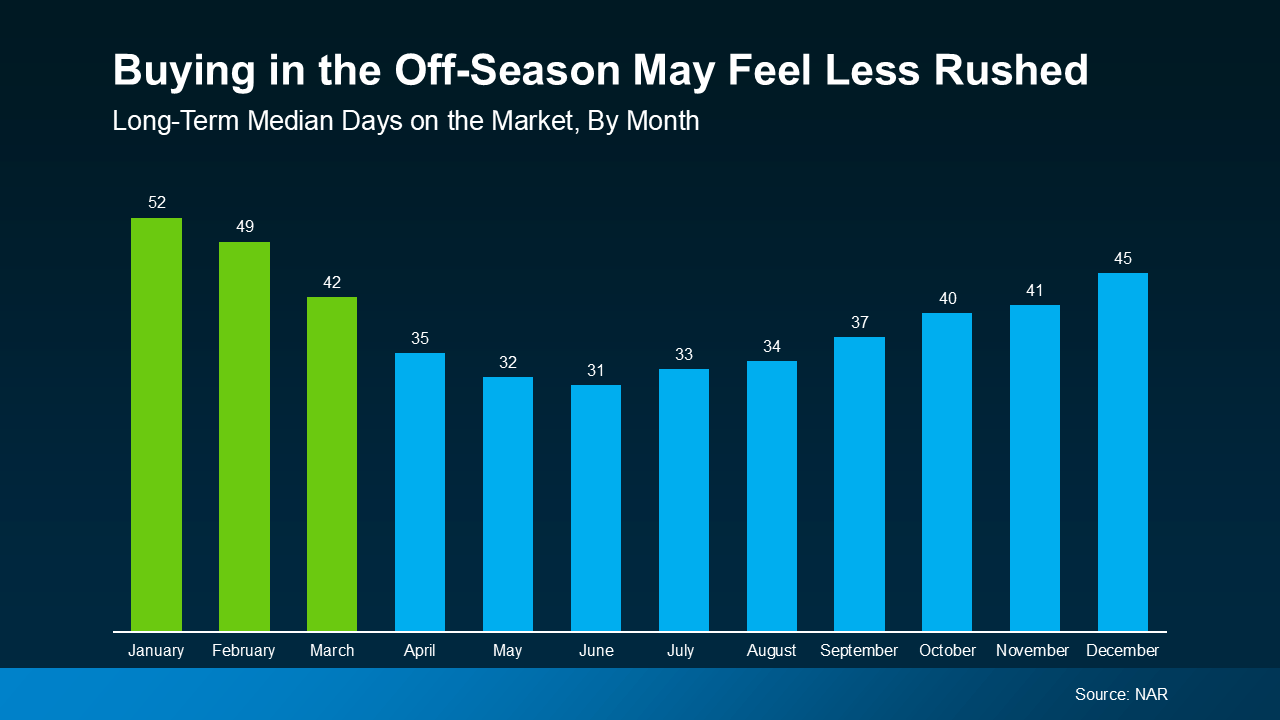
The winter months tend to be quieter in the real estate market. Fewer people are actively looking for homes, which means you’ll likely face less competition when you make an offer. This makes the process feel less rushed and less stressful.


According to the National Association of Realtors (NAR), homes sit on the market longer in winter compared to spring and summer (see graph below):
Fewer buyers in the market means you’ll likely have more time to make thoughtful decisions. It also means you may have more negotiating power. According to the Alabama Association of Realtors:


“ A significant benefit of buying a home in winter is the reduced competition.  Because of the perceived benefits of spring, many buyers delay the start of their house hunt. As a result, you will find fewer people competing for the same properties during winter. Less demand can translate into more negotiating power as sellers may be more willing to entertain offers or agree to concessions to get a deal closed quickly.”


2. More Negotiating Power


With homes staying on the market longer, sellers may be more willing to negotiate. This can lead to better deals for you as a buyer, whether that means a lower price or added incentives, like sellers covering closing costs or making repairs. As Chen Zhao, an Economist at Redfinpoints out:


“. . . buying during the off season means less competition from other buyers.  That means potentially negotiating a better deal. ”


Plus, when demand is lower, sellers often feel more pressure to work with serious buyers. This could give you an edge to negotiate terms that work best for your situation.


3. Lock in Today’s Prices Before They Rise


Historically, home prices tend to be at their lowest point in the winter months, too. According to data from NAR, home prices last year were at their lowest in January, February, and March — right before the spring buying season kicked in (see graph below):
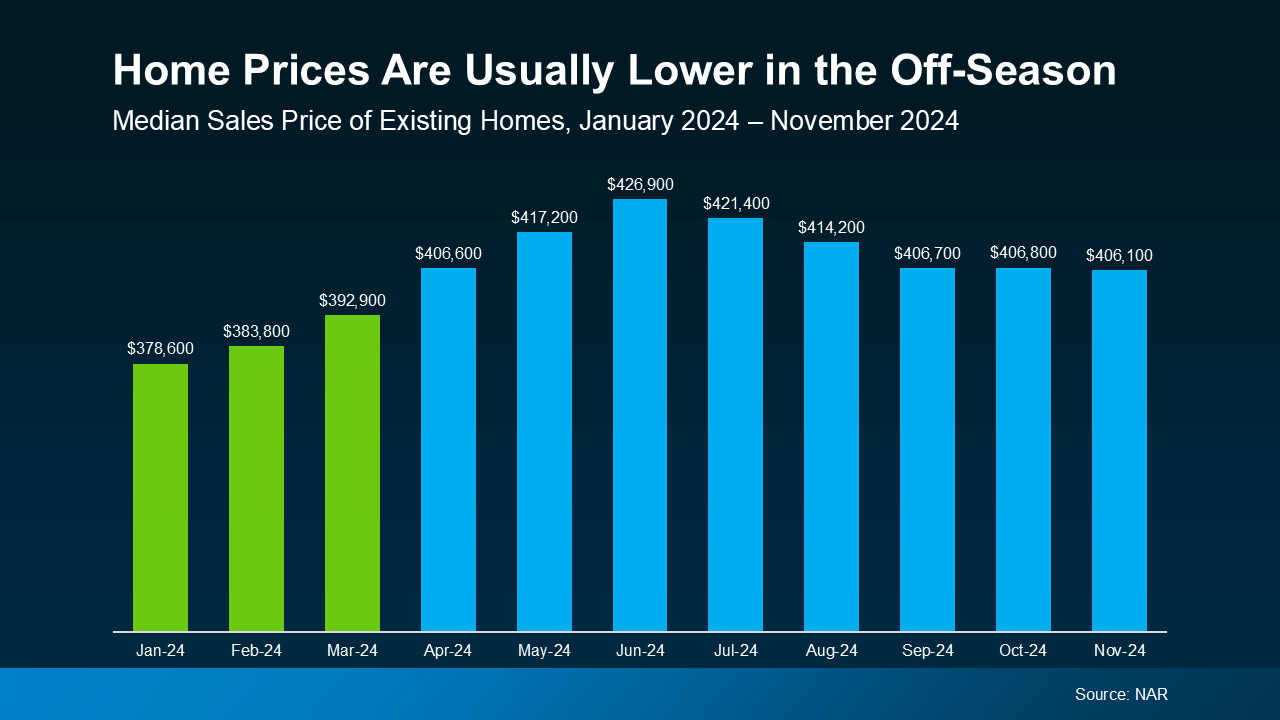
This trend isn’t new — Bright MLS shows between 2010 and 2024, home prices in January and February were, on average, 15% lower than during the month of peak home prices (typically June). Buying in the off-season means you’re more likely to avoid paying the premium prices that come with the high demand of spring.

On top of that, home prices generally appreciate over time, meaning they tend to go up year after year. That means if you’re ready to buy and you can make it happen, you’re not only taking advantage of what might be the lowest prices of the year, but you’re also locking in today’s price before it increases in the future.

Bottom Line


While spring may seem like the obvious time to buy, moving before the peak season can give you significant advantages, like less competition, more negotiation power, and lower prices.


If you’re ready to explore your options, let’s connect and get you shopping! 

April 28, 2026
According to Google Trends , online searches for down payment information recently hit an all-time high. And that’s a clear sign more buyers are trying to figure out what they really need to save before making a move ( see graph below ):
April 25, 2026
You’ve probably asked yourself lately: Is it even worth trying to buy a home right now ? It’s a question a lot of people are asking no matter where they live, or what their income is. With today’s home prices and mortgage rates, renting can feel like the easier path. In some cases, it might even seem like the only realistic option right now. And if that’s where you are, there’s nothing wrong with that. But if you’re weighing the decision, there’s one part of the conversation that doesn’t get talked about enough. It’s what each choice does for your future. What Renting Really Gets You (And What It Doesn’t) Depending on your situation, renting does have some advantages: Lower upfront costs. Less responsibility. More flexibility to move when you want. But even with those benefits, a Bank of America survey found 70% of aspiring homeowners worry about what long-term renting means for their future. And that concern comes down to one thing: you’re not building anything for your future. As Yahoo Finance explains: “Paying rent doesn't build equity. You get a place to live, but no ownership stake, no price appreciation, and no asset to leverage for future borrowing or investment .” So, while renting may feel easier, the flexibility you get comes at a cost. How Homeownership Builds Your Wealth Over Time On the other hand, owning a home is one of the most consistent ways people build wealth over time. Why? When you’re a homeowner, you gain something called equity . That’s the difference between what your home is worth and what you owe. That equity grows with every monthly payment you make. It also gets a boost as home values go up through the years – and it adds up quicker than you may think. Today, the National Association of Realtors (NAR) says the average homeowner’s net worth is 43X greater than that of a renter:
April 21, 2026
If you’re getting a tax refund this year, here’s something worth thinking about. That money could actually help you get closer to buying a home. It may not be something you’ve factored into your plan yet, but it can give your savings a nice boost right when you need it most. And whether your refund is a few thousand dollars or more, there are some smart ways to put that money to work as you get ready to buy . Your Refund May Be Even Bigger This Year Let’s start with the good news. People are getting even more money back in their refunds than they did last year. The visual below uses data from the Internal Revenue Service (IRS) to show the average individual’s refund is 11.1% higher this year:
April 18, 2026
For a lot of people, the math on buying a home just doesn’t really work right now. Maybe that’s how it feels for you too. You look at the cost of buying . Then you look at the cost of childcare. And it starts to feel like you have to choose one or the other. But some families are finding a way to make both work by doing something a little different: teaming up to purchase a multi-generational home . One Reason This Is Becoming More Common It’s no secret that affordability has been a challenge in recent years. But for families with young kids, there’s an added layer that can make it feel even harder: childcare. According to the Department of Health and Human Services , childcare should take up no more than 7% of your monthly income. But in reality, the average married couple spends closer to 10% ( see map below ): 
April 14, 2026
With economic headlines, global events, and near constant talk about affordability, you may be wondering if this is the right time to move. But here’s what you need to remember. While recent events do have some impact on the housing market, they don’t take buying off the table. You just have to use a different strategy. Mortgage Rates Have Been Up Slightly – Here's Why After trending down for most of 2025, mortgage rates have been higher again for over roughly a month now. And experts say it’s a result of what's happening overseas and in the broader economy. As Mark Fleming, Chief Economist at First American , explains : “Mortgage rates have recently moved higher, driven by geopolitical uncertainty and rising energy costs that are contributing to inflation concerns.” But what does that really mean for you? Should you wait for everything to settle back down before you buy a home? The short answer is no . You don’t have to wait. Your Window To Buy Didn’t Close It’s true that a month or so ago, when rates were just shy of 6%, buying felt a bit more affordable. And now that rates are hovering around the mid-6s, monthly payment costs are higher. But zoom out for a second. Let’s say you’re taking out a loan for $500k. Even with rates in the mid 6s, you’re still saving roughly $300 on your monthly payment compared to buyers who made their purchase early last year. That means this recent increase in rates hasn’t erased the progress we’ve seen. Buying is still more affordable than it was just one year ago ( see below ):
April 10, 2026
Be honest. Have you started looking at homes online yet? If you have, it’s already time to get pre-approved . Because here’s what not enough people know. If buying a home is on your radar – even if it’s more of a someday plan than a right now plan – you don’t want to wait until later on in the process to tackle this step. No matter what you’ve heard, pre-approval isn’t about commitment . It’s about clarity. And here are the two big ways pre-approval sets you up for success. You Know Your Numbers Up Front uring the pre-approval process, a lender will walk through your finances and tell you what you can borrow based on your income, debts, credit score , and more. And once you have that number, your search becomes a lot more focused. With a mortgage pre-approval, you know what you can borrow, so it’s easier to figure out your ideal price point, and what you can actually afford. And that clarity is key. Because if you just start browsing online and just guess at your price point, you run the risk of falling for a house that’s outside of your price range – or missing out on ones that aren’t. You want this number to be clearly defined before your search. Here’s why. You Can Move Quickly When You Find the One This is how a lot of home searches go today. You scroll through listings just to see what’s out there, and then it happens. You fall in love with something you’ve seen online. If you’re already pre-approved? You’re probably in great shape. But if you’re not… Instead of being able to jump on that house and quickly make an offer, you have to scramble to get a lender, gather the financial documents, and then submit the necessary pre-approval paperwork first. And while you’re waiting to hear back from your lender, someone else who’s more prepared could beat you to the house. As Bankrate explains : “The best time to get a mortgage preapproval is before you start looking for a home. If you find a home you love but don’t have a preapproval in hand, you likely won’t have time to get preapproved before you need to make an offer . . .” And that’s avoidable, with the right prep. Because while you can’t control when the right home shows up, you can be ready for it. Think of it like showing up to the starting line with your shoes tied and your warm-up done – while everyone else is still looking for parking. It’s not about rushing your timeline. It’s about removing the delay between finding the right home and being able to move on it. One Thing You Need To Know About Pre-Approvals Speaking of timing, pre-approvals do have an expiration date. So, be sure to ask your lender how long it’s good for. The Mortgage Reports explains: “ Mortgage preapproval letters are typically valid for anywhere from 30 to 90 days. However, a preapproval can be updated and extended if the lender re-checks your information.” Doing the right prep and knowing this information can make the whole process a lot smoother. You don’t have to be ready to buy to be ready to buy. Getting pre-approved doesn’t mean you’re committing to buy right now. It just means you’ve taken a step to understand your numbers. And when a home catches your attention, you’re prepped and good to go. Bottom Line Ask yourself this: if your perfect home popped up tomorrow, would you be ready to make a move? If the answer is no and you want to buy, or you are thinking about POSSIBLY buying in the near future here in Granite Bay, Roseville, Loomis, Folsom or any place among the Sacramento Valley and beyond, it is time to put in the work to get pre-approved. This will keep you from feeling lost, before your search even officially kicks off. If you’re looking for an amazing lender to help, call me… I am happy to refer you to a trusted professional who will not misguide you or pressure you into something you are not looking to do. Instead, they will help you make an educated decision about your future home ownership and support you along the way.
April 7, 2026
When your house sits on the market longer than expected, it can get frustrating fast. You start asking: what now? And for a growing number of homeowners, that turns into: should I just rent it instead? While it sounds like a simple backup plan, becoming “ accidental landlord ” is actually a much bigger decision than most people realize. That’s when someone planned to sell, didn’t get the price or traction they hoped for, and decided to rent the house out instead. And lately, that's happening more often. Why the Number of Accidental Landlords Is Rising If you’re faced with the same choice to rent or to sell, here’s what you need to know. First, you’re not alone. And that should actually be some comfort. According to Zillow about 2.3% of homes available for rent were previously listed for sale. That may not sound like a lot, but it’s actually the highest share in almost 6 years. Before you go that route yourself, it’s worth slowing down and looking at the full picture. Ask yourself these 3 questions first. 1. Would Your House Actually Work as a Rental? What’s right for your situation is going to depend on your location, your home’s condition, and what the rental market looks like in your area. Think about: If you’re moving away, do you have a plan for how you’ll handle ongoing maintenance and repairs from afar? Does your house need repairs before it’s rental-ready? And do you have the time, energy, and the funds for that? What's the market like in your area? Are there a lot of rental vacancies? What monthly rent could you realistically expect? As C&C Property Management explains: “At the heart of any rental market is the balance between supply and demand. When more tenants are looking for housing than there are available units, rental prices rise. On the other hand, if new construction adds hundreds of apartments or homes to a neighborhood, prices can soften as tenants have more choices.” If your home would struggle to stand out or command the rent you need, that’s something to take seriously. Just because you can rent it doesn’t mean it’s the best option for you. 2. Are You Ready To Be a Landlord? This is the part people don’t always think about upfront. On paper, renting sounds like easy passive income. But in reality, it’s a hands-on responsibility. Imagine: Taking midnight calls about clogged toilets or broken air conditioners Chasing down missed rent payments Covering unexpected repairs Fixing damage between tenants And those costs can hit when you least expect them. 3. Have You Run the Real Numbers? There’s also the financial side of things. For starters, renting out your house comes with extra expenses. Here are a few of the biggest according to Bankrate : Higher insurance premiums (landlord insurance typically costs about 25% more) Management fees (if you use a property manager, they typically charge around 10% of the rent) Routine maintenance and services Advertising fees to find tenants Gaps between tenants, where you cover the mortgage without rental income coming in For some people, that’s totally manageable. For others, it’s more than they want to take on. Your Next Step: A Conversation with Your Agent Before you make any decision, talk to me about overhauling your sales strategy first. Sometimes it’s not that buyers aren’t out there. It’s that something about the pricing, presentation, or marketing isn’t quite lining up with what they’re looking for. And a few small adjustments can make a big difference. Because while renting can be a great choice for the right person with the right house, if you’re only considering it because your listing didn’t get traction, there may be a better solution. Bottom Line If you're torn between selling and renting, make sure to carefully weigh the pros and cons first. For some homeowners, the hassle (and the expense) of renting may not be worth it.
April 4, 2026
While the Spring season consistently offers up some of the best conditions for home sellers, Realtor.com says there’s one window where the stars really seem to align year after year. And it’s coming up fast. Based on their analysis of historical trends, the ideal week to put your house on the market this year is: April 12–18. And here’s why this window stands out as being particularly seller-friendly: Buyers Are More Active. According to the research coming out of Realtor.com , homes listed during this week typically get about 16.7% more views than in a normal week. And in a market where buyers have options, getting that extra attention can set the tone for your entire sale. Sales Happen Faster. Realtor.com also explains the added demand from buyers sets you up for a faster process. While homes have been taking longer to sell lately, homes up for sale this week were on the market for 17% less time than usual. And that’s a difference you’ll be able to feel. A Better Price for Your House. Since the number of homes for sale has grown, it’s normal for buyers to ask for credits, repairs, and price adjustments today. But, during this early Spring window, about 18.9% fewer homes do a price cut . That gives you a better chance of getting your full asking price. More Profit in Your Pocket. According to the study, well-prepped homes listed this week can command a price that’s about $5,300 more than the average week (and $26,000 more than homes at the start of the year). And what seller doesn’t want more eyes on their house, getting an offer in hand sooner (rather than later), and their best shot at selling for top dollar? What You Need To Do To Get Ready If you’re already thinking about selling and you want to take advantage of this sweet spot, your next step is shockingly simple. Just talk to me as your local agent. My expertise on our area is going to be key over the next few weeks. Because these trends are going to vary by state, city, and even neighborhood. I know this. and to be honest, even though the people at Realtor.com feel the sweet spot is in April, I truly find it is February year over year... Houses have less competition and they stand out more than if you list in April like so many other people do. What ever you do, do not feel like you have missed your shot. I sell homes year round, even in July and in December which are historically the slowest years for us here in Granite Bay, Roseville, Rocklin, and our surrounding areas. I'll help guide youth get the house ready to sell. Some of this will include: What you’ll want to spruce up before listing How to prioritize any repairs (and contractors that can help) Quick wins that’ll have a big impact What buyers care most about today For some sellers, that’s a few easy fixes they can knock out in the next couple of weeks. A fresh coat of paint. Some new mulch. Or some light Spring cleaning. For others, it’s worth taking another month or so to make some minor updates before listing. And that’s okay. Because while this mid-April window may give sellers an advantage ( Per the internet gurus), it’s not your only opportunity to sell. Bottom Line Getting your house on the market in mid-April may give you an extra edge, but the bigger opportunity is the preparing rehouse to sell properly in the right t condition no matter what season we are in. The real question is: Do you know what you need to do before you can list? If you want your house to hit the market this week (or even this season), let’s talk about what it’ll take to get it ready and let's make as game plan. 
April 1, 2026
There’s a lot of noise out there right now about investors in the housing market. Some headlines make it sound like big Wall Street firms are buying up everything in sight. And if you’re trying to purchase a home yourself, that can make it feel like the odds are stacked against you. But when you take a closer look at the data, a very different picture starts to come into focus. Most Investors Are Just Everyday Owners For starters, when you hear the word investor , you probably picture big corporations. And that misconception is a large part of what’s feeding into the myth that they’re buying up all the homes. Most investors aren’t big companies, at all. They’re everyday people just like you. They’re someone who owns a second home (like a vacation house at the river), a neighbor who has 1 or 2 rentals, or even a homeowner who tried to sell their home, didn’t get the price they wanted, and decided to rent it instead. And when all of these groups are lumped together in the headlines, the number of investors sounds high – especially if you’re operating under the assumption all investors are big investors. But here’s what the numbers really show when you drill down. Institutional Investors Are a Small Slice of the Housing Market Large institutional investors, those big companies buying homes, actually make up a very small share of the overall housing market. According to BatchData , the largest investors (those with 1,000+ homes) own just 0.4% of the 86 million single-family homes in the country. And their share of the market is actually shrinking. Data from Parcl Labs shows big investors are selling 4 homes for every 1 they’re buying right now ( see visual below ):
March 30, 2026
The body content of your post goes here. To edit this text, click on it and delete this default text and start typing your own or paste your own from a different source.
Show More
April 28, 2026
According to Google Trends , online searches for down payment information recently hit an all-time high. And that’s a clear sign more buyers are trying to figure out what they really need to save before making a move ( see graph below ):
April 25, 2026
You’ve probably asked yourself lately: Is it even worth trying to buy a home right now ? It’s a question a lot of people are asking no matter where they live, or what their income is. With today’s home prices and mortgage rates, renting can feel like the easier path. In some cases, it might even seem like the only realistic option right now. And if that’s where you are, there’s nothing wrong with that. But if you’re weighing the decision, there’s one part of the conversation that doesn’t get talked about enough. It’s what each choice does for your future. What Renting Really Gets You (And What It Doesn’t) Depending on your situation, renting does have some advantages: Lower upfront costs. Less responsibility. More flexibility to move when you want. But even with those benefits, a Bank of America survey found 70% of aspiring homeowners worry about what long-term renting means for their future. And that concern comes down to one thing: you’re not building anything for your future. As Yahoo Finance explains: “Paying rent doesn't build equity. You get a place to live, but no ownership stake, no price appreciation, and no asset to leverage for future borrowing or investment .” So, while renting may feel easier, the flexibility you get comes at a cost. How Homeownership Builds Your Wealth Over Time On the other hand, owning a home is one of the most consistent ways people build wealth over time. Why? When you’re a homeowner, you gain something called equity . That’s the difference between what your home is worth and what you owe. That equity grows with every monthly payment you make. It also gets a boost as home values go up through the years – and it adds up quicker than you may think. Today, the National Association of Realtors (NAR) says the average homeowner’s net worth is 43X greater than that of a renter:
April 21, 2026
If you’re getting a tax refund this year, here’s something worth thinking about. That money could actually help you get closer to buying a home. It may not be something you’ve factored into your plan yet, but it can give your savings a nice boost right when you need it most. And whether your refund is a few thousand dollars or more, there are some smart ways to put that money to work as you get ready to buy . Your Refund May Be Even Bigger This Year Let’s start with the good news. People are getting even more money back in their refunds than they did last year. The visual below uses data from the Internal Revenue Service (IRS) to show the average individual’s refund is 11.1% higher this year:
April 18, 2026
For a lot of people, the math on buying a home just doesn’t really work right now. Maybe that’s how it feels for you too. You look at the cost of buying . Then you look at the cost of childcare. And it starts to feel like you have to choose one or the other. But some families are finding a way to make both work by doing something a little different: teaming up to purchase a multi-generational home . One Reason This Is Becoming More Common It’s no secret that affordability has been a challenge in recent years. But for families with young kids, there’s an added layer that can make it feel even harder: childcare. According to the Department of Health and Human Services , childcare should take up no more than 7% of your monthly income. But in reality, the average married couple spends closer to 10% ( see map below ): 
April 14, 2026
With economic headlines, global events, and near constant talk about affordability, you may be wondering if this is the right time to move. But here’s what you need to remember. While recent events do have some impact on the housing market, they don’t take buying off the table. You just have to use a different strategy. Mortgage Rates Have Been Up Slightly – Here's Why After trending down for most of 2025, mortgage rates have been higher again for over roughly a month now. And experts say it’s a result of what's happening overseas and in the broader economy. As Mark Fleming, Chief Economist at First American , explains : “Mortgage rates have recently moved higher, driven by geopolitical uncertainty and rising energy costs that are contributing to inflation concerns.” But what does that really mean for you? Should you wait for everything to settle back down before you buy a home? The short answer is no . You don’t have to wait. Your Window To Buy Didn’t Close It’s true that a month or so ago, when rates were just shy of 6%, buying felt a bit more affordable. And now that rates are hovering around the mid-6s, monthly payment costs are higher. But zoom out for a second. Let’s say you’re taking out a loan for $500k. Even with rates in the mid 6s, you’re still saving roughly $300 on your monthly payment compared to buyers who made their purchase early last year. That means this recent increase in rates hasn’t erased the progress we’ve seen. Buying is still more affordable than it was just one year ago ( see below ):
April 10, 2026
Be honest. Have you started looking at homes online yet? If you have, it’s already time to get pre-approved . Because here’s what not enough people know. If buying a home is on your radar – even if it’s more of a someday plan than a right now plan – you don’t want to wait until later on in the process to tackle this step. No matter what you’ve heard, pre-approval isn’t about commitment . It’s about clarity. And here are the two big ways pre-approval sets you up for success. You Know Your Numbers Up Front uring the pre-approval process, a lender will walk through your finances and tell you what you can borrow based on your income, debts, credit score , and more. And once you have that number, your search becomes a lot more focused. With a mortgage pre-approval, you know what you can borrow, so it’s easier to figure out your ideal price point, and what you can actually afford. And that clarity is key. Because if you just start browsing online and just guess at your price point, you run the risk of falling for a house that’s outside of your price range – or missing out on ones that aren’t. You want this number to be clearly defined before your search. Here’s why. You Can Move Quickly When You Find the One This is how a lot of home searches go today. You scroll through listings just to see what’s out there, and then it happens. You fall in love with something you’ve seen online. If you’re already pre-approved? You’re probably in great shape. But if you’re not… Instead of being able to jump on that house and quickly make an offer, you have to scramble to get a lender, gather the financial documents, and then submit the necessary pre-approval paperwork first. And while you’re waiting to hear back from your lender, someone else who’s more prepared could beat you to the house. As Bankrate explains : “The best time to get a mortgage preapproval is before you start looking for a home. If you find a home you love but don’t have a preapproval in hand, you likely won’t have time to get preapproved before you need to make an offer . . .” And that’s avoidable, with the right prep. Because while you can’t control when the right home shows up, you can be ready for it. Think of it like showing up to the starting line with your shoes tied and your warm-up done – while everyone else is still looking for parking. It’s not about rushing your timeline. It’s about removing the delay between finding the right home and being able to move on it. One Thing You Need To Know About Pre-Approvals Speaking of timing, pre-approvals do have an expiration date. So, be sure to ask your lender how long it’s good for. The Mortgage Reports explains: “ Mortgage preapproval letters are typically valid for anywhere from 30 to 90 days. However, a preapproval can be updated and extended if the lender re-checks your information.” Doing the right prep and knowing this information can make the whole process a lot smoother. You don’t have to be ready to buy to be ready to buy. Getting pre-approved doesn’t mean you’re committing to buy right now. It just means you’ve taken a step to understand your numbers. And when a home catches your attention, you’re prepped and good to go. Bottom Line Ask yourself this: if your perfect home popped up tomorrow, would you be ready to make a move? If the answer is no and you want to buy, or you are thinking about POSSIBLY buying in the near future here in Granite Bay, Roseville, Loomis, Folsom or any place among the Sacramento Valley and beyond, it is time to put in the work to get pre-approved. This will keep you from feeling lost, before your search even officially kicks off. If you’re looking for an amazing lender to help, call me… I am happy to refer you to a trusted professional who will not misguide you or pressure you into something you are not looking to do. Instead, they will help you make an educated decision about your future home ownership and support you along the way.
April 7, 2026
When your house sits on the market longer than expected, it can get frustrating fast. You start asking: what now? And for a growing number of homeowners, that turns into: should I just rent it instead? While it sounds like a simple backup plan, becoming “ accidental landlord ” is actually a much bigger decision than most people realize. That’s when someone planned to sell, didn’t get the price or traction they hoped for, and decided to rent the house out instead. And lately, that's happening more often. Why the Number of Accidental Landlords Is Rising If you’re faced with the same choice to rent or to sell, here’s what you need to know. First, you’re not alone. And that should actually be some comfort. According to Zillow about 2.3% of homes available for rent were previously listed for sale. That may not sound like a lot, but it’s actually the highest share in almost 6 years. Before you go that route yourself, it’s worth slowing down and looking at the full picture. Ask yourself these 3 questions first. 1. Would Your House Actually Work as a Rental? What’s right for your situation is going to depend on your location, your home’s condition, and what the rental market looks like in your area. Think about: If you’re moving away, do you have a plan for how you’ll handle ongoing maintenance and repairs from afar? Does your house need repairs before it’s rental-ready? And do you have the time, energy, and the funds for that? What's the market like in your area? Are there a lot of rental vacancies? What monthly rent could you realistically expect? As C&C Property Management explains: “At the heart of any rental market is the balance between supply and demand. When more tenants are looking for housing than there are available units, rental prices rise. On the other hand, if new construction adds hundreds of apartments or homes to a neighborhood, prices can soften as tenants have more choices.” If your home would struggle to stand out or command the rent you need, that’s something to take seriously. Just because you can rent it doesn’t mean it’s the best option for you. 2. Are You Ready To Be a Landlord? This is the part people don’t always think about upfront. On paper, renting sounds like easy passive income. But in reality, it’s a hands-on responsibility. Imagine: Taking midnight calls about clogged toilets or broken air conditioners Chasing down missed rent payments Covering unexpected repairs Fixing damage between tenants And those costs can hit when you least expect them. 3. Have You Run the Real Numbers? There’s also the financial side of things. For starters, renting out your house comes with extra expenses. Here are a few of the biggest according to Bankrate : Higher insurance premiums (landlord insurance typically costs about 25% more) Management fees (if you use a property manager, they typically charge around 10% of the rent) Routine maintenance and services Advertising fees to find tenants Gaps between tenants, where you cover the mortgage without rental income coming in For some people, that’s totally manageable. For others, it’s more than they want to take on. Your Next Step: A Conversation with Your Agent Before you make any decision, talk to me about overhauling your sales strategy first. Sometimes it’s not that buyers aren’t out there. It’s that something about the pricing, presentation, or marketing isn’t quite lining up with what they’re looking for. And a few small adjustments can make a big difference. Because while renting can be a great choice for the right person with the right house, if you’re only considering it because your listing didn’t get traction, there may be a better solution. Bottom Line If you're torn between selling and renting, make sure to carefully weigh the pros and cons first. For some homeowners, the hassle (and the expense) of renting may not be worth it.
April 4, 2026
While the Spring season consistently offers up some of the best conditions for home sellers, Realtor.com says there’s one window where the stars really seem to align year after year. And it’s coming up fast. Based on their analysis of historical trends, the ideal week to put your house on the market this year is: April 12–18. And here’s why this window stands out as being particularly seller-friendly: Buyers Are More Active. According to the research coming out of Realtor.com , homes listed during this week typically get about 16.7% more views than in a normal week. And in a market where buyers have options, getting that extra attention can set the tone for your entire sale. Sales Happen Faster. Realtor.com also explains the added demand from buyers sets you up for a faster process. While homes have been taking longer to sell lately, homes up for sale this week were on the market for 17% less time than usual. And that’s a difference you’ll be able to feel. A Better Price for Your House. Since the number of homes for sale has grown, it’s normal for buyers to ask for credits, repairs, and price adjustments today. But, during this early Spring window, about 18.9% fewer homes do a price cut . That gives you a better chance of getting your full asking price. More Profit in Your Pocket. According to the study, well-prepped homes listed this week can command a price that’s about $5,300 more than the average week (and $26,000 more than homes at the start of the year). And what seller doesn’t want more eyes on their house, getting an offer in hand sooner (rather than later), and their best shot at selling for top dollar? What You Need To Do To Get Ready If you’re already thinking about selling and you want to take advantage of this sweet spot, your next step is shockingly simple. Just talk to me as your local agent. My expertise on our area is going to be key over the next few weeks. Because these trends are going to vary by state, city, and even neighborhood. I know this. and to be honest, even though the people at Realtor.com feel the sweet spot is in April, I truly find it is February year over year... Houses have less competition and they stand out more than if you list in April like so many other people do. What ever you do, do not feel like you have missed your shot. I sell homes year round, even in July and in December which are historically the slowest years for us here in Granite Bay, Roseville, Rocklin, and our surrounding areas. I'll help guide youth get the house ready to sell. Some of this will include: What you’ll want to spruce up before listing How to prioritize any repairs (and contractors that can help) Quick wins that’ll have a big impact What buyers care most about today For some sellers, that’s a few easy fixes they can knock out in the next couple of weeks. A fresh coat of paint. Some new mulch. Or some light Spring cleaning. For others, it’s worth taking another month or so to make some minor updates before listing. And that’s okay. Because while this mid-April window may give sellers an advantage ( Per the internet gurus), it’s not your only opportunity to sell. Bottom Line Getting your house on the market in mid-April may give you an extra edge, but the bigger opportunity is the preparing rehouse to sell properly in the right t condition no matter what season we are in. The real question is: Do you know what you need to do before you can list? If you want your house to hit the market this week (or even this season), let’s talk about what it’ll take to get it ready and let's make as game plan. 
April 1, 2026
There’s a lot of noise out there right now about investors in the housing market. Some headlines make it sound like big Wall Street firms are buying up everything in sight. And if you’re trying to purchase a home yourself, that can make it feel like the odds are stacked against you. But when you take a closer look at the data, a very different picture starts to come into focus. Most Investors Are Just Everyday Owners For starters, when you hear the word investor , you probably picture big corporations. And that misconception is a large part of what’s feeding into the myth that they’re buying up all the homes. Most investors aren’t big companies, at all. They’re everyday people just like you. They’re someone who owns a second home (like a vacation house at the river), a neighbor who has 1 or 2 rentals, or even a homeowner who tried to sell their home, didn’t get the price they wanted, and decided to rent it instead. And when all of these groups are lumped together in the headlines, the number of investors sounds high – especially if you’re operating under the assumption all investors are big investors. But here’s what the numbers really show when you drill down. Institutional Investors Are a Small Slice of the Housing Market Large institutional investors, those big companies buying homes, actually make up a very small share of the overall housing market. According to BatchData , the largest investors (those with 1,000+ homes) own just 0.4% of the 86 million single-family homes in the country. And their share of the market is actually shrinking. Data from Parcl Labs shows big investors are selling 4 homes for every 1 they’re buying right now ( see visual below ):
March 30, 2026
The body content of your post goes here. To edit this text, click on it and delete this default text and start typing your own or paste your own from a different source.
Show More